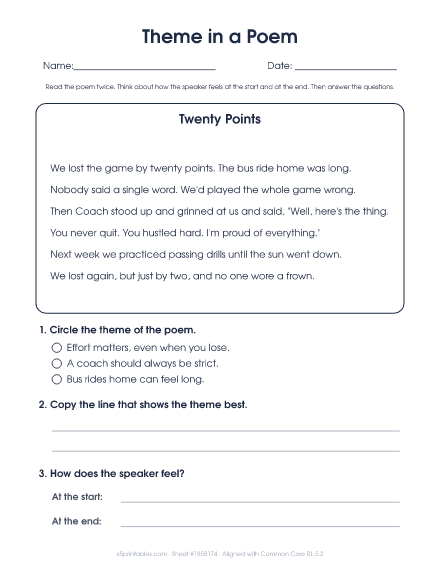
Theme in a Poem
Read the poem twice. Think about how the speaker feels at the start and at the end. Then answer the questions.
Fresh sheet anytime. Tap New sheet or reload for a different one. Tap + for up to 10.
This is sheet #185824601.
How to do it
- Read the poem twice.
- Circle the theme and copy the line that shows it best.
- Write how the speaker feels at the start and at the end.
Teaching tip
The change in the speaker's feelings from the start to the end is often the best clue to the theme. This sheet is aligned with Common Core RL.5.2.
About this worksheet
Four original poems where the speaker reflects on something that happened, each with three theme choices, a line to copy and how the speaker's feelings change. New sheet gives a different poem. Includes an answer key.
What kids practice
A theme is a story's message about life. Fifth graders find it by looking at how a character responds to a challenge, or how the speaker of a poem feels about something, and they write it as a sentence that could fit many stories. They also look at who is telling the story: a character (first person), or an outside narrator who shares one character's thoughts (third person limited) or many characters' thoughts (third person omniscient). A narrator's feelings shape the words they use, so the same event can sound very different depending on who tells it.
Watch for
- Giving a topic, like "courage," instead of a full theme sentence.
- Writing a theme that only fits this story, like "Maya should ask her coach for help."
- Calling any story with he or she third person omniscient, even when only one character's thoughts are shared.
- Treating a narrator's description as plain fact without noticing how the narrator feels.
It's free to print, with an answer key. See the full theme and point of view guide for 5th grade.
More sheets in this set
- See it all
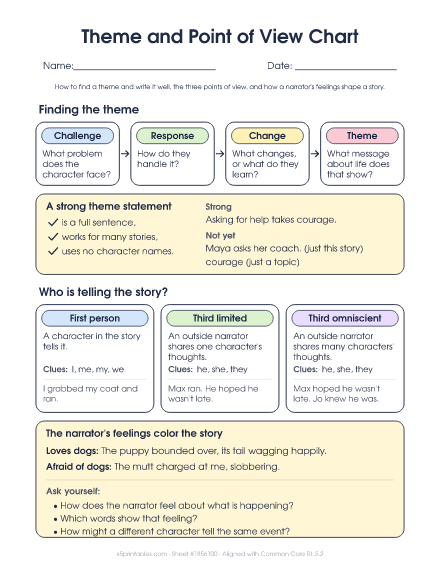 1. Theme and Point of View ChartFour steps from a character's challenge to the theme, what makes a strong theme statement, first person, third person limited and third person omniscient with clues and examples, and how a narrator's feelings color a story.
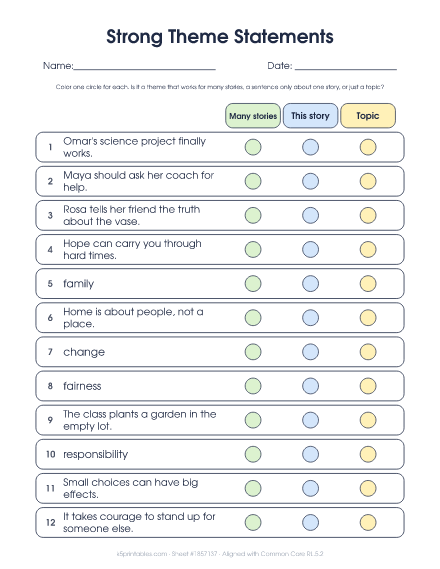 2. Strong Theme StatementsTheme statements, sentences about one story and single-word topics mixed together, to sort into three columns. Fewer, Standard or More give 9, 12 or 15. Includes an answer key.
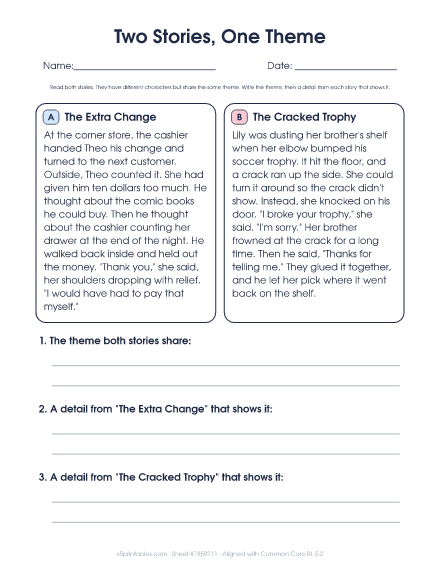 4. Two Stories, One ThemeThree pairs of short original stories with different characters and the same theme, with lines to write the theme and a detail from each story. New sheet gives a different pair. The answer key has example answers.
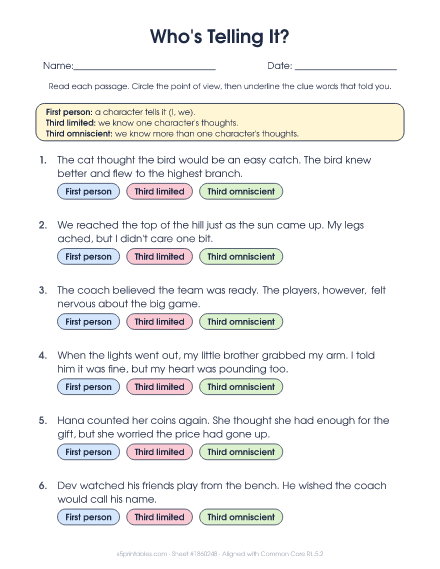 5. Who's Telling It?Short passages in first person, third person limited and third person omniscient, with a key to the three at the top. Fewer, Standard or More give 4, 6 or 8 passages. The answer key underlines the clues.
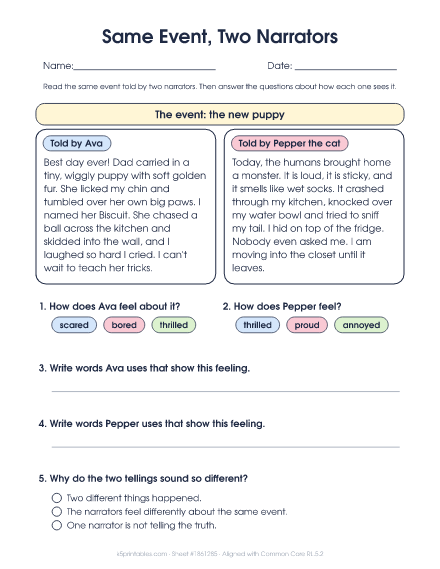 6. Same Event, Two NarratorsOne event told by two narrators who feel differently about it, like a new puppy told by a kid and by the family cat, with questions about each narrator's feelings and word choice. New sheet gives a different event. Includes an answer key.
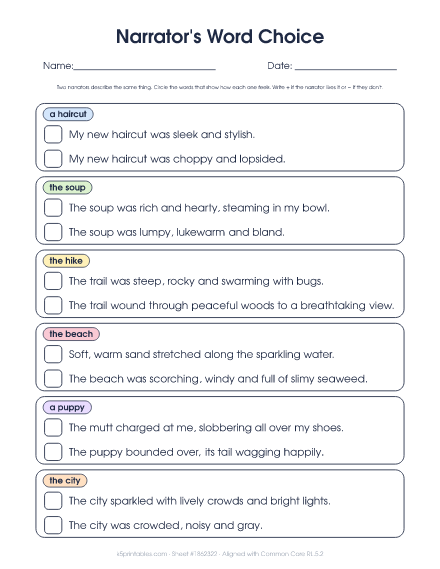 7. Narrator's Word ChoicePairs of sentences describing the same thing, one by a narrator who likes it and one by a narrator who doesn't. Fewer, Standard or More give 4, 6 or 7 pairs. Includes an answer key.