Figurative Language Chart
Four new figures of speech, a reminder of similes and metaphors, and three ways words relate to each other.
Need more than one? Tap + for extra copies (up to 10).
How to do it
- Read each kind of figurative language and its example.
- Say what each example really means.
- Read how synonyms, antonyms and homographs work.
Teaching tip
Keep the chart nearby while your student works on the other pages. This sheet is aligned with Common Core L.5.5.
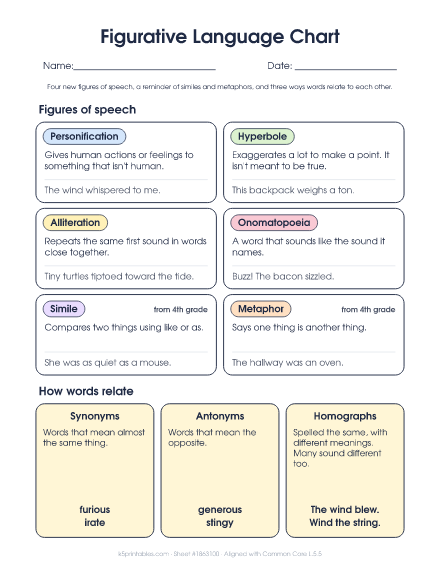
About this chart
Personification, hyperbole, alliteration and onomatopoeia, plus similes and metaphors as a reminder, each with what it is and an example, and synonyms, antonyms and homographs.
What kids practice
In 4th grade, students learned similes, metaphors, idioms and proverbs. This topic adds four more kinds of figurative language: personification (giving human actions to things), hyperbole (big exaggeration), alliteration (repeating first sounds) and onomatopoeia (sound words). Students also look at how words relate: synonyms, antonyms, and homographs, which are spelled the same but mean different things, like the wind and wind the string.
Watch for
- Taking a hyperbole literally, like thinking a backpack really weighs a ton.
- Calling any sentence about a thing personification, even when the thing does something it really can do.
- Counting words that only share a letter, not a sound, as alliteration.
- Choosing a homograph's meaning without reading the rest of the sentence.
It's free to print, as many copies as you need. See the full figurative language guide for 5th grade.
More sheets in this set
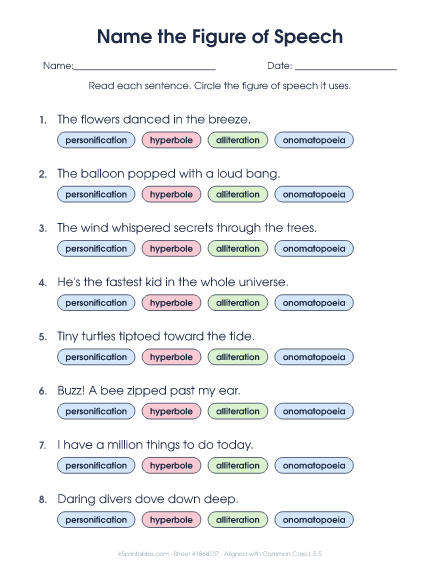 2. Name the Figure of SpeechSentences using personification, hyperbole, alliteration or onomatopoeia, with the four choices to circle. Fewer, Standard or More give 6, 8 or 10. Includes an answer key.
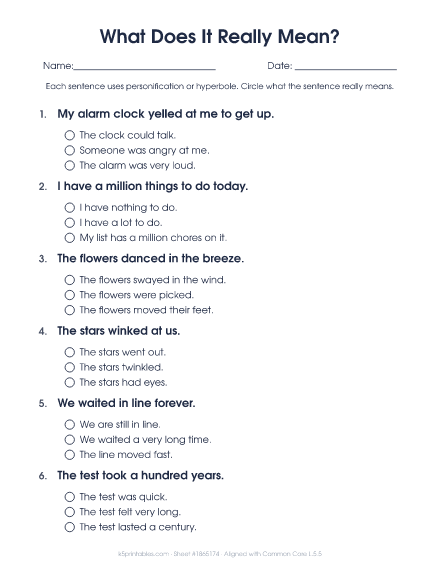 3. What Does It Really Mean?Sentences with personification or hyperbole, each with three meanings to choose from, like "The backpack is very heavy" for "This backpack weighs a ton." Fewer, Standard or More give 5, 6 or 7. Includes an answer key.
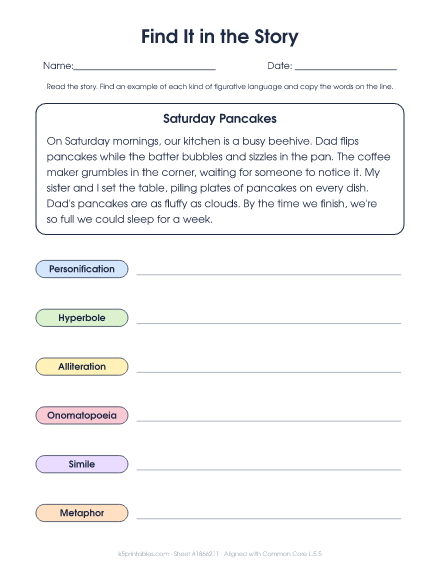 4. Find It in the StoryThree short original stories, each with personification, hyperbole, alliteration, onomatopoeia, a simile and a metaphor to find. New sheet gives a different story. Includes an answer key.
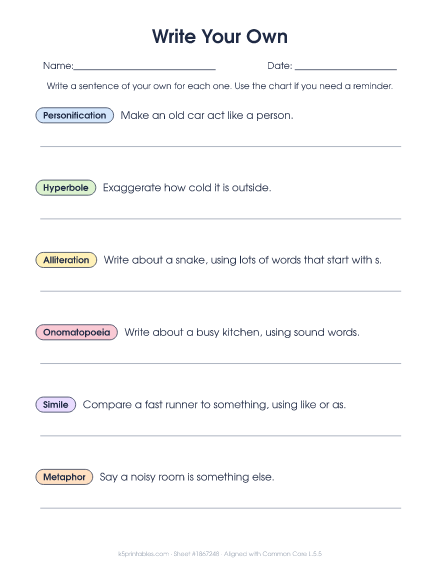 5. Write Your OwnPrompts like "Exaggerate how tired you are" to answer with a sentence of your own. Fewer gives the four new kinds, Standard adds a simile and a metaphor, and More adds two extra prompts. The answer key shows sample sentences.
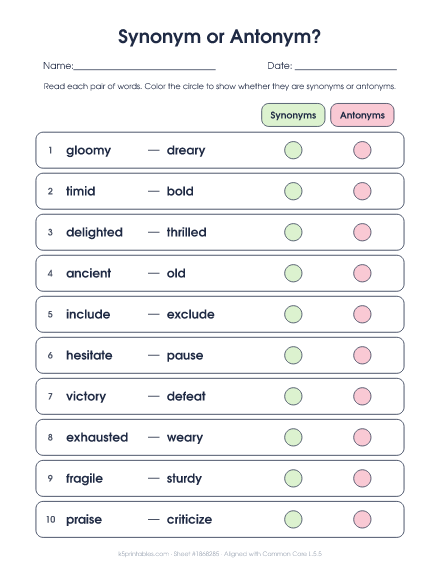 6. Synonym or Antonym?Pairs of fifth-grade words like furious and irate or generous and stingy, to mark as synonyms or antonyms. Fewer, Standard or More give 8, 10 or 12 pairs. Includes an answer key.
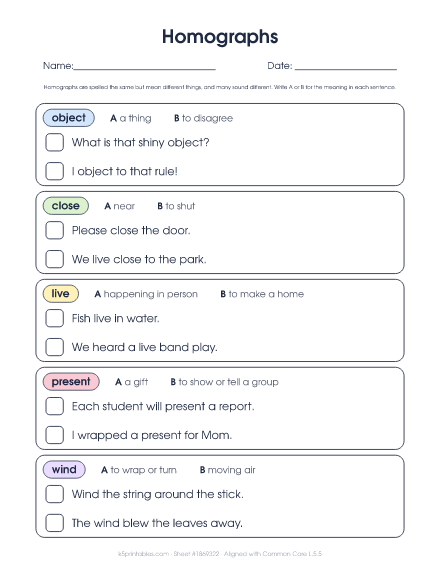 7. HomographsHomographs like wind, tear and present, each with two meanings and two sentences to match. Fewer, Standard or More give 4, 5 or 6 words. Includes an answer key.