Where Do the Parentheses Go?
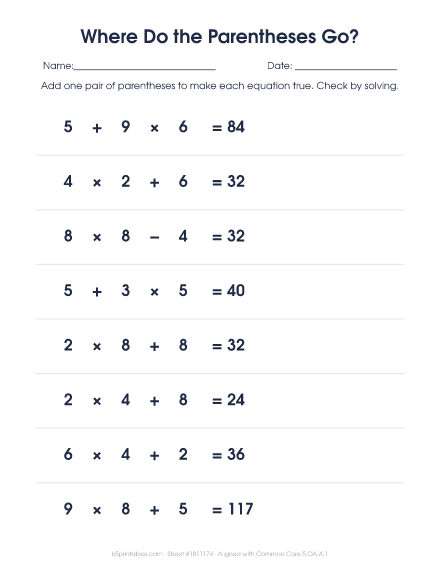
Add one pair of parentheses to make each equation true. Check by solving.
Fresh sheet anytime. Tap New sheet or reload for a different one. Tap + for up to 10.
This is sheet #181124601.
How to do it
- Solve the problem with no parentheses.
- Try parentheses in different places.
- Keep the one that makes the equation true.
Teaching tip
Trying and checking is the whole point here. Wrong tries are part of the work. This sheet is aligned with Common Core 5.OA.A.1.
About this worksheet
Equations missing one pair of parentheses, with only one place that works. Fewer has 6 problems with two choices to pick from, Standard has 8 with three numbers, and More has 8 with four numbers. Includes an answer key.
What kids practice
When a problem has more than one operation, everyone needs to do the steps in the same order to get the same answer. Students work inside parentheses, brackets and braces first, from the inside out. Then they multiply and divide from left to right, and last they add and subtract from left to right. So 3 + 4 × 2 is 11, but (3 + 4) × 2 is 14. Students also turn words into expressions, like "add 8 and 7, then multiply by 2" as (8 + 7) × 2, and read what an expression means without solving it.
Watch for
- Working from left to right without doing × and ÷ first.
- Always multiplying before dividing, or always adding before subtracting.
- Starting with the outside brackets instead of the innermost parentheses.
- Copying the rest of the problem wrong when rewriting it after a step.
- Leaving out parentheses when turning words like "add, then multiply" into an expression.
It's free to print, with Fewer, Standard or More on the page and an answer key. See the full order of operations guide for 5th grade.
More sheets in this set
- See it all
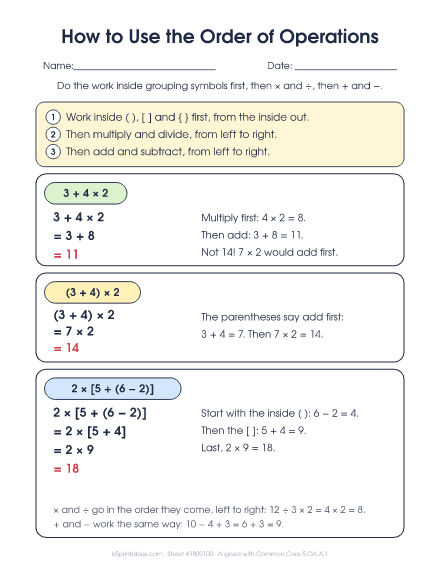 1. How to Use the Order of OperationsWorked examples of 3 + 4 × 2, (3 + 4) × 2 and 2 × [5 + (6 − 2)], each solved one step at a time, plus why × and ÷ (and + and −) go from left to right.
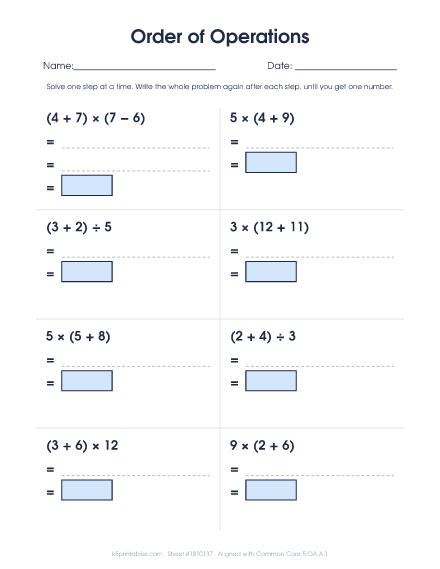 2. Order of OperationsExpressions to solve one step at a time on lines. Fewer has 6 problems with two operations, Standard has 8 with parentheses, and More has 8 with brackets and braces. The answer key shows every step.
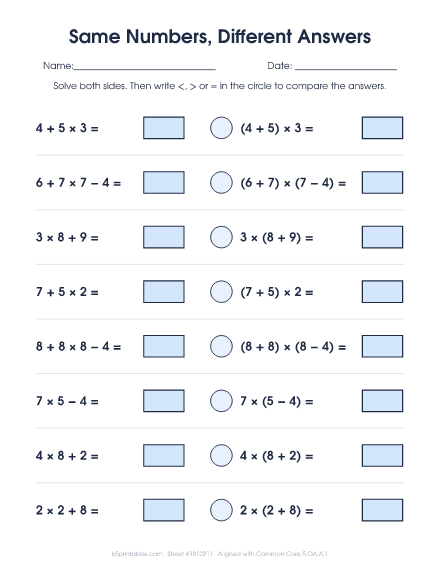 4. Same Numbers, Different AnswersPairs like 8 × 7 + 3 and 8 × (7 + 3) to solve and compare. Fewer has 6 pairs, Standard has 8, and More has 10 with longer problems. Includes an answer key.
- See it all
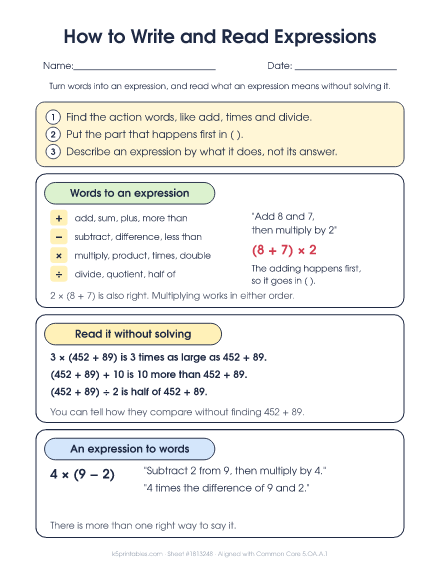 5. How to Write and Read ExpressionsA word list for each operation, "add 8 and 7, then multiply by 2" written as (8 + 7) × 2, expressions read without solving, like 3 × (452 + 89) is 3 times as large as 452 + 89, and 4 × (9 − 2) said in words.
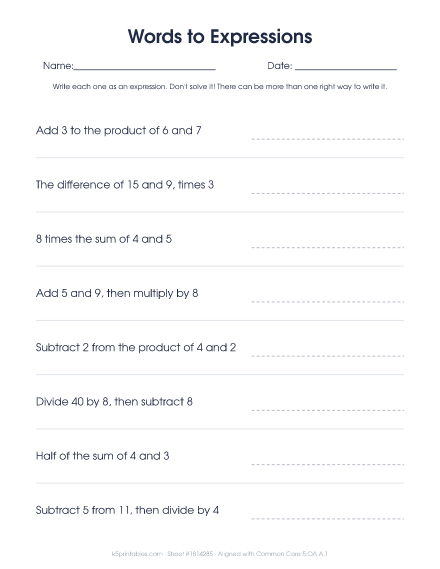 6. Words to ExpressionsPhrases like "triple the difference of 11 and 9" to write as expressions. Fewer has 6 with three expressions to pick from, Standard has 8 to write, and More has 8 that also go from an expression to words. The answer key shows one right way to write each.
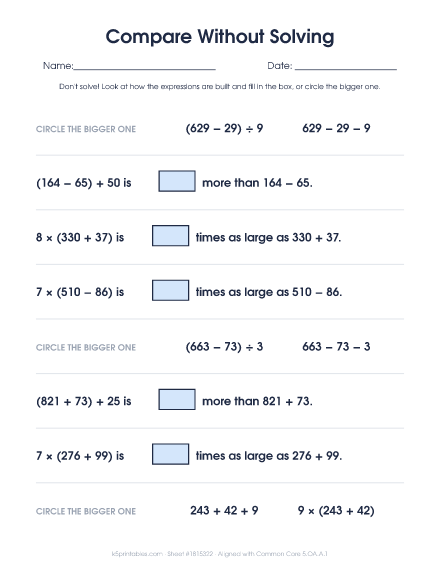 7. Compare Without SolvingStatements like "6 × (272 + 91) is ___ times as large as 272 + 91" to fill in without solving. Fewer has 6, Standard has 8 that add circling the bigger expression, and More has 10 that also include fractions of an expression. Includes an answer key.