How to Multiply Fractions
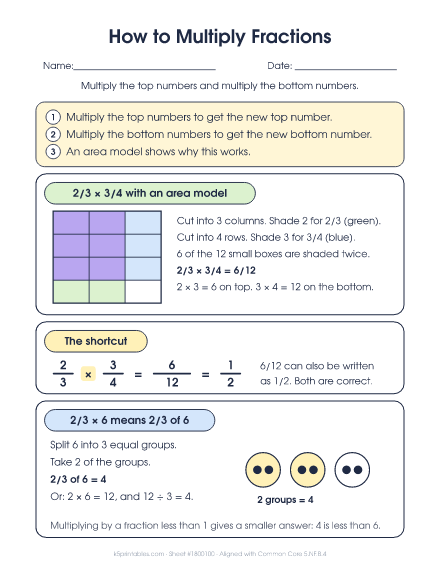
Multiply the top numbers and multiply the bottom numbers.
Need more than one? Tap + for extra copies (up to 10).
How to do it
- Multiply the top numbers to get the new top number.
- Multiply the bottom numbers to get the new bottom number.
- An area model shows why this works.
Teaching tip
Have your student shade an area model and use the rule on the same problem. Getting the same answer both ways builds trust in the shortcut. This sheet is aligned with Common Core 5.NF.B.4.
About this chart
2/3 × 3/4 shown on an area model with the overlap shaded, the multiply-the-tops-and-bottoms shortcut, and 2/3 of 6 shown with groups of dots.
What kids practice
In 4th grade, students multiplied a whole number by a fraction, like 3 × 2/5 as three groups of 2/5. Now they multiply a fraction by a fraction. An area model shows why 2/3 × 3/4 = 6/12: the part shaded twice is 6 of 12 boxes. From there, students use the rule of multiplying the top numbers and the bottom numbers, find a fraction of a number, like 2/3 of 12, and reason about whether multiplying by a fraction makes a number bigger or smaller. They also see that a fraction is a division, like 3 ÷ 4 = 3/4, and divide unit fractions and whole numbers, like 1/3 ÷ 4 and 4 ÷ 1/3.
Watch for
- Finding a common denominator first, as if adding.
- Multiplying the top numbers but keeping the bottom number the same.
- Multiplying a whole number by both the top and the bottom number.
- Expecting multiplication to always make a number bigger.
- Mixing up 1/3 ÷ 4 (a smaller piece) and 4 ÷ 1/3 (how many pieces fit).
It's free to print, as many copies as you need. See the full multiplying and dividing fractions guide for 5th grade.
More sheets in this set
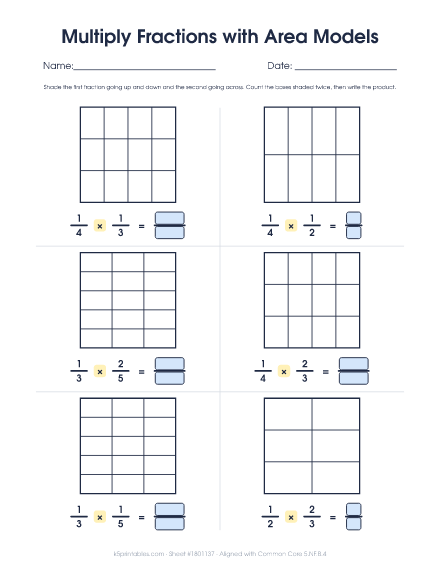 2. Multiply Fractions with Area ModelsSquares to shade for fraction multiplication problems. Fewer has 4 problems with the grid lines drawn and the first fraction shaded, Standard has 6 with the grid lines drawn, and More has 8 on blank squares. Includes an answer key with the shading.
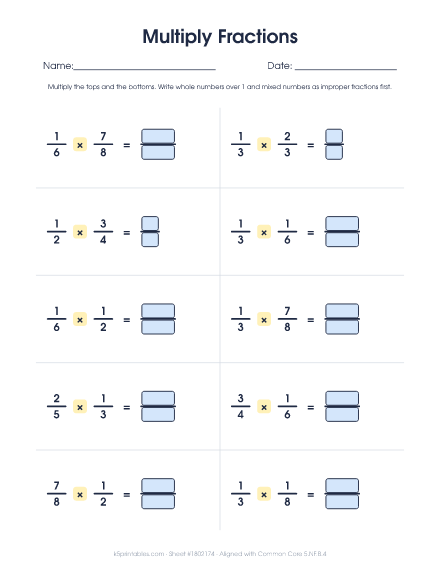 3. Multiply FractionsFraction multiplication problems. Fewer has 8 problems with unit fractions, Standard has 10 with any fractions, and More has 12 that add whole numbers and mixed numbers. The answer key shows simplified answers too.
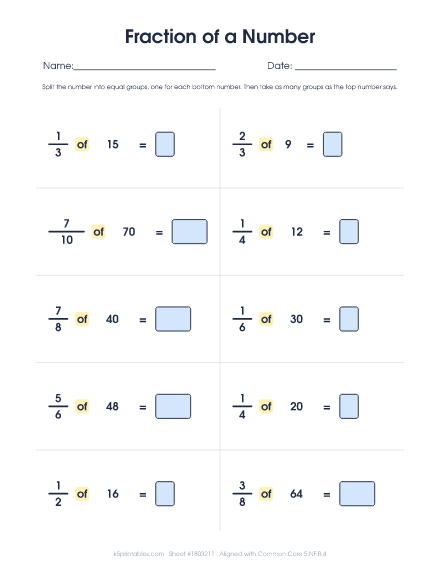 4. Fraction of a NumberProblems like 2/3 of 12. Fewer has 6 problems with dot pictures to circle, Standard has 10 with whole-number answers, and More has 12 that include answers with fractions, like 5/6 of 10 = 8 2/6. Includes an answer key.
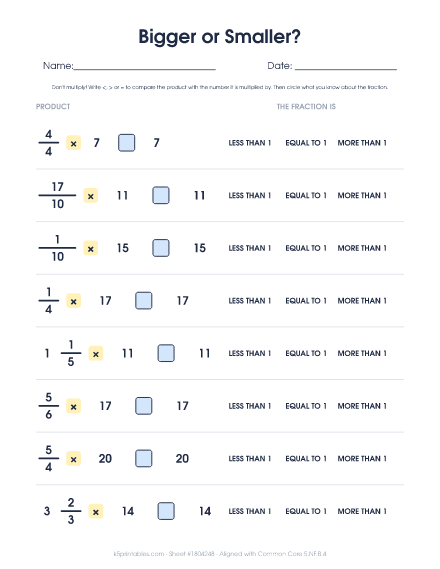 5. Bigger or Smaller?Products to compare with the number being multiplied, without multiplying. Fewer has 6 problems, Standard has 8 that add mixed numbers and fractions equal to 1, and More has 10 that also multiply by fractions. Includes an answer key.
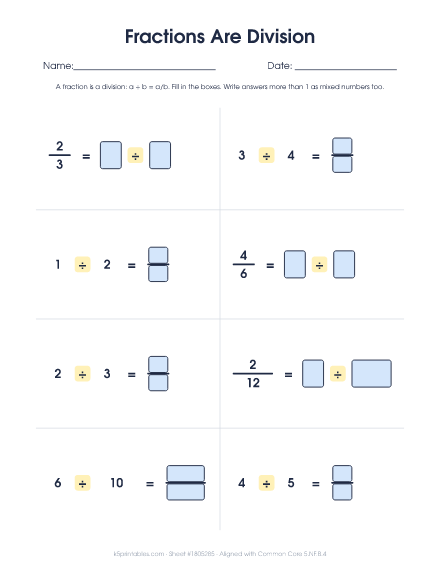 6. Fractions Are DivisionProblems like 2 ÷ 5 = 2/5. Fewer has 6 problems with pizzas to shade one person's share, Standard has 8 that also go the other way, like 3/8 = 3 ÷ 8, and More has 10 that add answers more than 1. Includes an answer key.
- See it all
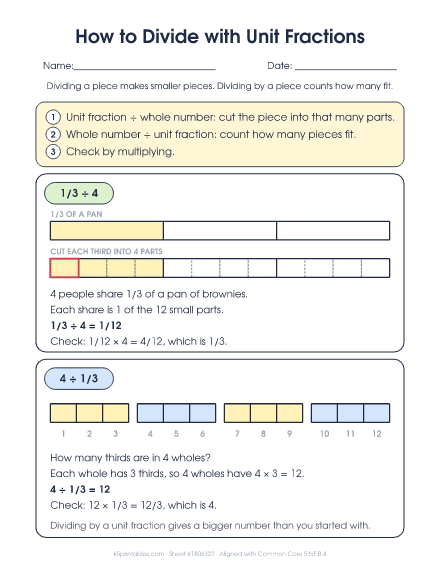 7. How to Divide with Unit Fractions1/3 ÷ 4 shown as a third of a pan cut into 4 parts, and 4 ÷ 1/3 shown as four wholes cut into thirds and counted, each checked by multiplying.
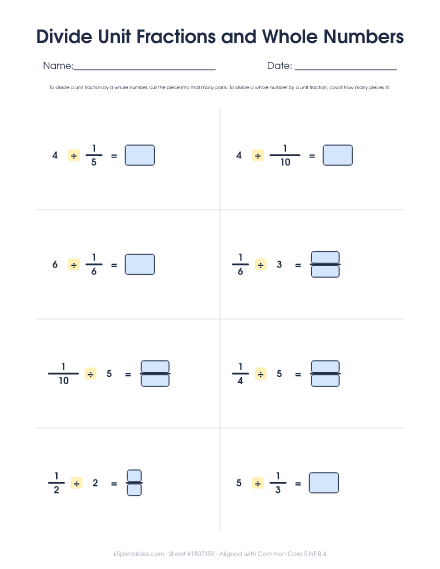 8. Divide Unit Fractions and Whole NumbersProblems like 1/3 ÷ 4 and 4 ÷ 1/3, mixed on every sheet. Fewer has 6 problems with bars to shade or count, Standard has 8, and More has 10 with a multiplication check for each. Includes an answer key.
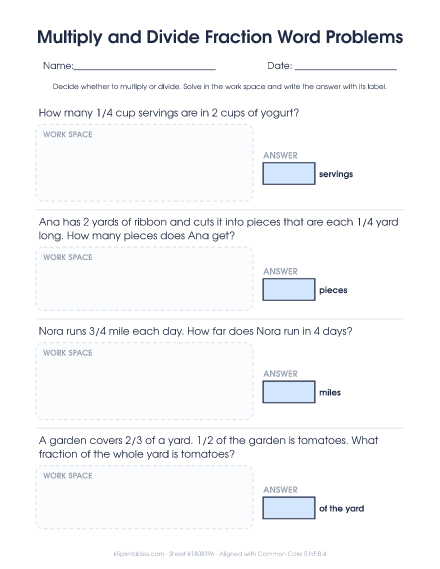 9. Multiply and Divide Fraction Word ProblemsStories about recipes, gardens, running, sharing pizza and sandwiches, cutting ribbon and serving yogurt. Fewer has 3 problems, Standard has 4 and More has 5. Includes an answer key.