Multiplying and dividing fractions worksheets
Aligned with Common Core 5.NF.B.4
Printable fifth-grade fraction worksheets and how-to teaching pages: multiplying fractions with area models and the multiply-the-tops-and-bottoms rule, finding a fraction of a number, telling whether a product will be bigger or smaller, fractions as division, dividing with unit fractions, and word problems.
The worksheets
- See it all
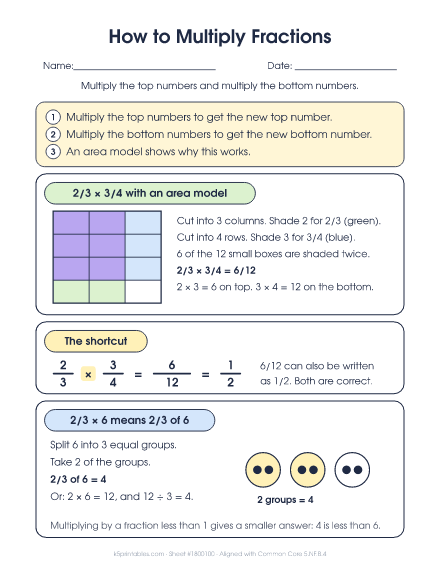
How to Multiply Fractions
2/3 × 3/4 shown on an area model with the overlap shaded, the multiply-the-tops-and-bottoms shortcut, and 2/3 of 6 shown with groups of dots.
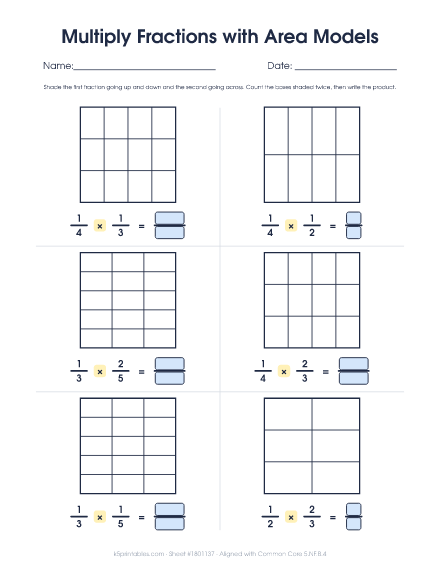
Multiply Fractions with Area Models
Squares to shade for fraction multiplication problems. Fewer has 4 problems with the grid lines drawn and the first fraction shaded, Standard has 6 with the grid lines drawn, and More has 8 on blank squares. Includes an answer key with the shading.
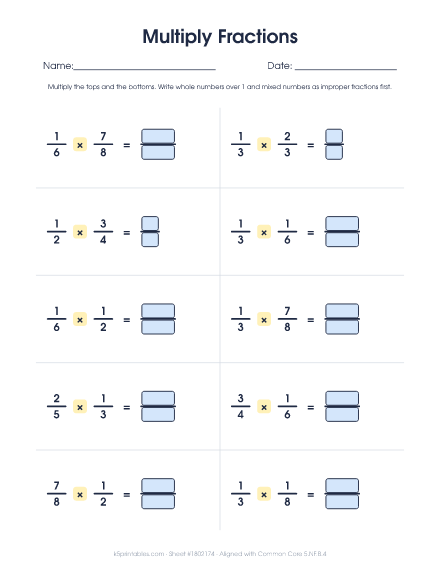
Multiply Fractions
Fraction multiplication problems. Fewer has 8 problems with unit fractions, Standard has 10 with any fractions, and More has 12 that add whole numbers and mixed numbers. The answer key shows simplified answers too.
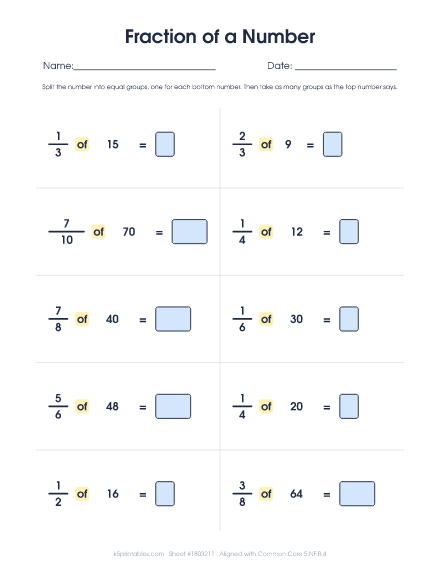
Fraction of a Number
Problems like 2/3 of 12. Fewer has 6 problems with dot pictures to circle, Standard has 10 with whole-number answers, and More has 12 that include answers with fractions, like 5/6 of 10 = 8 2/6. Includes an answer key.
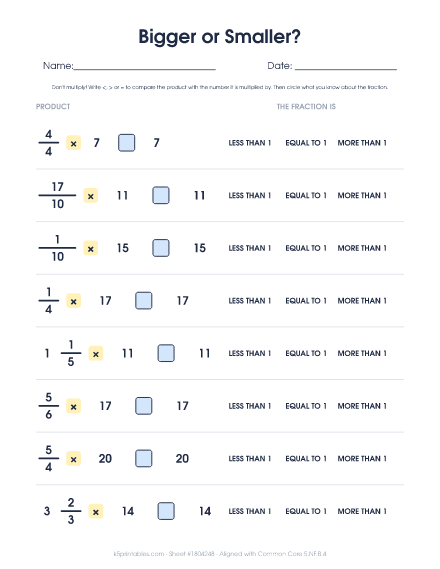
Bigger or Smaller?
Products to compare with the number being multiplied, without multiplying. Fewer has 6 problems, Standard has 8 that add mixed numbers and fractions equal to 1, and More has 10 that also multiply by fractions. Includes an answer key.
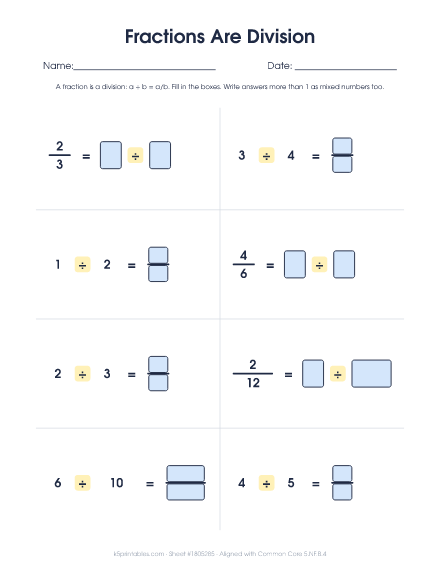
Fractions Are Division
Problems like 2 ÷ 5 = 2/5. Fewer has 6 problems with pizzas to shade one person's share, Standard has 8 that also go the other way, like 3/8 = 3 ÷ 8, and More has 10 that add answers more than 1. Includes an answer key.
- See it all
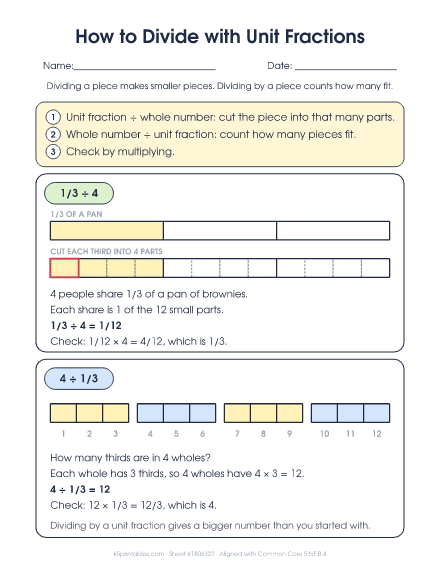
How to Divide with Unit Fractions
1/3 ÷ 4 shown as a third of a pan cut into 4 parts, and 4 ÷ 1/3 shown as four wholes cut into thirds and counted, each checked by multiplying.
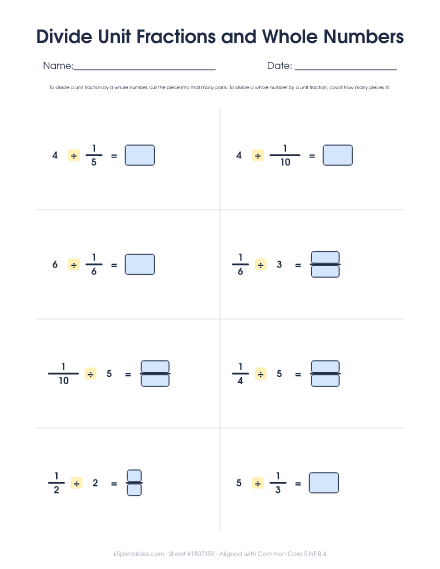
Divide Unit Fractions and Whole Numbers
Problems like 1/3 ÷ 4 and 4 ÷ 1/3, mixed on every sheet. Fewer has 6 problems with bars to shade or count, Standard has 8, and More has 10 with a multiplication check for each. Includes an answer key.
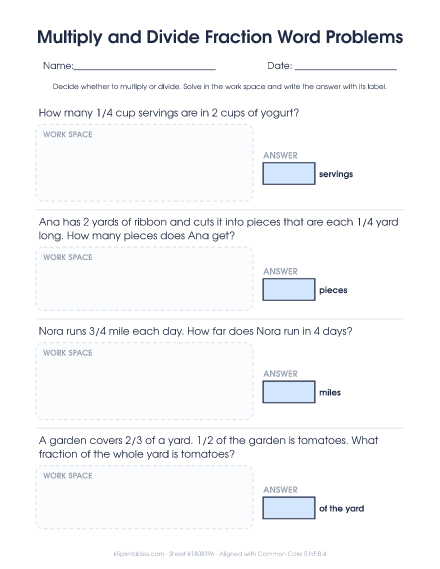
Multiply and Divide Fraction Word Problems
Stories about recipes, gardens, running, sharing pizza and sandwiches, cutting ribbon and serving yogurt. Fewer has 3 problems, Standard has 4 and More has 5. Includes an answer key.
Print the whole packet
One copy of every sheet above, in order. Tap + for more copies (up to 10).
For the parent or teacher
What it is
In 4th grade, students multiplied a whole number by a fraction, like 3 × 2/5 as three groups of 2/5. Now they multiply a fraction by a fraction. An area model shows why 2/3 × 3/4 = 6/12: the part shaded twice is 6 of 12 boxes. From there, students use the rule of multiplying the top numbers and the bottom numbers, find a fraction of a number, like 2/3 of 12, and reason about whether multiplying by a fraction makes a number bigger or smaller. They also see that a fraction is a division, like 3 ÷ 4 = 3/4, and divide unit fractions and whole numbers, like 1/3 ÷ 4 and 4 ÷ 1/3.
What comes next
Order of operations.
How to teach it
- Teach in order or jump to whatever your student needs. A student may know the multiply-the-tops-and-bottoms rule and still be building an understanding of why it works.
- Read × as "of." 2/3 × 6 means 2/3 of 6, which is easier to picture.
- Use an area model to show what the product means before practicing the rule.
- Ask "will the answer be bigger or smaller?" before multiplying. A fraction less than 1 makes a number smaller.
- Check division by multiplying. If 1/3 ÷ 4 = 1/12, then 1/12 × 4 should give back 1/3.
Common mistakes
- Finding a common denominator first, as if adding.
- Multiplying the top numbers but keeping the bottom number the same.
- Multiplying a whole number by both the top and the bottom number.
- Expecting multiplication to always make a number bigger.
- Mixing up 1/3 ÷ 4 (a smaller piece) and 4 ÷ 1/3 (how many pieces fit).