Add and Subtract Decimals
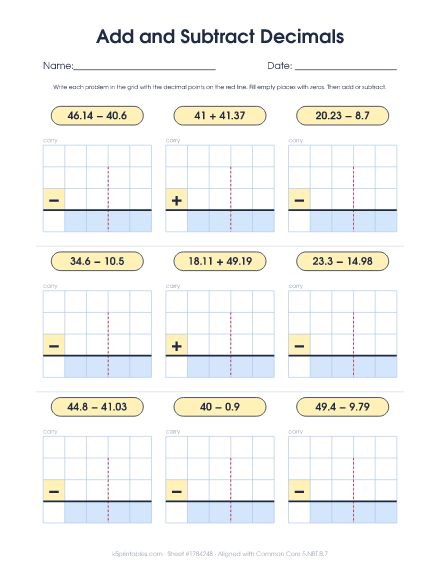
Write each problem in the grid with the decimal points on the red line. Fill empty places with zeros. Then add or subtract.
Fresh sheet anytime. Tap New sheet or reload for a different one. Tap + for up to 10.
This is sheet #178424601.
How to do it
- Write the numbers in the grid with the points on the red line.
- Fill empty places with zeros.
- Add or subtract.
Teaching tip
Lining up the problem is part of the skill, so let your student copy the numbers into the grid themselves. This sheet is aligned with Common Core 5.NBT.B.7.
About this worksheet
Decimal problems written across, to line up on graph paper with a red line for the decimal point. Fewer has 6 addition problems, Standard has 9 and More has 12 with bigger numbers, mixing addition and subtraction. The answer key shows the lined-up numbers, zeros and answers.
What kids practice
Fifth graders extend decimals to thousandths, the third place after the decimal point. They read and write decimals in word and expanded form, compare and order them, and round them to the nearest whole, tenth or hundredth. Then they add and subtract decimals by lining up the decimal points, so each digit lands in the right place, and filling empty places with zeros. Last, they multiply and divide decimals to hundredths, working like whole numbers and using place value and estimates to place the decimal point.
Watch for
- Thinking a decimal with more digits is always bigger, like 0.407 > 0.47.
- Lining up the last digits instead of the decimal points.
- Forgetting that a whole number like 7 has a decimal point at the end (7.00).
- Rounding by looking at the wrong digit, or forgetting to carry when rounding a 9 up.
- Lining up the decimal points when multiplying, instead of counting decimal places.
- Leaving out the decimal point in the quotient, or putting it in the wrong place.
It's free to print, with Fewer, Standard or More on the page and an answer key. See the full decimal operations guide for 5th grade.
More sheets in this set
- See it all
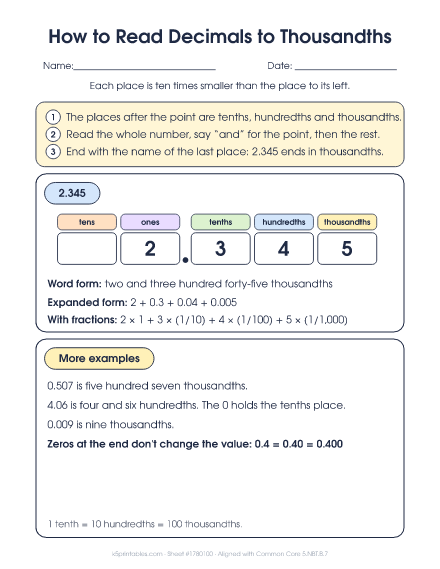 1. How to Read Decimals to Thousandths2.345 in a place value chart with word form, expanded form and fraction form, plus more examples and why 0.4 = 0.40 = 0.400.
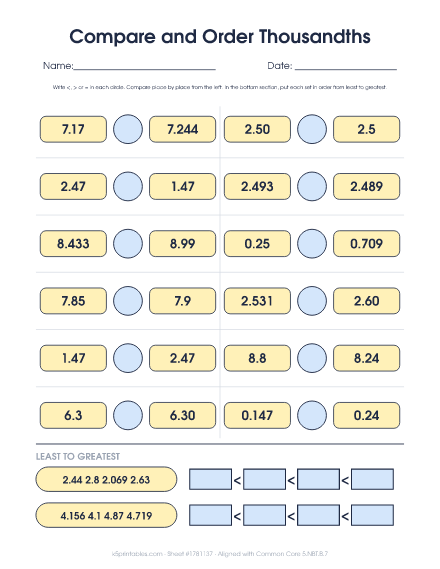 2. Compare and Order ThousandthsPairs of decimals to compare, including tricky ones like 0.47 and 0.407 and equal ones like 6.70 and 6.7. Fewer has 10 pairs, Standard has 12 pairs and 2 sets to order, and More has 12 pairs and 4 sets. Includes an answer key.
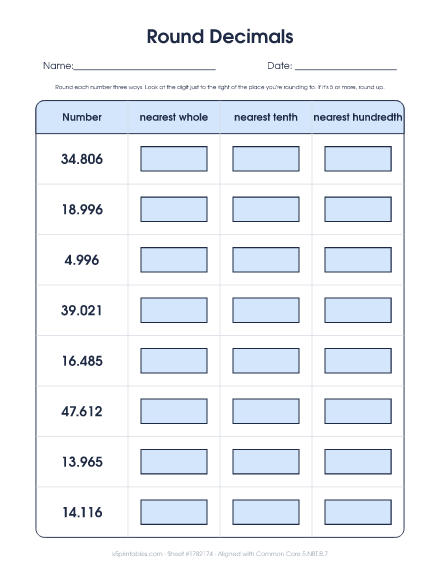 3. Round DecimalsDecimals to thousandths to round to the nearest whole, tenth and hundredth, including some where rounding carries, like 16.997. Fewer has 6, Standard has 8 and More has 10. Includes an answer key.
- See it all
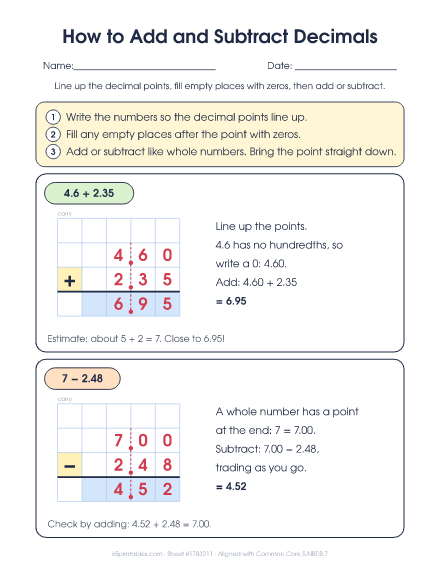 4. How to Add and Subtract Decimals4.6 + 2.35 and 7 − 2.48 worked on graph paper, with the decimal points lined up and zeros filled in.
- See it all
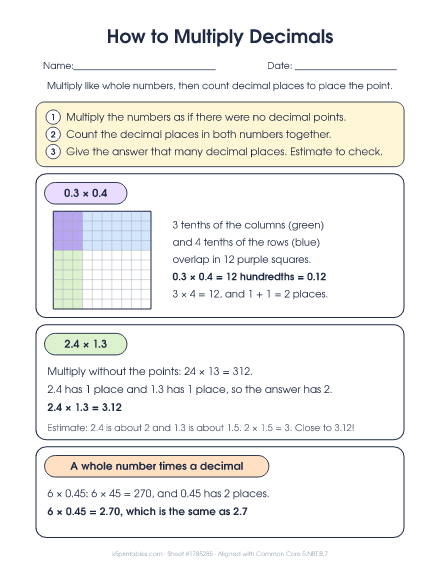 6. How to Multiply Decimals0.3 × 0.4 shaded on a hundredths grid, 2.4 × 1.3 worked without the points and checked with an estimate, and a whole number times a decimal.
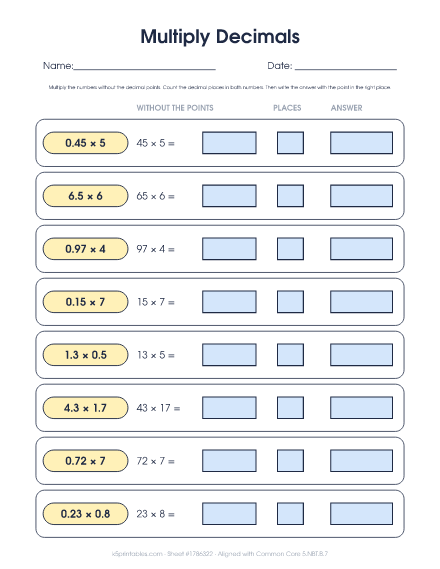 7. Multiply DecimalsDecimal multiplication problems with boxes for the whole-number product, the number of decimal places and the answer. Fewer has 6 problems with a decimal times a whole number, Standard has 8 that add tenths times tenths and hundredths, and More has 10 that add tenths times hundredths. Includes an answer key.
- See it all
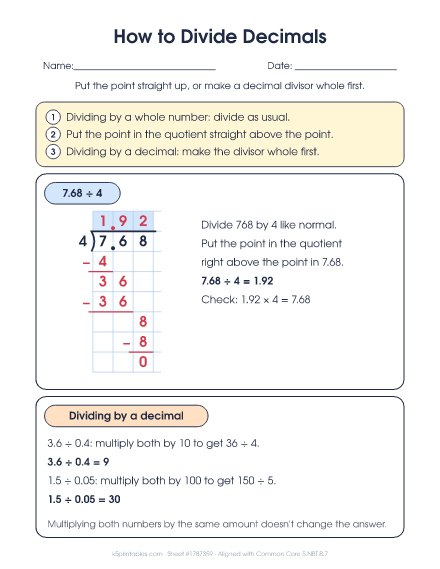 8. How to Divide Decimals7.68 ÷ 4 worked on a long division grid with the decimal point carried straight up, and 3.6 ÷ 0.4 and 1.5 ÷ 0.05 turned into whole-number divisors.
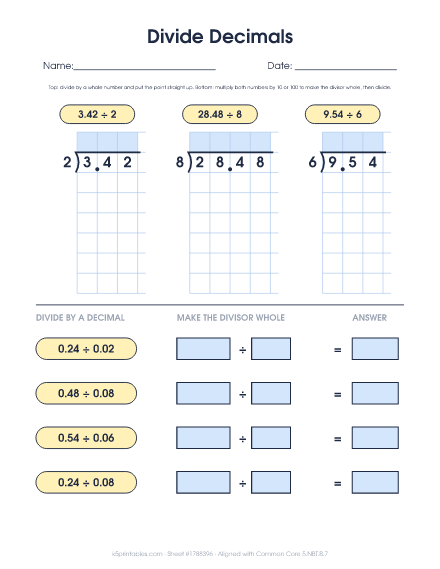 9. Divide DecimalsDecimals divided by a whole number on long division grids, plus problems that divide by a decimal. Fewer has 4 grids, Standard has 3 grids and 4 divide-by-a-decimal problems, and More has 3 grids and 6. Every problem divides evenly. The answer key shows every step.
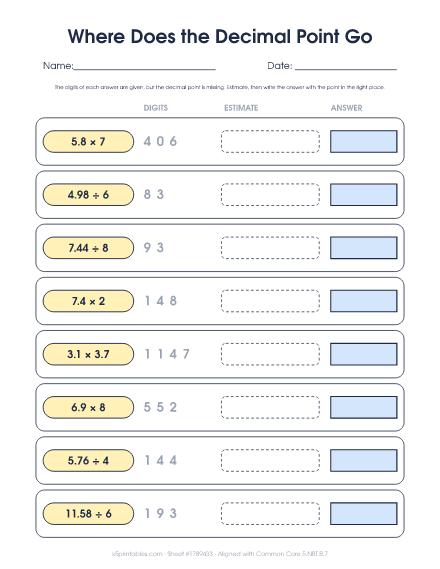 10. Where Does the Decimal Point GoMultiplication and division problems with the digits of each answer given and the decimal point missing. Students estimate, then place the point. Fewer has 6 multiplication problems, Standard has 8 and More has 10, mixing multiplication and division. The answer key includes sample estimates.
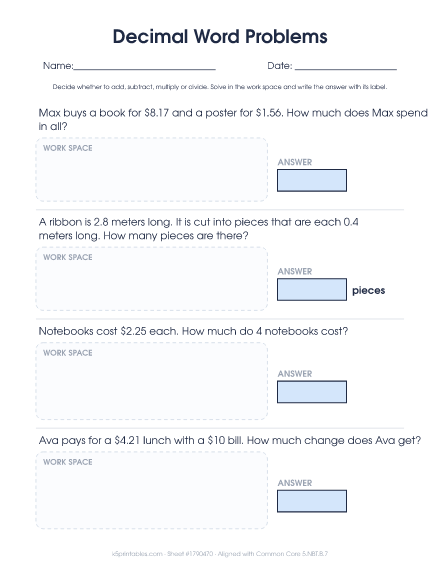 11. Decimal Word ProblemsMoney and measurement word problems that use all four operations with decimals, like making change, sharing a cost, and finding a distance. Fewer has 3 problems, Standard has 4 and More has 5. Includes an answer key.