How to Convert Both Ways
Big unit to small unit: multiply. Small unit to big unit: divide.
Need more than one? Tap + for extra copies (up to 10).
How to do it
- Big unit to small unit, multiply.
- Small unit to big unit, divide.
- Metric units go by powers of 10, so the digits just move.
Teaching tip
Have your student say the fact first, like "12 inches in a foot," and then decide whether to multiply or divide. This sheet is aligned with Common Core 5.MD.A.1.
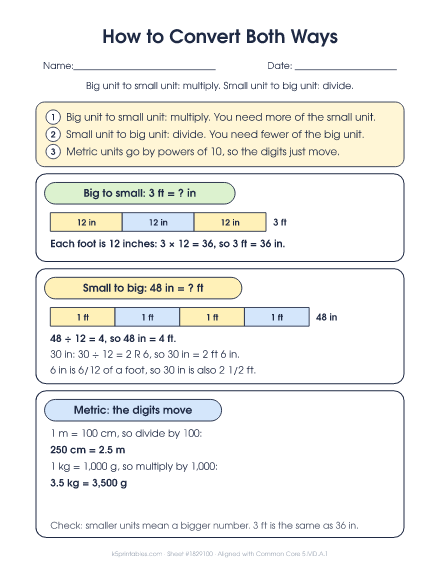
About this chart
3 ft = 36 in and 48 in = 4 ft shown with bars, 30 in written as 2 ft 6 in and as 2 1/2 ft, and metric examples like 250 cm = 2.5 m and 3.5 kg = 3,500 g.
What kids practice
In 4th grade, students changed big units to small units by multiplying, like 3 ft = 36 in. Now they go both ways. Changing small units to big units means dividing, like 48 in = 4 ft, and leftovers can be written in the small unit or as a fraction, like 30 in = 2 ft 6 in = 2 1/2 ft. Metric units go by powers of 10, so converting just moves the digits, like 250 cm = 2.5 m. Students also compare measurements in different units and solve multi-step problems by converting first so the units match.
Watch for
- Multiplying when going from small units to big units.
- Writing a remainder as a decimal, like 30 in = 2.6 ft.
- Using the wrong fact, like 10 inches in a foot.
- Moving the digits the wrong number of places in metric conversions.
- Adding or subtracting amounts in different units without converting first.
It's free to print, as many copies as you need. See the full converting units guide for 5th grade.
More sheets in this set
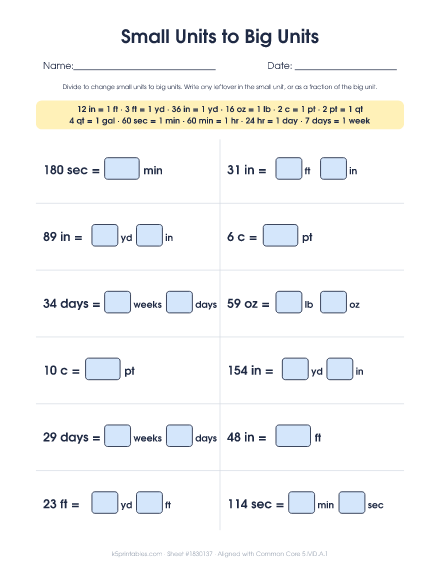 2. Small Units to Big UnitsCustomary length, weight, liquid volume and time to change from small units to big units, with the facts printed at the top. Fewer has 10 that divide evenly, Standard has 12 with leftovers, and More has 12 that include mixed numbers, like 168 in = 4 2/3 yd. Includes an answer key.
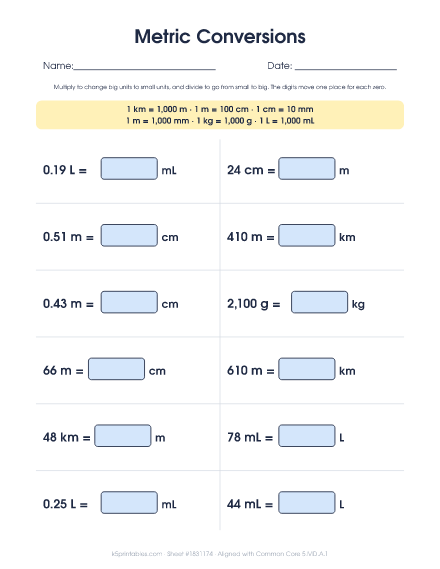 3. Metric ConversionsKilometers, meters, centimeters, millimeters, kilograms, grams, liters and milliliters to convert both ways, with the facts printed at the top. Fewer has 10 with whole-number answers, Standard has 12 with decimals, and More has 12 that add kilometers and millimeters. Includes an answer key.
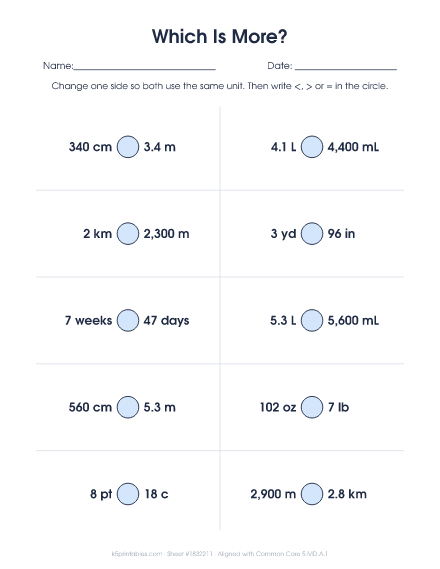 4. Which Is More?Pairs of measurements in different units to compare, like 3 gal and 14 qt. Fewer has 8 customary pairs, Standard has 10 that add metric decimals, like 3,900 mL and 4.2 L, and More has 12 that add mixed units, like 4 yd 14 in. Includes an answer key.
- See it all
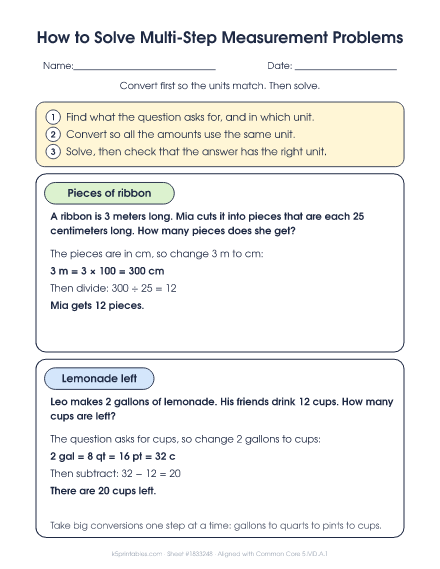 5. How to Solve Multi-Step Measurement ProblemsTwo worked stories, cutting a 3 meter ribbon into 25 centimeter pieces and finding the cups of lemonade left from 2 gallons, each converted first and then solved.
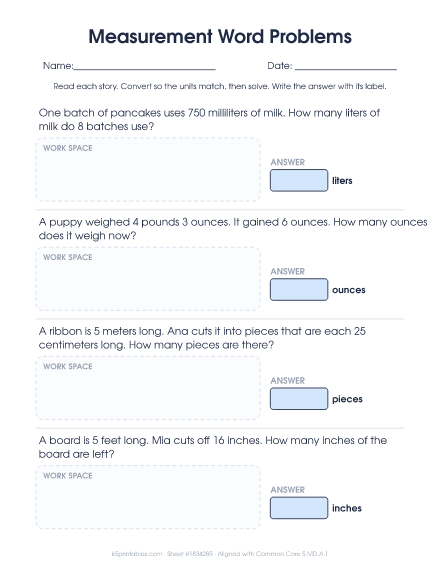 6. Measurement Word ProblemsMulti-step stories about ribbon, lemonade, a puppy's weight, running, recipes, boards, movies, books and jugs of water. Fewer has 3 problems, Standard has 4 and More has 5. Includes an answer key.