Complete Sentences Chart
What makes a complete sentence, and how to fix a fragment or a run-on.
Need more than one? Tap + for extra copies (up to 10).
How to do it
- Read the three parts of a complete sentence.
- Read why each fragment isn't complete.
- Read the three ways to fix a run-on.
Teaching tip
Keep the chart nearby while your student works on the other pages. This sheet is aligned with Common Core L.4.1f.
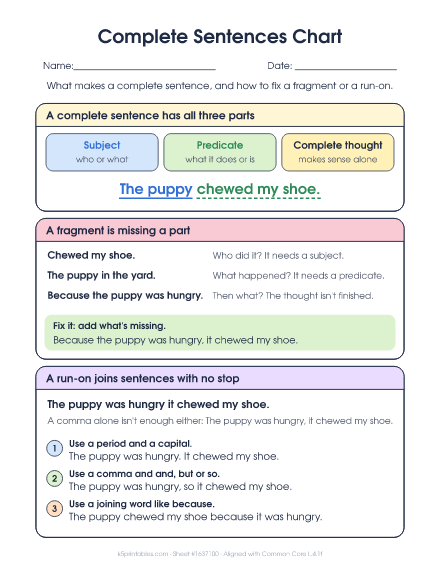
About this chart
The three parts of a complete sentence with a marked example, three kinds of fragments and how to fix them, and three ways to fix a run-on.
What kids practice
A complete sentence has a subject, a predicate and a complete thought. A fragment is missing one of those parts, like "Ran to the bus stop." A run-on joins two sentences with no stop between them, or with only a comma, like "The rain stopped we went outside." Fourth graders write longer sentences, so both mistakes show up often.
Watch for
- Thinking a long sentence must be a run-on. A long sentence can be correct if it is joined the right way.
- Fixing a run-on with only a comma, like "I wanted pizza, my brother wanted tacos."
- Starting a sentence with because, when or after and never finishing the thought.
- Thinking a short sentence must be a fragment. "Maya laughed." is a complete sentence.
It's free to print, as many copies as you need. See the full fragments and run-ons guide for 4th grade.
More sheets in this set
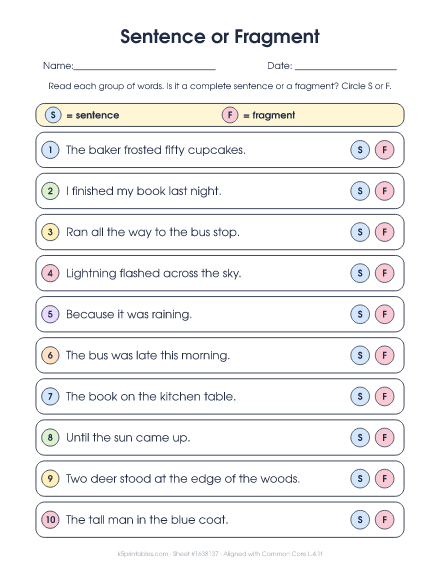 2. Sentence or FragmentComplete sentences and fragments mixed together, to circle S for sentence or F for fragment. Fewer, Standard or More give 8, 10 or 12. Includes an answer key.
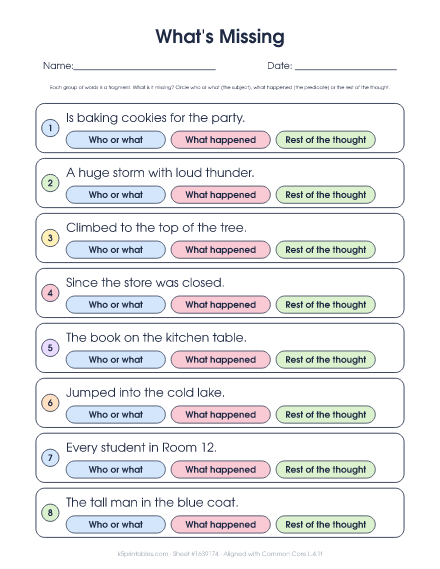 3. What's MissingFragments missing a subject, a predicate or the rest of the thought, like "When the bell rang." Fewer, Standard or More give 6, 8 or 10. Includes an answer key.
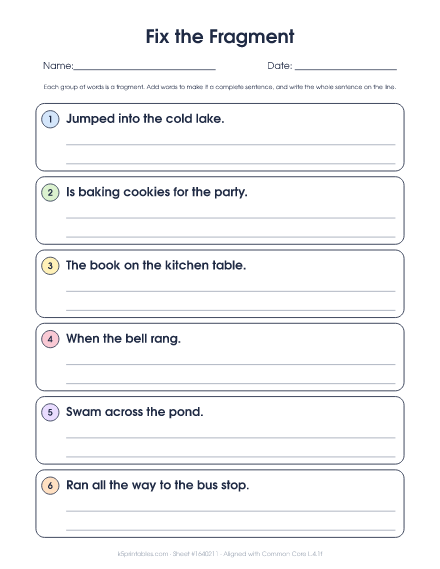 4. Fix the FragmentFragments to turn into complete sentences, with lines to write on. Fewer, Standard or More give 5, 6 or 7. The answer key shows one way to fix each one; other complete sentences work too.
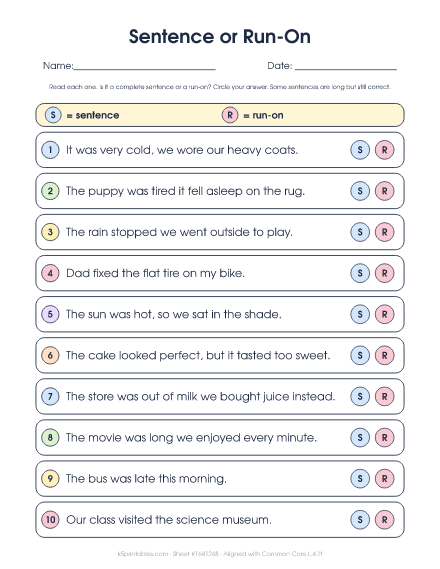 5. Sentence or Run-OnRun-ons and complete sentences mixed together, including long sentences joined the right way with a comma and and, but or so. Fewer, Standard or More give 8, 10 or 12. Includes an answer key.
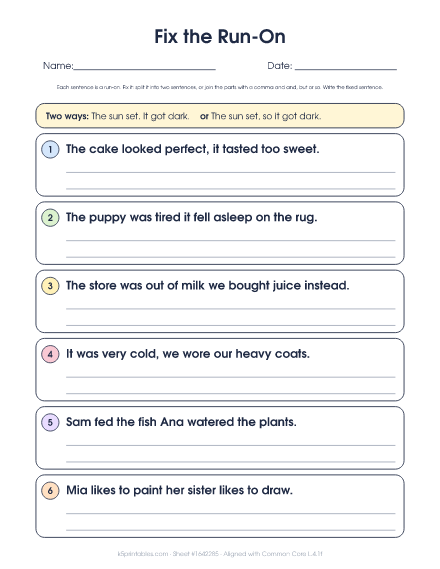 6. Fix the Run-OnRun-ons with no punctuation and run-ons joined with only a comma, with lines to write the fixed sentence. Fewer, Standard or More give 5, 6 or 7. The answer key shows both ways to fix each one.
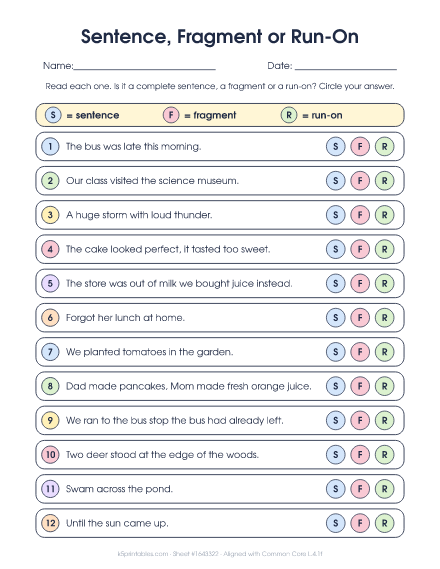 7. Sentence, Fragment or Run-OnComplete sentences, fragments and run-ons mixed together, to sort by circling S, F or R. Fewer, Standard or More give 9, 12 or 15. Includes an answer key.
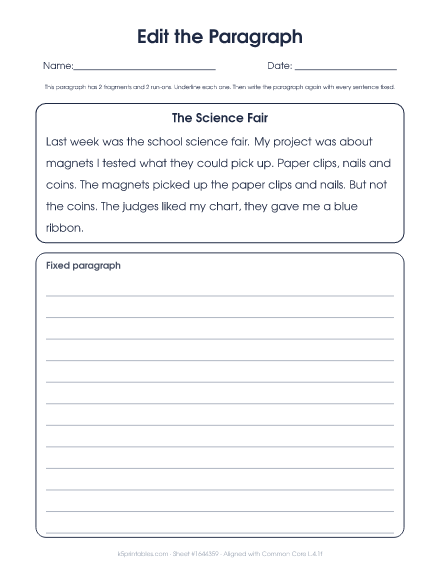 8. Edit the ParagraphSix short paragraphs, like "The Bird Feeder" and "The School Play," each with 2 fragments and 2 run-ons to find and fix. The answer key marks them and shows one way to write the fixed paragraph.