Text features worksheets
Aligned with Common Core RI.3.5
Printable third-grade text feature worksheets: a chart of titles, headings, bold words, photos, captions, diagrams, tables of contents, glossaries and indexes, plus practice labeling an article and using a table of contents, glossary and index.
The worksheets
- See it all
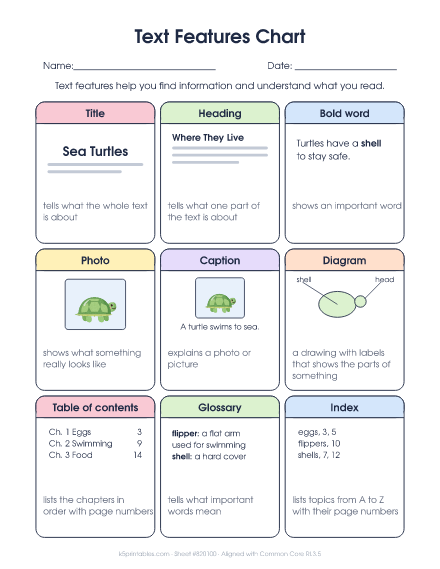
Text Features Chart
Title, heading, bold word, photo, caption, diagram, table of contents, glossary and index, each with an example.
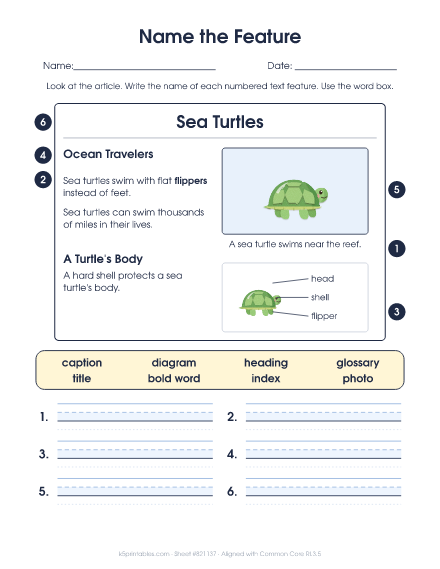
Name the Feature
A sample article about bees, volcanoes, sea turtles or frogs with six numbered features to label.
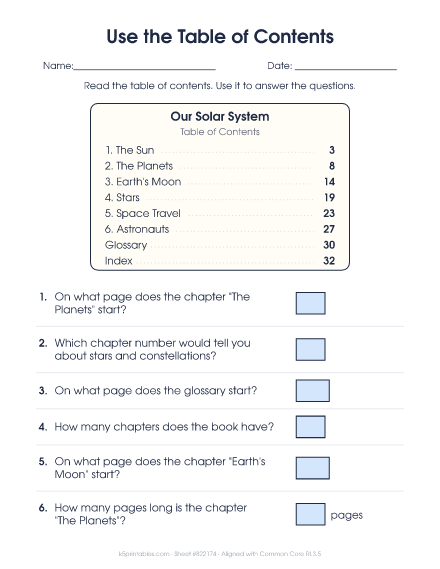
Use the Table of Contents
A book's contents page with questions about which page and which chapter to turn to.
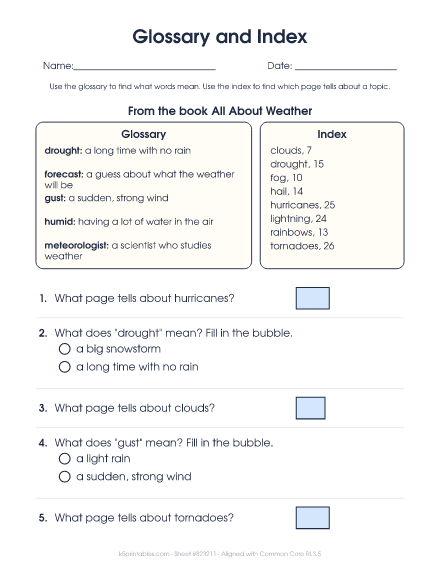
Glossary and Index
A short glossary and index from a nonfiction book, with questions that use each one.
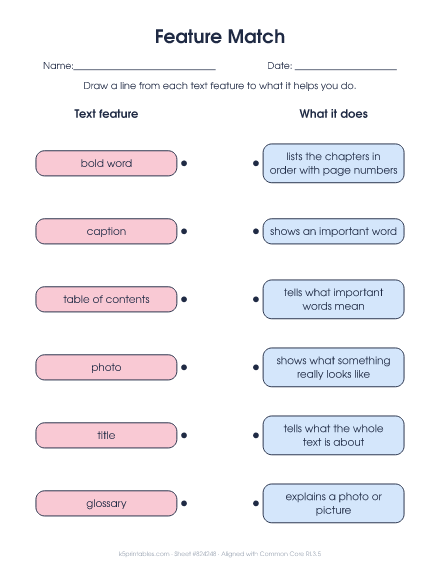
Feature Match
Match text features like caption, glossary and index to what each one does.
Print the whole packet
One copy of every sheet above, in order. Tap + for more copies (up to 10).
For the parent or teacher
What it is
Text features are the parts of a nonfiction book or article that help readers find and understand information, like headings, captions, diagrams and the glossary. Third graders learn what each feature is for and use them to find answers quickly without reading every page.
What comes next
Greek and Latin roots and more nonfiction reading in 4th grade.
How to teach it
- Flip through a nonfiction book together and name each feature you see.
- Before reading, look at the title, headings and pictures to predict what you'll learn.
- Play "find it fast" with the table of contents and the index.
- Look up bold words in the glossary as you read.
- Read the captions and labels. They often have facts that aren't in the main text.
Common mistakes
- Skipping captions, labels and diagrams.
- Mixing up the glossary (what words mean) and the index (where topics are).
- Mixing up the table of contents (chapters in order) and the index (topics A to Z).