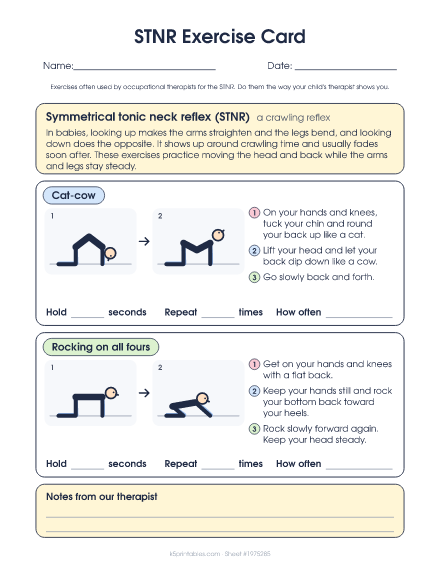
STNR Exercise Card
Exercises often used by occupational therapists for the STNR. Do them the way your child's therapist shows you.
Need more than one? Tap + for extra copies (up to 10).
How to do it
- Look at the two pictures for each exercise.
- Follow the numbered steps, slowly.
- Fill in Hold, Repeat and How often with your therapist.
Tip
A soft mat or folded blanket under the knees makes all-fours exercises more comfortable.
About this worksheet
Cat-cow and Rocking on all fours, two exercises often used for the symmetrical tonic neck reflex (STNR), with pictures, steps and blanks for your child's therapist to fill in.
What it is
Primitive reflexes are automatic movements babies are born with, and most fade in the first year or so. Some occupational therapists use simple movement exercises when they think a reflex is still showing up. These cards show exercises they commonly use, with pictures, steps and blanks for how long and how often. They aren't a test or a treatment plan. Use them the way your child's therapist suggests.
Watch for
- Rushing. Slow, smooth moves matter more than speed or how many.
- Holding the breath. Counting the hold out loud keeps the breathing going.
- Straining the neck in Superman or Curl-up ball. Keep it gentle.
- Pain, dizziness or headaches. Stop and check with your child's therapist or doctor.
It's free to print, as many copies as you need. See the full primitive reflexes guide.
We made these printables to support the work you're doing with your child's occupational therapist. They're meant to go alongside professional care, not replace it. If an activity causes pain, dizziness or headaches, stop and check with your child's therapist or doctor.
More sheets in this set
- See it all
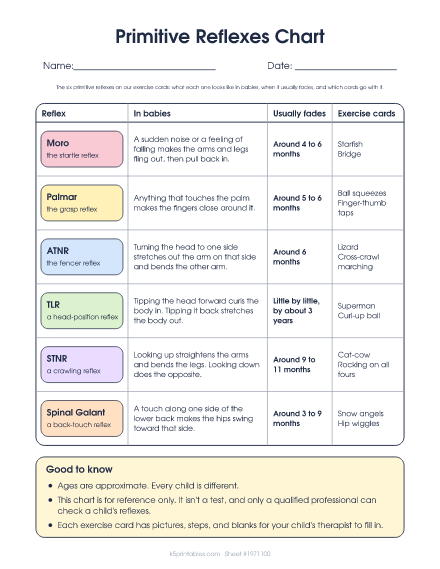 1. Primitive Reflexes ChartA one-page chart of the six reflexes on our exercise cards: what each looks like in babies, when it usually fades, and which cards go with it.
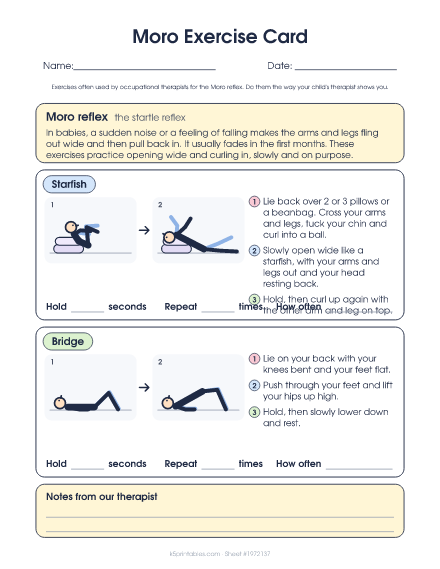 2. Moro Exercise CardStarfish and Bridge, two exercises often used for the Moro (startle) reflex, with pictures, steps and blanks for your child's therapist to fill in.
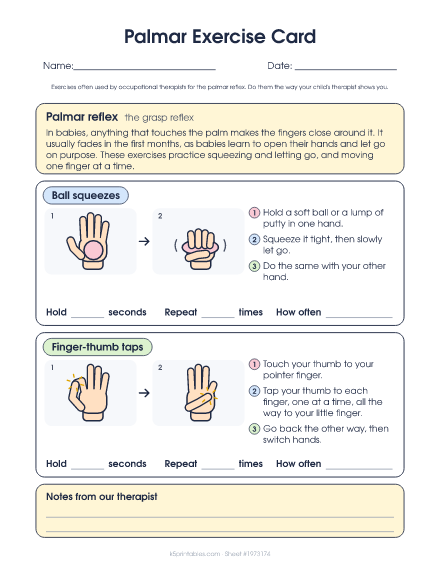 3. Palmar Exercise CardBall squeezes and Finger-thumb taps, two exercises often used for the palmar (grasp) reflex, with pictures, steps and blanks for your child's therapist to fill in.
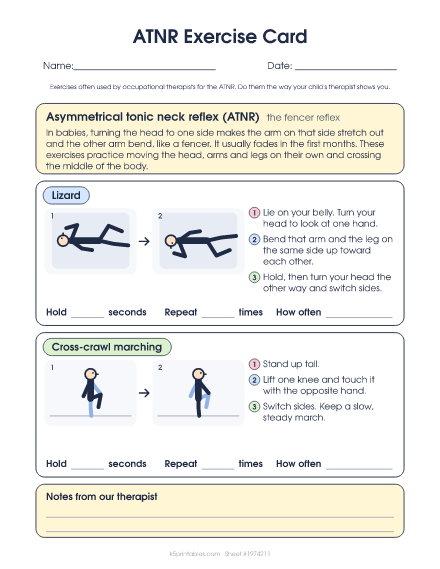 4. ATNR Exercise CardLizard and Cross-crawl marching, two exercises often used for the asymmetrical tonic neck reflex (ATNR), with pictures, steps and blanks for your child's therapist to fill in.
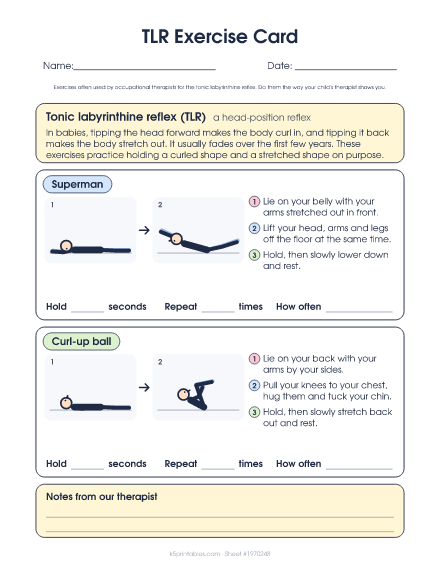 5. TLR Exercise CardSuperman and Curl-up ball, two exercises often used for the tonic labyrinthine reflex (TLR), with pictures, steps and blanks for your child's therapist to fill in.
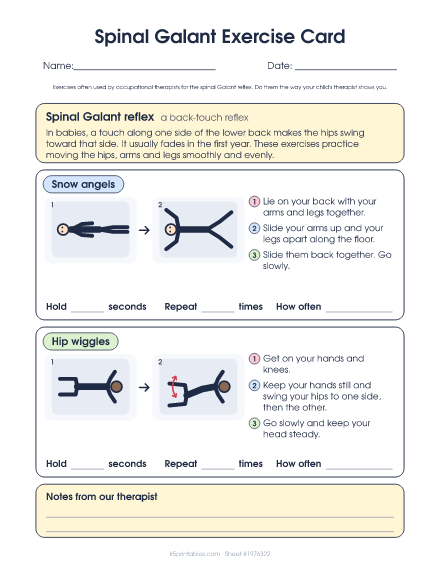 7. Spinal Galant Exercise CardSnow angels and Hip wiggles, two exercises often used for the spinal Galant reflex, with pictures, steps and blanks for your child's therapist to fill in.
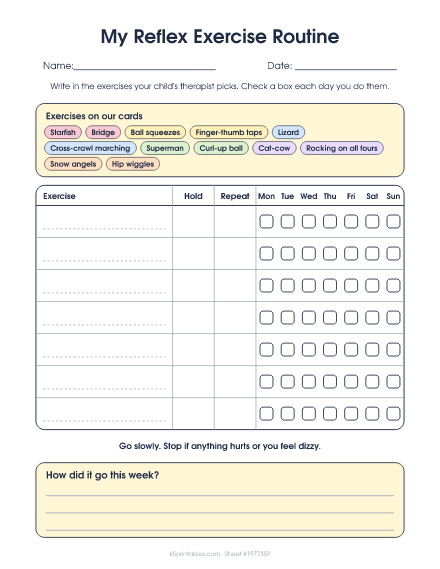 8. My Reflex Exercise RoutineA weekly routine sheet with the names of all twelve exercises, a table to write in the ones your child's therapist picks, a box for each day and room for notes.
Helpful supplies (affiliate links)
Simple supplies that go with these activities. Check with your child's therapist about what's right for your child.
Kids' exercise mat
A soft spot for floor exercises.
Find it on AmazonTherapy ball
For rolling, bouncing and core work.
Find it on AmazonScooter board
Push and pull on your tummy.
Find it on AmazonBean bags
Toss, catch and balance them.
Find it on Amazon