Heavy Work Around the House
Everyday jobs that count as heavy work. Check off the ones you did this week.
Need more than one? Tap + for extra copies (up to 10).
How to do it
- Read the jobs for each part of the house.
- Check off the ones you did this week.
- Add your own ideas at the bottom.
Tip
Print a fresh copy each week, or laminate it and use a dry-erase marker.
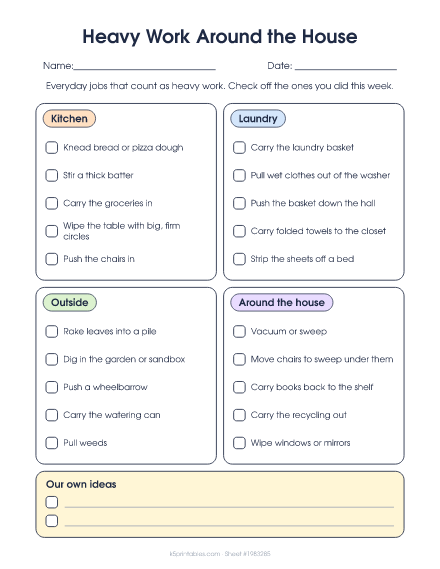
About this chart
A checklist of everyday chores that count as heavy work in the kitchen, laundry, outside and around the house, with room for your own ideas.
What it is
Heavy work means activities where the muscles push, pull, carry, lift or squeeze against something heavy. It gives the muscles and joints strong, steady input, sometimes called proprioceptive input. Occupational therapists often suggest it as short bursts during the day, and many everyday chores count. These sheets show activities they commonly use, with pictures, steps and blanks for how long and how often. Use them the way your child's therapist suggests.
Watch for
- Going too heavy. A basket or bucket should feel like work, not a strain.
- Rounding the back to lift. Bend the knees and keep the load close to the body.
- Rushing through moves. Slow and steady gives the muscles more work than fast and floppy.
- Pain, dizziness or headaches. Stop and check with your child's therapist or doctor.
It's free to print, as many copies as you need. See the full heavy work and proprioceptive input guide.
We made these printables to support the work you're doing with your child's occupational therapist. They're meant to go alongside professional care, not replace it. If an activity causes pain, dizziness or headaches, stop and check with your child's therapist or doctor.
More sheets in this set
- See it all
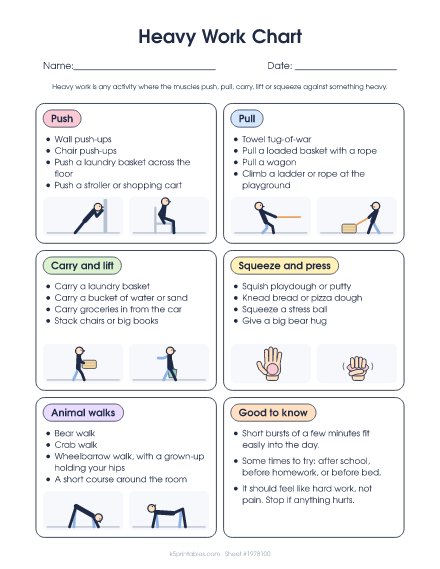 1. Heavy Work ChartA one-page chart of the kinds of heavy work, push, pull, carry and lift, squeeze and press, and animal walks, with pictures and everyday examples of each.
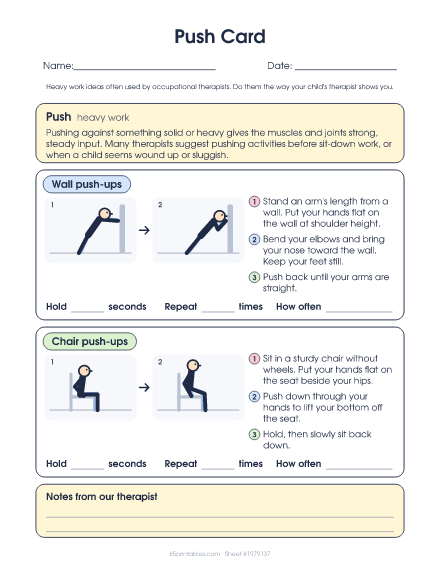 2. Push CardWall push-ups and Chair push-ups, two pushing activities often used by occupational therapists, with pictures, steps and blanks for your child's therapist to fill in.
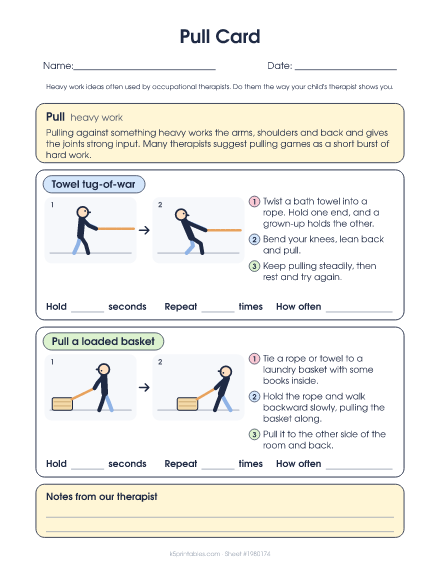 3. Pull CardTowel tug-of-war and Pull a loaded basket, two pulling activities often used by occupational therapists, with pictures, steps and blanks for your child's therapist to fill in.
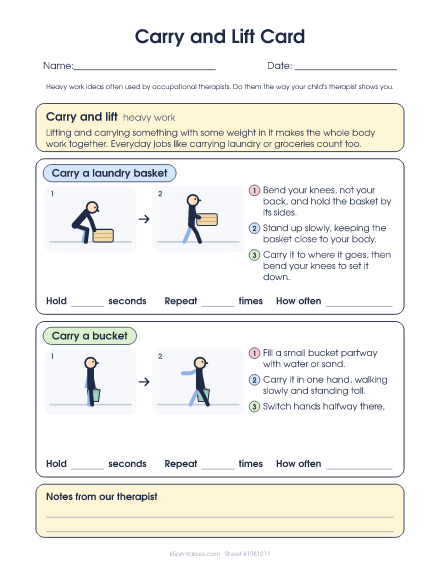 4. Carry and Lift CardCarry a laundry basket and Carry a bucket, two carrying activities often used by occupational therapists, with pictures, steps and blanks for your child's therapist to fill in.
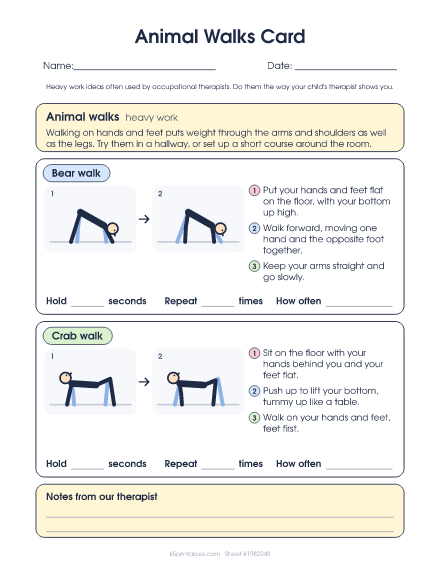 5. Animal Walks CardBear walk and Crab walk, two animal walks often used by occupational therapists, with pictures, steps and blanks for your child's therapist to fill in.
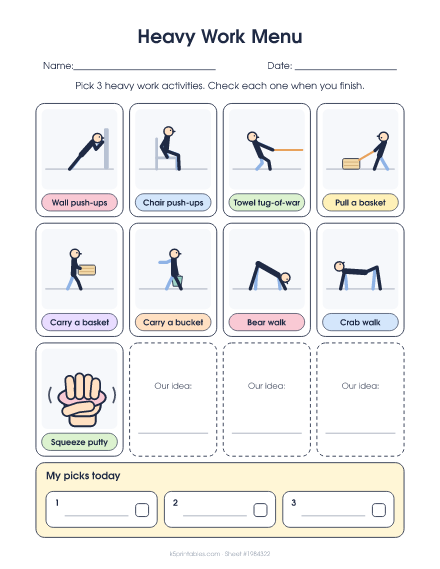 7. Heavy Work MenuA pick-3 choice board with nine heavy work activities, three blank tiles for your therapist's ideas, and a My picks today row to check off.
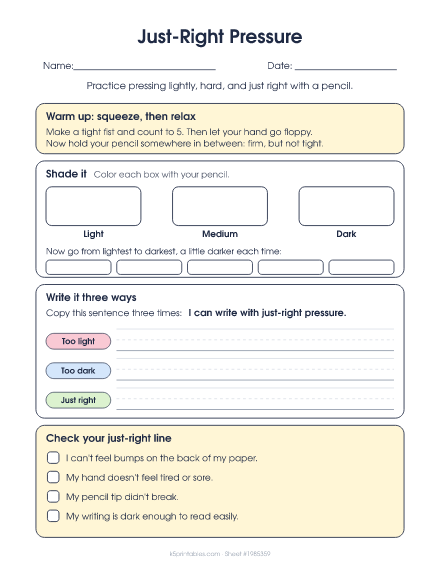 8. Just-Right PressureA pencil pressure worksheet: a squeeze-and-relax warm-up, light, medium and dark shading, writing one sentence three ways, and a just-right checklist.
Helpful supplies (affiliate links)
Simple supplies that go with these activities. Check with your child's therapist about what's right for your child.
Soft weighted ball
For carrying, rolling and tossing.
Find it on AmazonScooter board
Push and pull on your tummy.
Find it on AmazonPlay tunnel
Crawl through for an obstacle course.
Find it on AmazonKids' exercise mat
A soft spot for floor exercises.
Find it on Amazon