In-Hand Skills Card
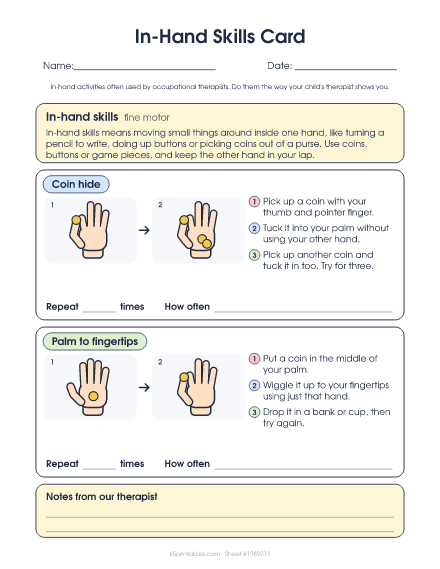
In-hand activities often used by occupational therapists. Do them the way your child's therapist shows you.
Need more than one? Tap + for extra copies (up to 10).
How to do it
- Look at the two pictures for each activity.
- Follow the numbered steps, using one hand.
- Fill in Repeat and How often with your therapist.
Tip
Keep coins and other small objects away from younger children who might put them in their mouths.
About this worksheet
Coin hide and Palm to fingertips, two in-hand activities often used by occupational therapists, with pictures, steps and blanks for your child's therapist to fill in.
What it is
Fine motor skills are the small movements of the hands and fingers, like holding a pencil, picking up coins or doing up buttons. Pre-writing skills are the drawing, copying and coloring that come before writing letters. Occupational therapists often work on both with simple activities like playdough, copying shapes and practicing a comfortable pencil grip. Use these sheets the way your child's therapist suggests.
Watch for
- Pushing letters too soon. Drawing, copying shapes and coloring come first.
- Gripping the pencil hard. A firm but relaxed grip is easier on the hand.
- Using the other hand, chest or table to help with in-hand activities. Keep the other hand in the lap.
- Sore or tired hands. Take a break, and check with your child's therapist if it keeps happening.
It's free to print, as many copies as you need. See the full fine motor and pre-writing guide.
We made these printables to support the work you're doing with your child's occupational therapist. They're meant to go alongside professional care, not replace it. If an activity causes pain, dizziness or headaches, stop and check with your child's therapist or doctor.
More sheets in this set
- See it all
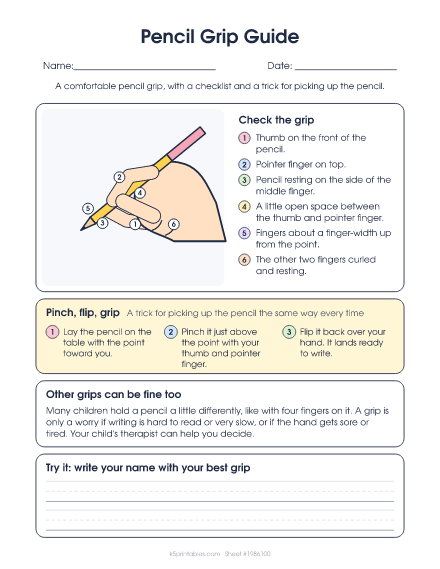 1. Pencil Grip GuideA picture of a comfortable pencil grip with a 6-point checklist, the pinch, flip, grip trick for picking up the pencil, a note on other grips, and lines to try it out.
- See it all
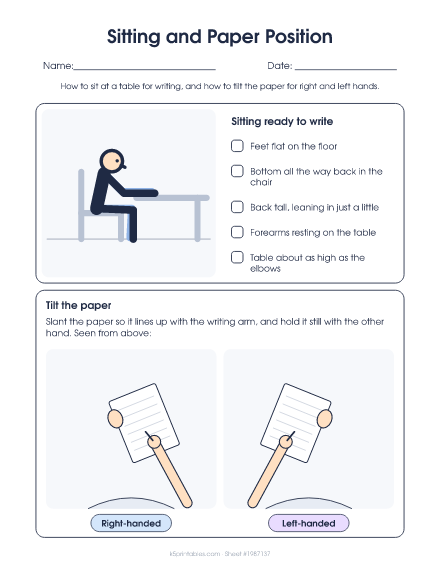 2. Sitting and Paper PositionA chart for setting up to write: a picture of sitting at a table with a five-point checklist, and pictures from above of how to tilt the paper for right- and left-handed writers.
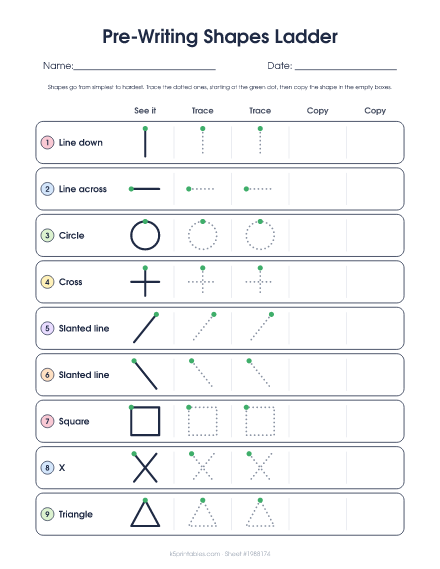 3. Pre-Writing Shapes LadderNine shapes from simplest to hardest: line down, line across, circle, cross, two slanted lines, square, X and triangle. Each has a model, two to trace and two boxes to copy.
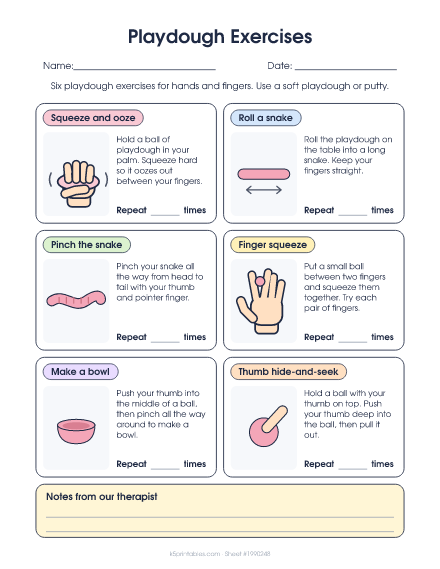 5. Playdough ExercisesSix playdough exercises for hands and fingers: Squeeze and ooze, Roll a snake, Pinch the snake, Finger squeeze, Make a bowl and Thumb hide-and-seek, each with a Repeat blank.
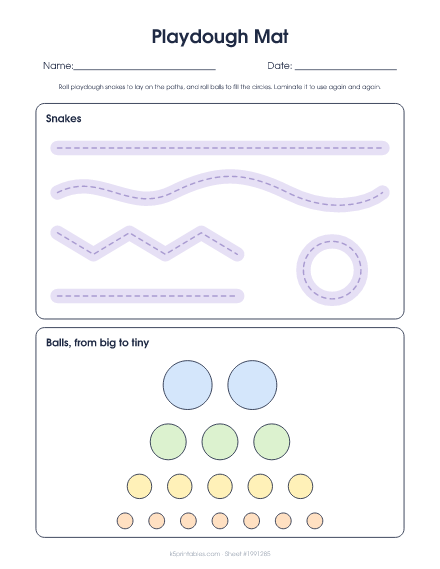 6. Playdough MatA playdough mat with five snake paths to roll and lay on, including a wave, a zigzag and a ring, and rows of circles from big to tiny to fill with rolled balls.
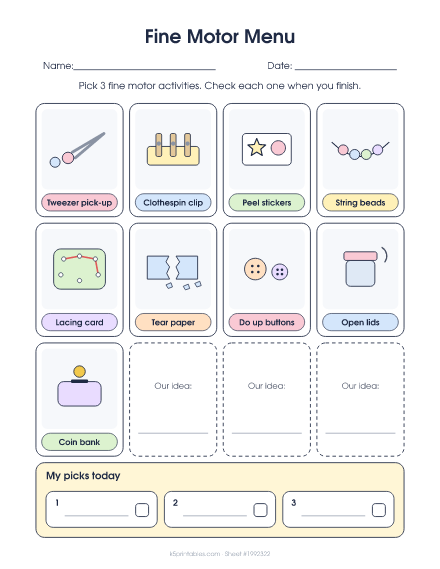 7. Fine Motor MenuA pick-3 choice board with nine fine motor activities like tweezers, clothespins, beads and buttons, three blank tiles for your therapist's ideas, and a My picks today row.
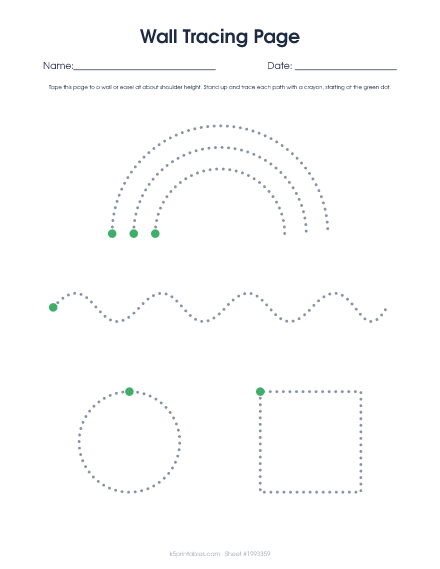 8. Wall Tracing PageA page to tape to a wall or easel, with big rainbow arcs, a long wave, a circle and a square to trace standing up.
Helpful supplies (affiliate links)
Simple supplies that go with these activities. Check with your child's therapist about what's right for your child.
Kids' tweezers and tongs
Pick up pom-poms and beads.
Find it on AmazonLacing cards
Thread laces in and out.
Find it on AmazonPlay dough
Roll, pinch and squish.
Find it on AmazonPegboard
Push small pegs into holes.
Find it on Amazon