Core Card
Strength activities often used by occupational therapists. Do them the way your child's therapist shows you.
Need more than one? Tap + for extra copies (up to 10).
How to do it
- Look at the two pictures for each exercise.
- Follow the numbered steps, slowly.
- Fill in Hold, Repeat and How often with your therapist.
Tip
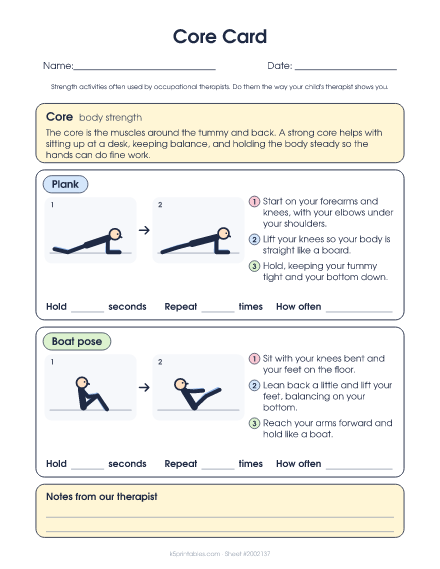
If a plank on the toes is too hard, keep the knees down. A straight body matters more than how it's done.
About this worksheet
Plank and Boat pose, two core exercises often used by occupational therapists, with pictures, steps and blanks for your child's therapist to fill in.
What it is
Body strength and stability means a strong core, good balance and steady shoulders. Together they help a child sit up at a desk, move safely, and hold the body still so the hands can do fine work like writing and cutting. Occupational therapists often build them with active play and simple exercises. These sheets show activities they commonly use, with pictures, steps and blanks for how long and how often. Use them the way your child's therapist suggests.
Watch for
- Holding the breath during holds. Counting out loud keeps the breathing going.
- Sagging hips in a plank or a wheelbarrow walk. A shorter hold with a straight body is better.
- Pushing through tiredness. Wobbling or sagging means it's time for a break.
- Pain, dizziness or headaches. Stop and check with your child's therapist or doctor.
It's free to print, as many copies as you need. See the full body strength and stability guide.
We made these printables to support the work you're doing with your child's occupational therapist. They're meant to go alongside professional care, not replace it. If an activity causes pain, dizziness or headaches, stop and check with your child's therapist or doctor.
More sheets in this set
- See it all
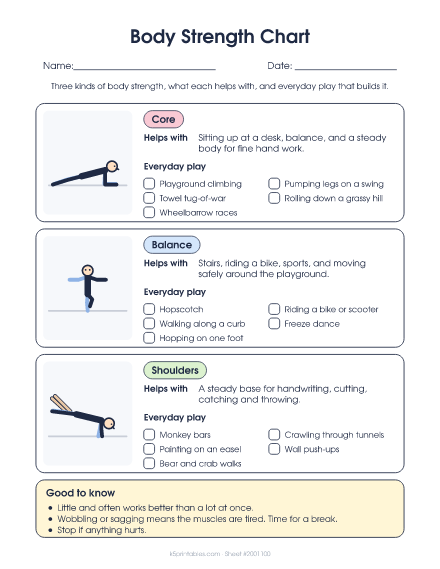 1. Body Strength ChartA chart of three kinds of body strength, core, balance and shoulders, with a picture, what each helps with, and five everyday play ideas to check off.
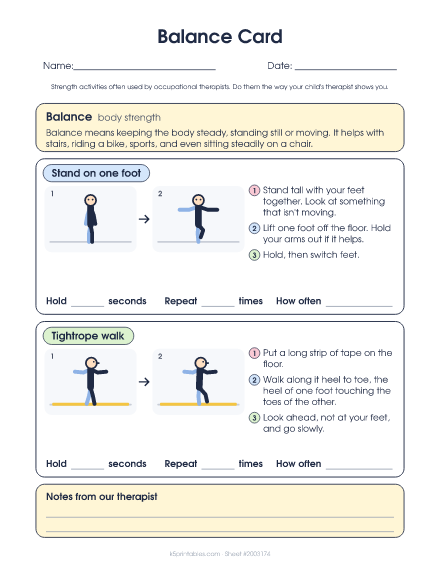 3. Balance CardStand on one foot and Tightrope walk, two balance activities often used by occupational therapists, with pictures, steps and blanks for your child's therapist to fill in.
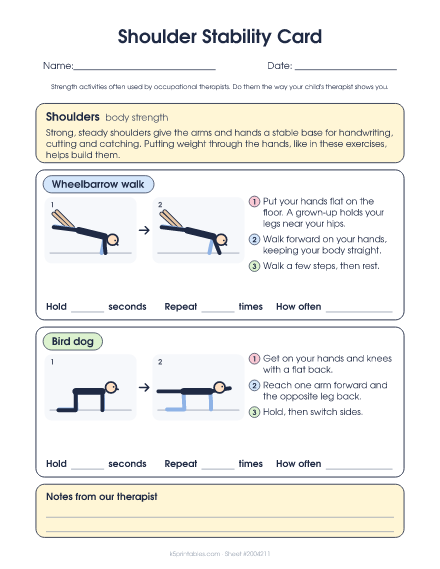 4. Shoulder Stability CardWheelbarrow walk and Bird dog, two shoulder and core exercises often used by occupational therapists, with pictures, steps and blanks for your child's therapist to fill in.
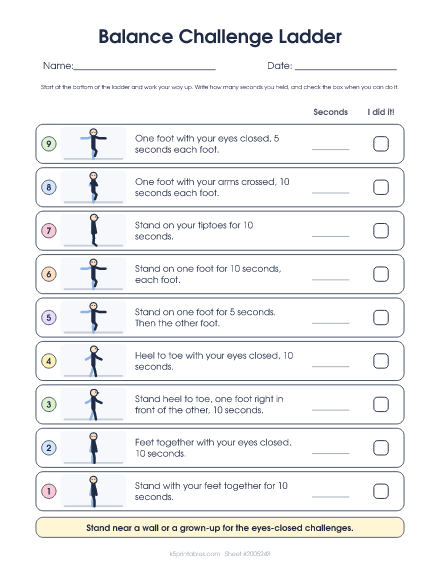 5. Balance Challenge LadderNine balance challenges from easy to hard, like feet together, heel to toe, one foot and tiptoes, each with a picture, a seconds blank and an I did it box.
- See it all
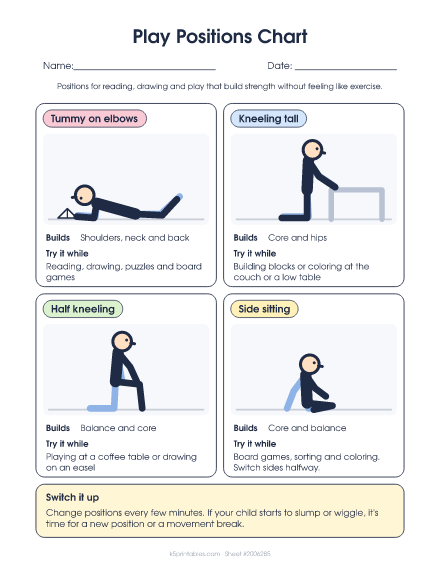 6. Play Positions ChartFour positions for reading, drawing and play, tummy on elbows, kneeling tall, half kneeling and side sitting, with what each builds and when to try it.
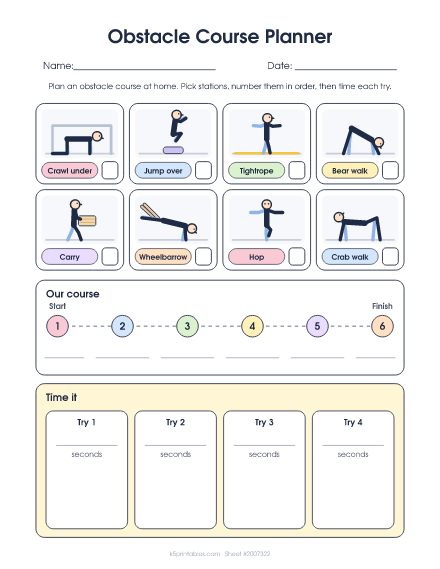 7. Obstacle Course PlannerA page to plan a home obstacle course, with eight picture stations to choose from, a six-step course to fill in, and a Time it box for four tries.
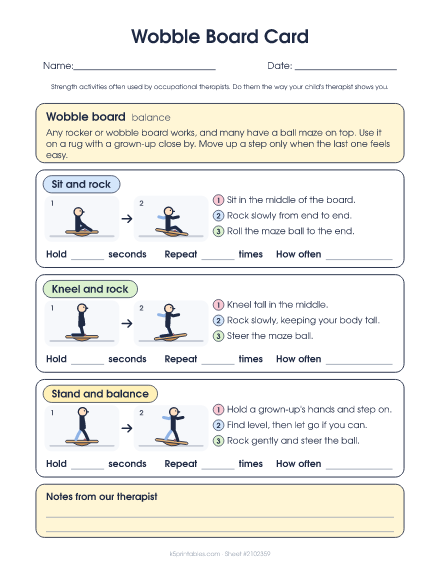 8. Wobble Board CardThree wobble board activities with pictures, from sitting and rocking to standing and steering a ball maze, with blanks for hold, repeat and how often.
Helpful supplies (affiliate links)
Simple supplies that go with these activities. Check with your child's therapist about what's right for your child.
Maze balance board
A wobble board with a ball maze.
See it on AmazonTherapy ball
For rolling, bouncing and core work.
Find it on AmazonBalance stepping stones
Step across for balance games.
Find it on AmazonKids' exercise mat
A soft spot for floor exercises.
Find it on Amazon