How to Multiply and Divide by Powers of 10
Multiplying by 10, 100 or 1,000 moves each digit left. Dividing moves each digit right.
Need more than one? Tap + for extra copies (up to 10).
How to do it
- × 10, 100 or 1,000, each digit moves 1, 2 or 3 places left.
- ÷ 10, 100 or 1,000, each digit moves 1, 2 or 3 places right.
- Fill empty places between the digits and the point with zeros.
Teaching tip
Tacking on a zero works for whole numbers, like 34 × 10 = 340, but not for decimals. Moving the digits works for both. This sheet is aligned with Common Core 5.NBT.A.2.
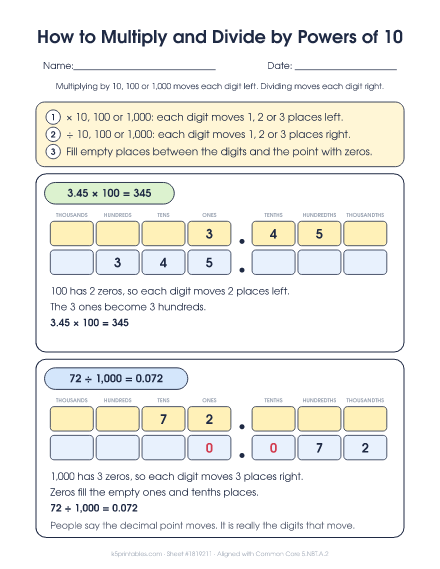
About this chart
3.45 × 100 and 72 ÷ 1,000 shown on place value charts, with each digit moving to its new place and zeros filling the empty places.
What kids practice
In 4th grade, students saw that a digit is worth 10 times as much one place to the left. Now that works for decimals too, and going right, a digit is worth 1/10 as much. Students also learn exponents for powers of 10: 10³ means 10 × 10 × 10, which is 1,000. The exponent tells how many tens are multiplied, and how many zeros the number has. Then they multiply and divide by 10, 100 and 1,000, moving each digit one place for every zero.
Watch for
- Reading 10³ as 10 × 3 = 30.
- Counting a place to the right as 10 times bigger instead of 1/10 as big.
- Losing track of the places when a decimal point is in the way.
- Mixing up 10 times and 100 times when the digits are two places apart.
- Adding a zero to the end of a decimal to multiply by 10, like 3.4 × 10 = 3.40.
It's free to print, as many copies as you need. See the full powers of 10 guide for 5th grade.
More sheets in this set
- See it all
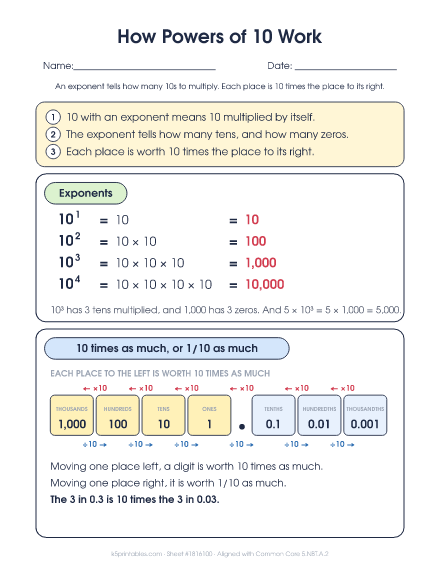 1. How Powers of 10 Work10¹ to 10⁴ written as exponents, as multiplication and as numbers, and a place value chart from thousands to thousandths showing 10 times as much to the left and 1/10 as much to the right.
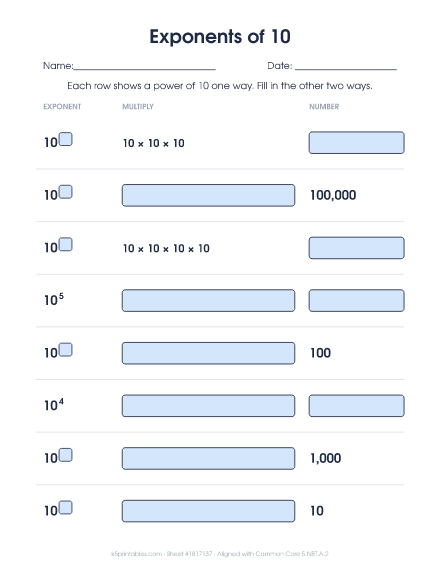 2. Exponents of 10Rows that show a power of 10 one way, to fill in the other two ways. Fewer has 6 rows up to 10³, Standard has 8 up to 10⁵, and More has 10 up to 10⁶ with problems like 4 × 10² and 80,000 = 8 × 10⁴. Includes an answer key.
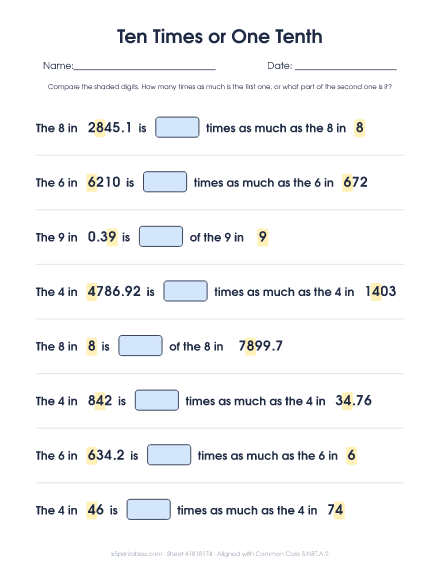 3. Ten Times or One TenthPairs of numbers with the same digit shaded, to compare, like "the 9 in 98.6 is 100 times as much as the 9 in 0.9." Fewer has 6 pairs one place apart, Standard has 8 up to two places apart, and More has 10 down to thousandths. Includes an answer key.
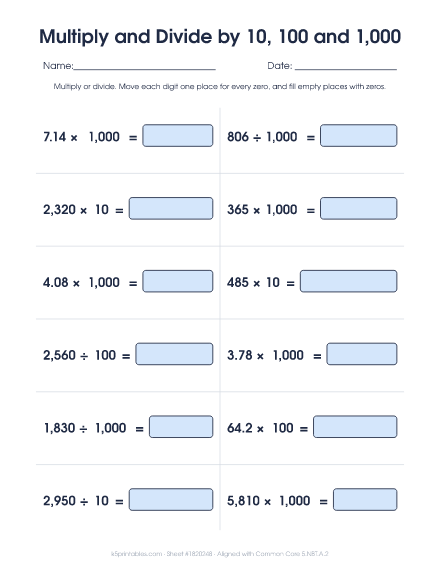 5. Multiply and Divide by 10, 100 and 1,000Multiplication and division by 10, 100 and 1,000, mixed on every sheet. Fewer has 10 problems with whole numbers, Standard has 12 with decimals, and More has 14 written with exponents, like 2.72 × 10³. Includes an answer key.
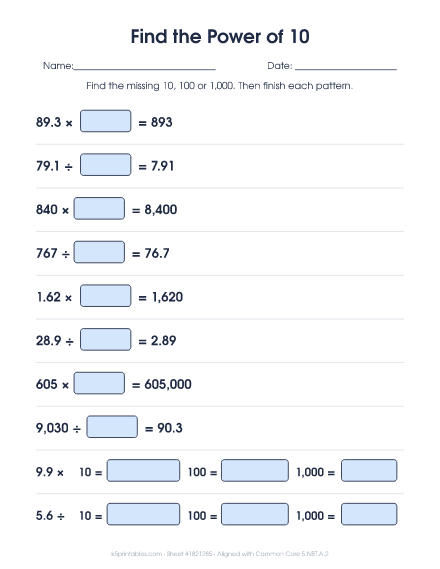 6. Find the Power of 10Missing-number problems like 39.3 ÷ ___ = 0.393, plus × and ÷ patterns to finish. Fewer uses whole numbers, Standard uses decimals, and More asks for the exponent. Includes an answer key.