Line plots worksheets
Aligned with Common Core 5.MD.B.2
Printable fifth-grade line plot worksheets and a how-to teaching page: plotting measurements in halves, fourths and eighths, then multiplying, adding and dividing fractions to find totals and equal shares.
The worksheets
- See it all
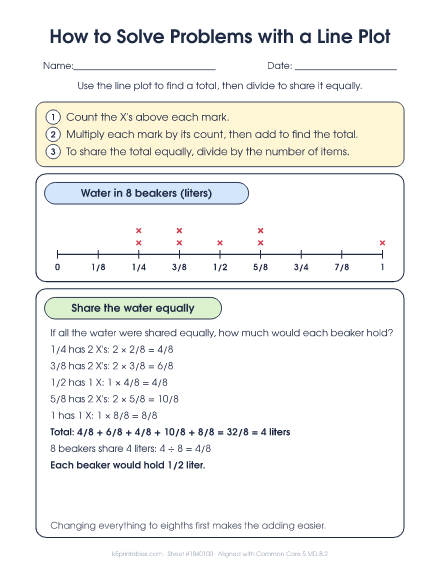
How to Solve Problems with a Line Plot
A line plot of water in 8 beakers, with each mark multiplied by its count, the total of 4 liters, and the equal share of 1/2 liter for each beaker.
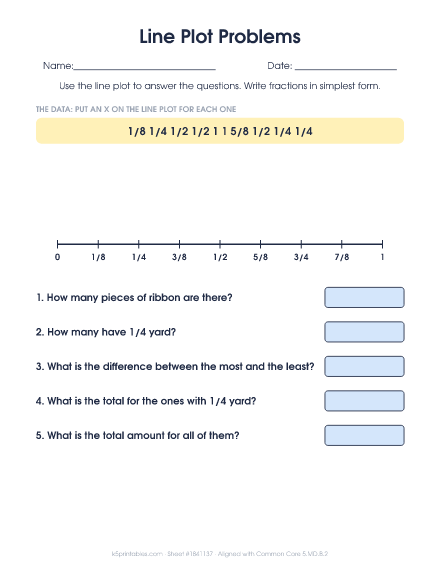
Line Plot Problems
Measurements in eighths, fourths and halves, with questions about counts, differences and totals. Fewer has a line plot already drawn and 4 questions, Standard has a list to plot and 5 questions, and More adds an equal share question. Includes an answer key.
Print the whole packet
One copy of every sheet above, in order. Tap + for more copies (up to 10).
For the parent or teacher
What it is
In 4th grade, students made line plots with fractions and added and subtracted to answer questions. Now they use more of what they know about fractions. They multiply a value by how many times it shows up, add everything to find a total, and divide the total to find what each item would get if it were all shared equally.
What comes next
5th grade reading.
How to teach it
- Teach in order or jump to whatever your student needs. A student may read a line plot easily and still be building the steps for finding a total.
- Change every value to eighths before adding. It keeps the bottom numbers the same.
- Use real measuring, like pouring water into cups, to make "shared equally" make sense.
- Have your student check that the number of X's matches the number of items in the list.
Common mistakes
- Adding the fractions on the number line instead of the values of the X's.
- Missing an item when plotting a list.
- Forgetting to multiply when a value has more than one X.
- Dividing by the wrong number when sharing equally.