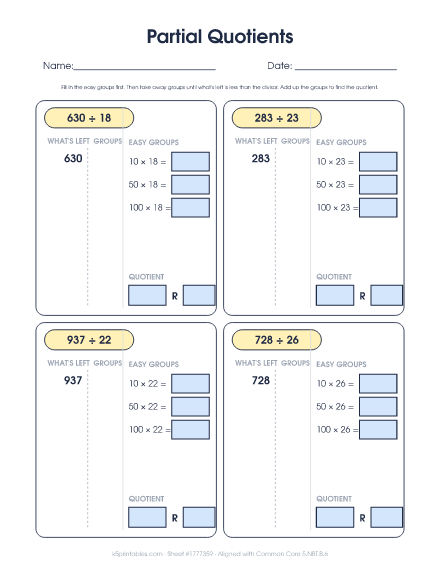
Partial Quotients
Fill in the easy groups first. Then take away groups until what's left is less than the divisor. Add up the groups to find the quotient.
Fresh sheet anytime. Tap New sheet or reload for a different one. Tap + for up to 10.
This is sheet #177724601.
How to do it
- Fill in the easy groups.
- Take away groups until what's left is less than the divisor.
- Add the groups to find the quotient.
Teaching tip
There's more than one right way to take away groups. Any path that ends at the same quotient works. This sheet is aligned with Common Core 5.NBT.B.6.
About this worksheet
Division with space to take away easy groups, a box for 10, 50 and 100 groups of the divisor, and the quotient and remainder. Fewer has 2 and Standard has 4 with 3-digit numbers. More has 4 with 4-digit numbers. The answer key shows one way.
What kids practice
Fifth graders divide numbers up to four digits by two-digit numbers, like 864 ÷ 32. The steps are the same as in 4th grade (divide, multiply, subtract, bring down), but each digit of the answer is now a guess. Rounding the divisor helps, and sometimes the guess is one too big or one too small and needs fixing. Partial quotients, taking away easy groups like 10 or 50 of the divisor, is another way to divide that shows why it works.
Watch for
- Keeping a guess that's too small, so what's left is as big as the divisor or bigger.
- Forgetting to write a 0 in the quotient when the divisor doesn't fit after bringing down a digit.
- Writing the first quotient digit above the wrong place.
- Getting a remainder and not deciding what it means in a word problem.
It's free to print, with Fewer, Standard or More on the page and an answer key. See the full division with two-digit divisors guide for 5th grade.
More sheets in this set
- See it all
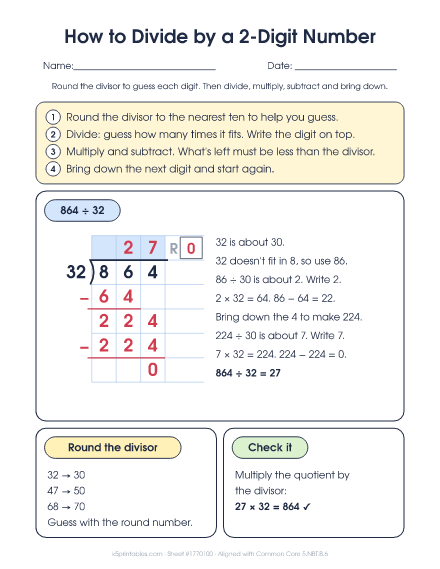 1. How to Divide by a 2-Digit Number864 ÷ 32 worked step by step with long division on graph paper, plus how to round the divisor and check the answer.
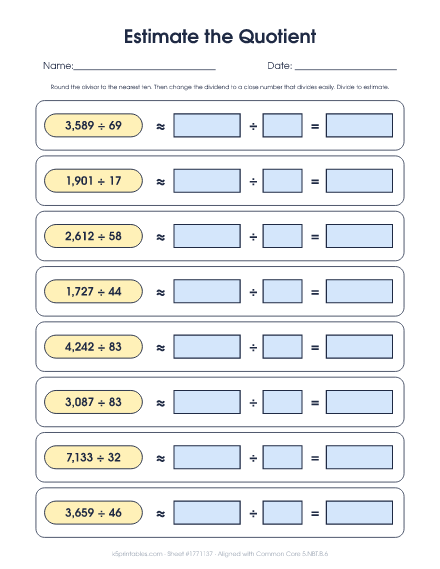 2. Estimate the QuotientDivision problems to estimate with compatible numbers, like 3,456 ÷ 48 ≈ 3,500 ÷ 50 = 70. Fewer has 6 with 3-digit dividends, Standard has 8 and More has 10. The answer key shows one good estimate for each.
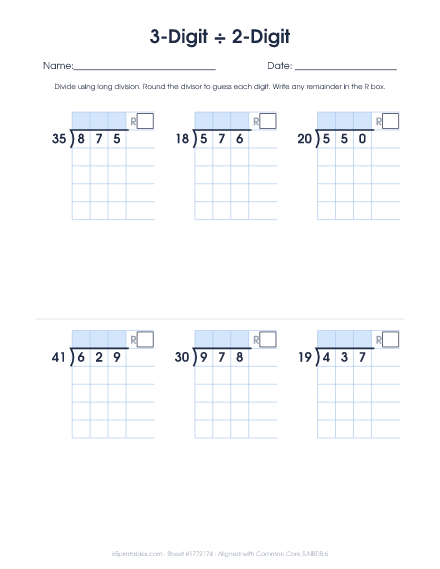 3. 3-Digit ÷ 2-DigitLong division with 3-digit dividends and 2-digit divisors on graph paper. Fewer has 4 with no remainders, Standard has 6 and More has 9 with bigger divisors. The answer key shows every step.
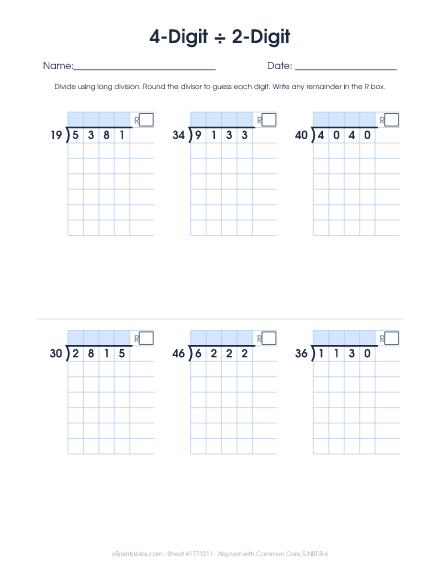 4. 4-Digit ÷ 2-DigitLong division with 4-digit dividends and 2-digit divisors on graph paper. Fewer has 4, Standard has 6 and More has 9. The answer key shows every step.
- See it all
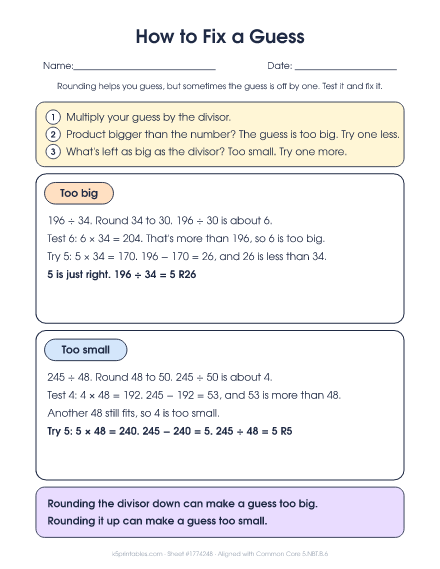 5. How to Fix a GuessTwo worked examples, one guess that's too big and one that's too small, and how rounding the divisor causes each.
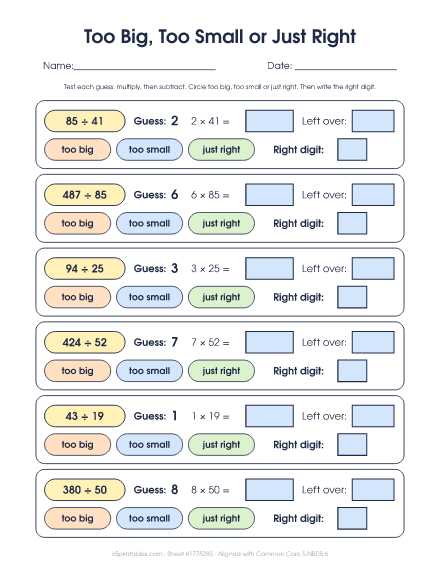 6. Too Big, Too Small or Just RightDivision steps with a guessed digit to test, a mix of guesses that are too big, too small and just right. Fewer has 5, Standard has 6 and More has 8. Includes an answer key.
- See it all
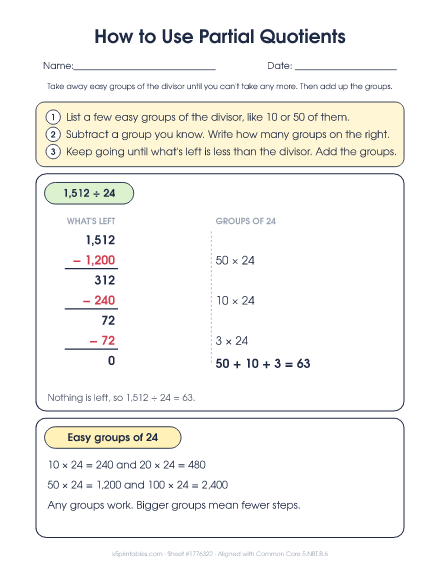 7. How to Use Partial Quotients1,512 ÷ 24 worked by taking away easy groups of 24, with a list of easy groups to use.
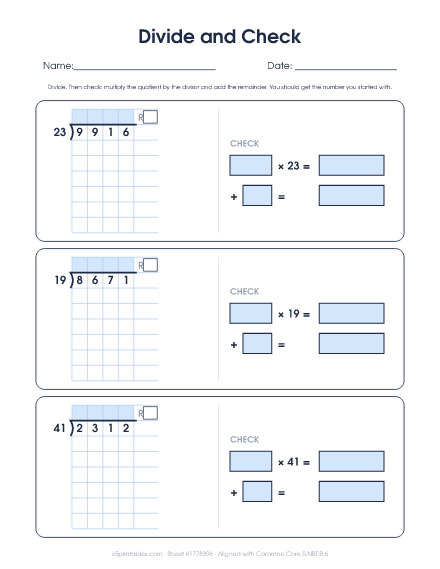 9. Divide and CheckLong division problems with remainders, each with a check by multiplying and adding the remainder. Fewer has 2 with 3-digit numbers, Standard has 3 and More has 4. Includes an answer key.
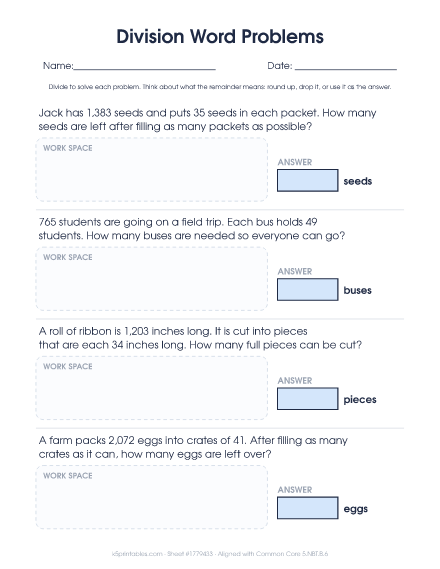 10. Division Word ProblemsWord problems with 2-digit divisors. Some need the remainder rounded up, some drop it and some ask for it. Fewer has 3, Standard has 4 and More has 5. Includes an answer key.