How to Add and Subtract Unlike Fractions
Give the fractions the same bottom number. Then add or subtract the top numbers.
Need more than one? Tap + for extra copies (up to 10).
How to do it
- Find a common bottom number.
- Rewrite each fraction with that bottom number.
- Add or subtract the top numbers. Keep the bottom number.
Teaching tip
Have your student say it in words, "3 sixths plus 2 sixths is 5 sixths." It makes clear why the bottom number stays the same. This sheet is aligned with Common Core 5.NF.A.1.
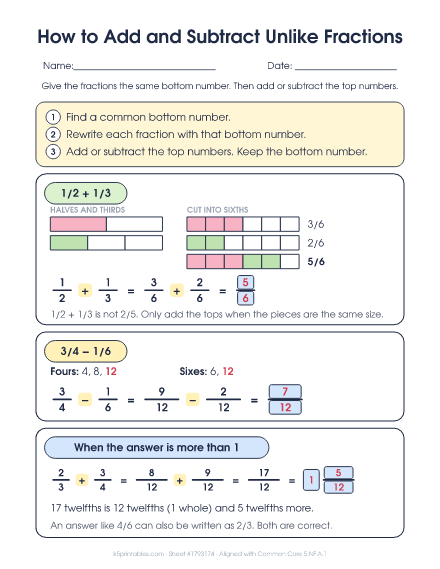
About this chart
1/2 + 1/3 shown with fraction strips cut into sixths, 3/4 − 1/6 worked with twelfths, and a sum over 1 written as a mixed number.
What kids practice
In 4th grade, students added and subtracted fractions with the same bottom number. Now the bottom numbers are different, like 1/2 + 1/3. The pieces are different sizes, so students first find a common denominator by listing multiples, rewrite each fraction with that bottom number, and then add or subtract the top numbers. Answers over 1 are written as mixed numbers. They also add and subtract mixed numbers, estimate with benchmark fractions like 0, 1/2 and 1 to check whether an answer makes sense, and solve word problems.
Watch for
- Adding the top numbers and the bottom numbers, like 1/2 + 1/3 = 2/5.
- Changing the bottom number but forgetting to change the top number.
- Forgetting to trade a whole when the fraction being subtracted is bigger.
- Multiplying the bottom by one number and the top by another.
- Using a common denominator that isn't a multiple of both bottom numbers.
It's free to print, as many copies as you need. See the full adding and subtracting unlike fractions guide for 5th grade.
More sheets in this set
- See it all
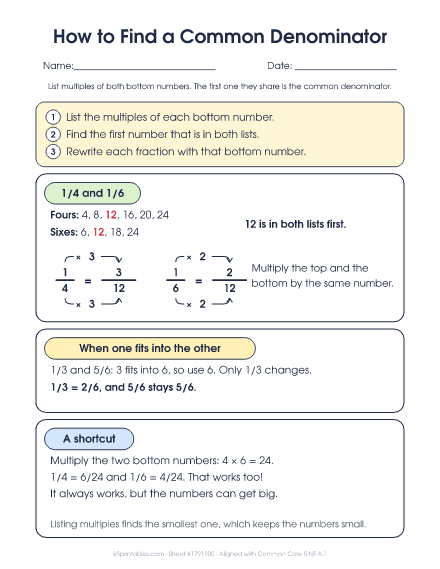 1. How to Find a Common Denominator1/4 and 1/6 rewritten as twelfths by listing multiples, a pair where one bottom number fits into the other, and the shortcut of multiplying the bottom numbers.
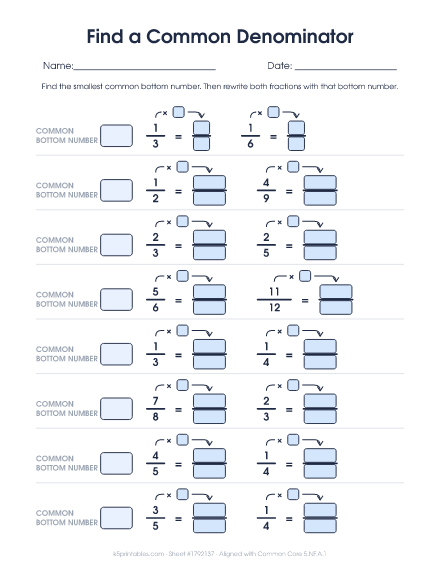 2. Find a Common DenominatorPairs of fractions to rewrite with their smallest common denominator. Fewer has 6 pairs where one bottom number fits into the other, Standard has 8 pairs where both fractions change, and More has 10 harder pairs without the multiplier arrows. Includes an answer key.
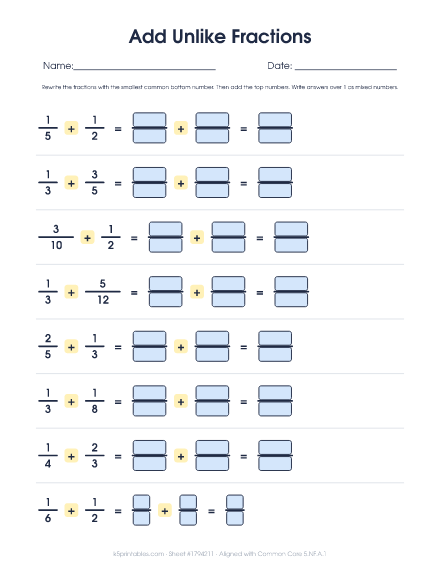 4. Add Unlike FractionsFraction addition problems with different bottom numbers, each with spaces to rewrite the fractions before adding. Fewer has 6 problems with the common bottom number printed, Standard has 8, and More has 10 with some sums over 1. The answer key shows simplified answers too.
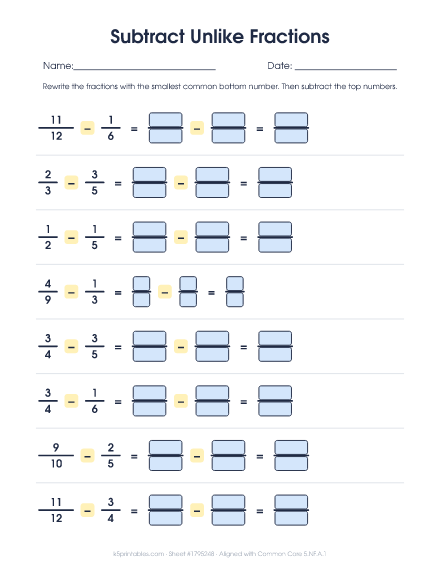 5. Subtract Unlike FractionsFraction subtraction problems with different bottom numbers, each with spaces to rewrite the fractions before subtracting. Fewer has 6 problems with the common bottom number printed, Standard has 8, and More has 10 with bottom numbers up to 36. The answer key shows simplified answers too.
- See it all
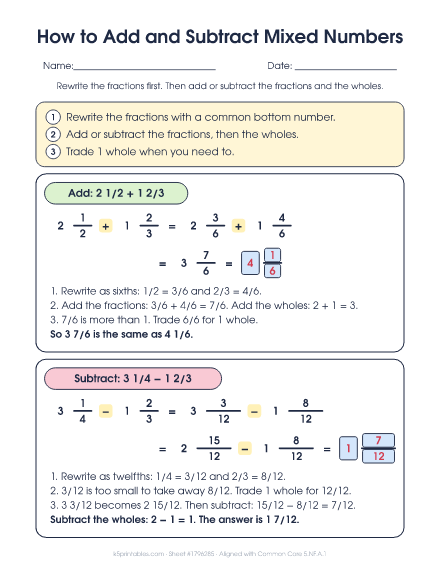 6. How to Add and Subtract Mixed Numbers2 1/2 + 1 2/3 worked with sixths, trading 6/6 for a whole, and 3 1/4 − 1 2/3 worked with twelfths, trading a whole for 12/12.
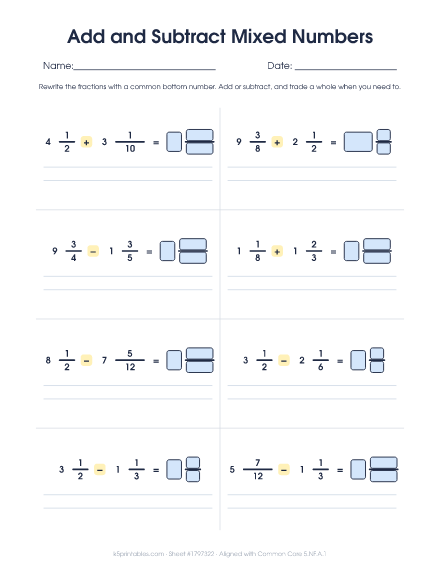 7. Add and Subtract Mixed NumbersMixed number addition and subtraction with different bottom numbers and lines to work on. Fewer has 6 problems where one bottom number fits into the other, Standard has 8, and More has 10 where many need a trade. None of the Fewer or Standard problems need a trade. The answer key shows simplified answers too.
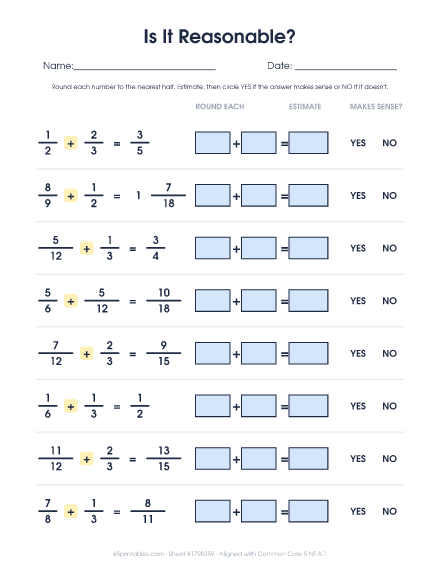 8. Is It Reasonable?Fraction addition and subtraction problems with an answer given. Students round each fraction to 0, 1/2 or 1, estimate, and circle whether the answer makes sense. Wrong answers come from adding the tops and the bottoms. Fewer has 6, Standard has 8, and More has 10 with mixed numbers. Includes an answer key.
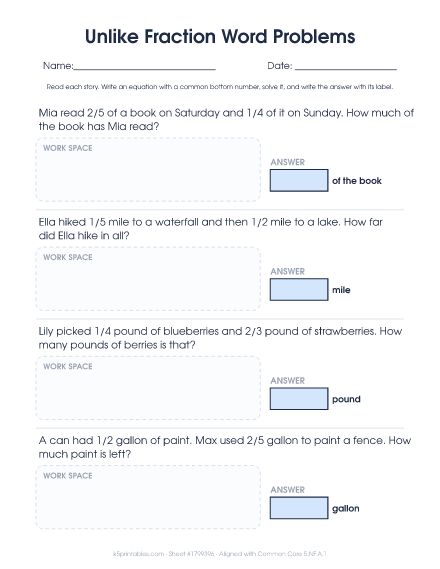 9. Unlike Fraction Word ProblemsWord problems about recipes, ribbon, hiking, paint and gardens, with a work space for each. Fewer has 3 problems, Standard has 4, and More has 5 with mixed numbers. Includes an answer key.