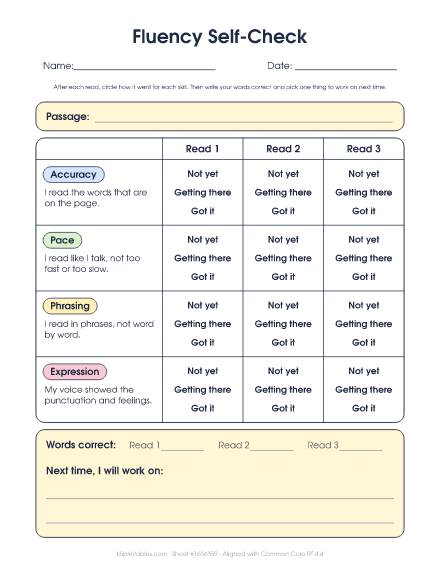
Fluency Self-Check
After each read, circle how it went for each skill. Then write your words correct and pick one thing to work on next time.
Need more than one? Tap + for extra copies (up to 10).
How to do it
- Write the passage title.
- After each read, circle how it went for each skill.
- Write your words correct.
- Pick one thing to work on next time.
Teaching tip
Use it with the timed passage, so your student can see what got better with each read. This sheet is aligned with Common Core RF.4.4.
About this worksheet
A self-check for 3 reads of the same passage: accuracy, pace, phrasing and expression, each marked not yet, getting there or got it, plus words correct and a next-time goal.
What kids practice
Fluency is reading accurately, at a good pace and with expression, the way people talk. Fourth graders read longer passages, so fluent reading leaves more of their attention for understanding what they read. Timed reads show progress, reading in phrases makes reading smoother, and checking that each sentence makes sense helps a reader catch and fix their own mistakes.
Watch for
- Racing through the words and skipping punctuation.
- Reading word by word in a flat voice.
- Reading a word that looks similar and moving on, even when the sentence doesn't make sense.
- Focusing only on speed and not on what the passage says.
It's free to print, as many copies as you need. See the full fluency passages guide for 4th grade.
More sheets in this set
- See it all
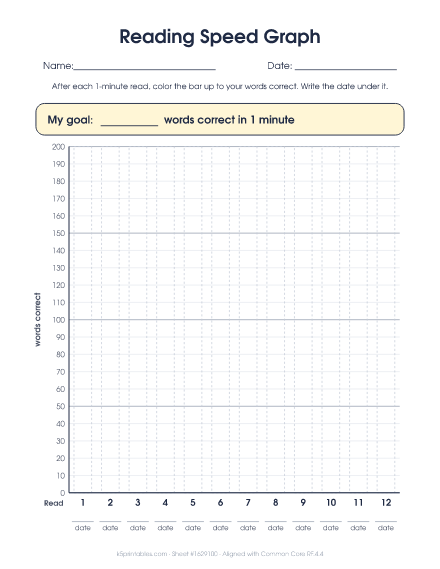 1. Reading Speed GraphA bar graph for 12 timed reads, up to 200 words correct a minute, with a space to write a goal.
- See it all
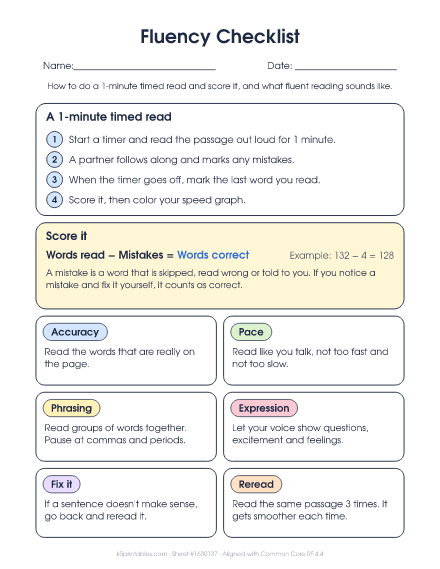 2. Fluency ChecklistHow to do and score a 1-minute timed read, what counts as a mistake, and six tips: accuracy, pace, phrasing, expression, fixing mistakes and rereading.
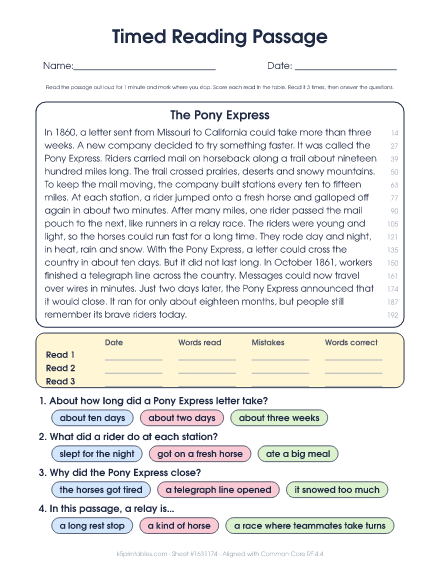 3. Timed Reading PassageTen fourth-grade passages, half stories and half nonfiction, each about 180 to 200 words with a running word count, a score table for 3 reads and four questions. The last question asks what a word means in the passage. Includes an answer key.
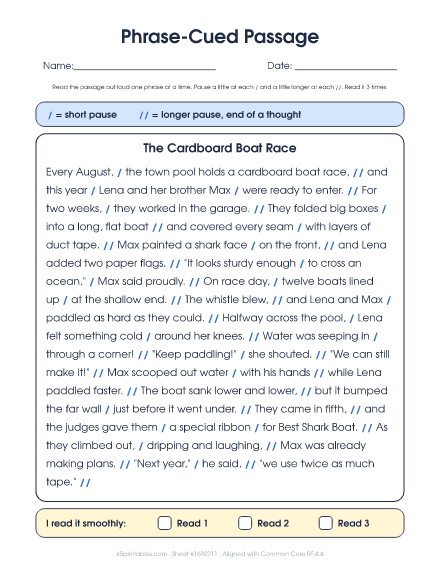 4. Phrase-Cued PassageThe same ten passages with slashes marking where to pause, to practice reading in smooth phrases instead of word by word.
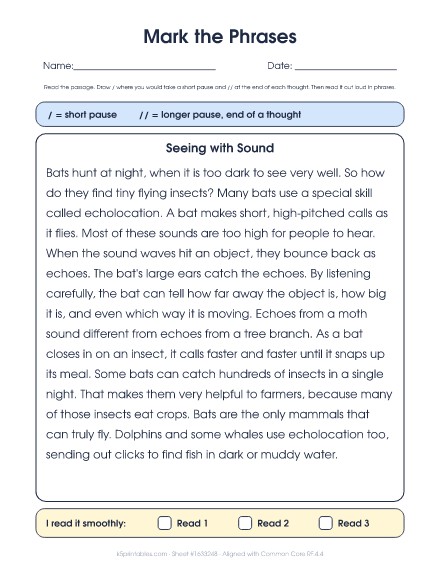 5. Mark the PhrasesOne of the ten passages with no marks, for your student to add their own pauses. The answer key shows one good way to mark it; other places can work too.
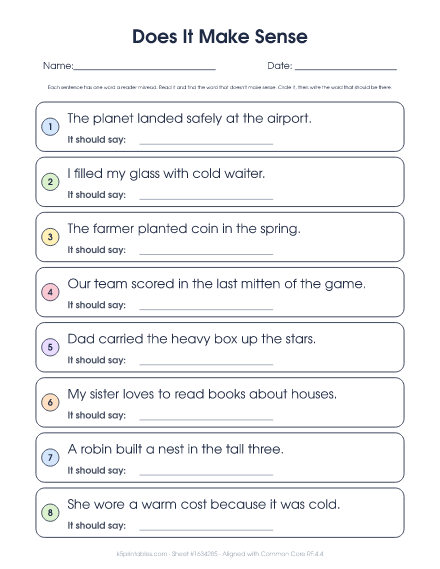 6. Does It Make SenseSentences with one look-alike word a reader might say by mistake, like "Please be quite in the library." Fewer, Standard or More give 6, 8 or 10 sentences. Includes an answer key.
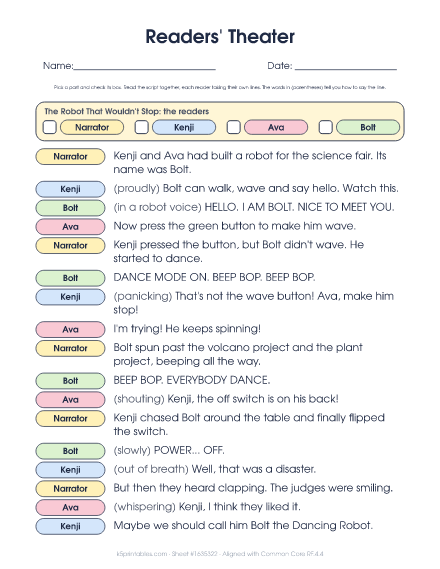 7. Readers' TheaterSix short scripts for 4 readers, with a narrator and stage directions like (whispering) and (panicking) to practice reading with expression.