How to Use the Standard Algorithm
Multiply right to left, carry when you need to, and estimate to check.
Need more than one? Tap + for extra copies (up to 10).
How to do it
- Multiply by the ones digit, right to left, carrying the tens.
- For a 2-digit number, write a 0 and multiply by the tens digit.
- Add the rows and estimate to check.
Teaching tip
Say each step out loud, including what you carry. This sheet is aligned with Common Core 4.NBT.B.5.
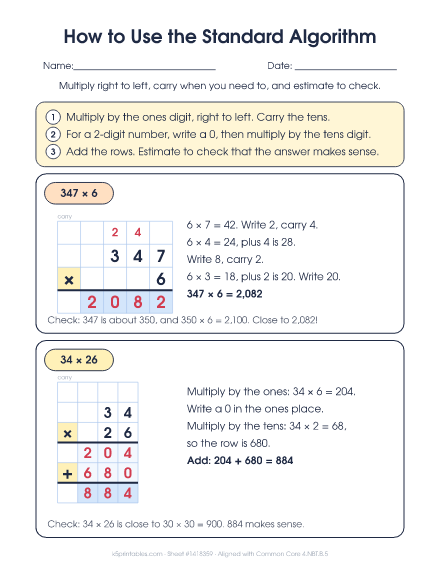
About this chart
347 × 6 with carrying and 34 × 26 on graph paper, each with an estimate to check.
What kids practice
Fourth graders multiply numbers up to four digits by a one-digit number, and two-digit numbers by two-digit numbers, like 34 × 26. They learn to break numbers into place value parts with area models and partial products, then use the standard algorithm. Estimating first helps them check that an answer makes sense.
Watch for
- Forgetting the 0 in the ones place when multiplying by the tens digit.
- Forgetting to add a carried digit, or adding it before multiplying.
- Lining up partial products in the wrong columns.
- Multiplying only the ones by the ones and the tens by the tens, like 34 × 26 = 6 hundreds and 24.
It's free to print, as many copies as you need. See the full multi-digit multiplication guide for 4th grade.
More sheets in this set
- See it all
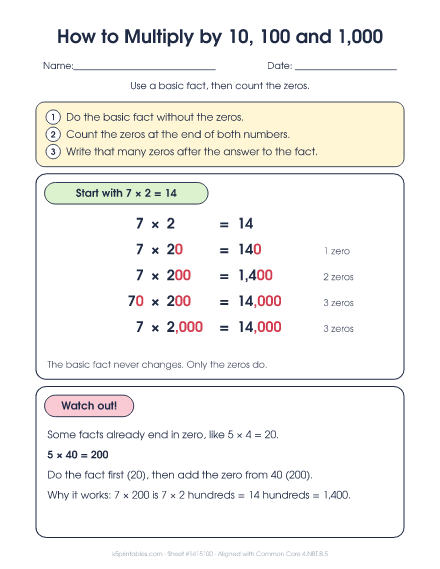 1. How to Multiply by 10, 100 and 1,000Worked rows from 7 × 2 = 14 up to 70 × 200 = 14,000 with the zeros in red, plus facts like 5 × 40 that already end in zero.
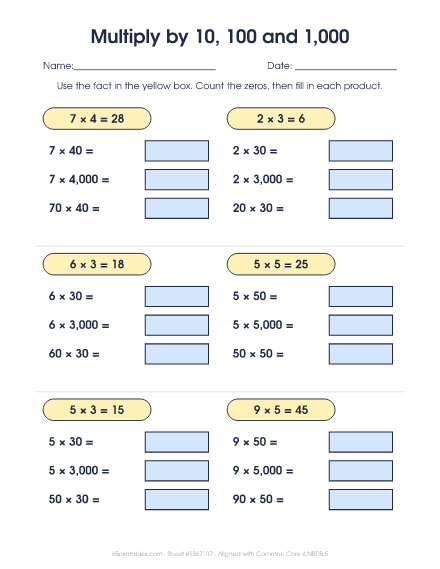 2. Multiply by 10, 100 and 1,000Basic facts like 7 × 2 = 14 with products like 7 × 200 and 70 × 20 to fill in. More includes problems like 60 × 400.
- See it all
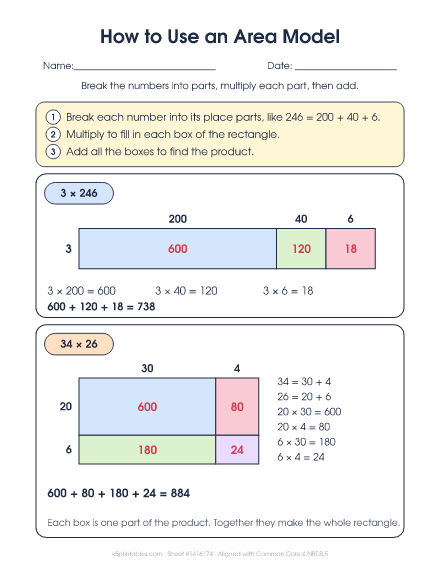 3. How to Use an Area ModelArea models for 3 × 246 and 34 × 26, with every box filled in and added up.
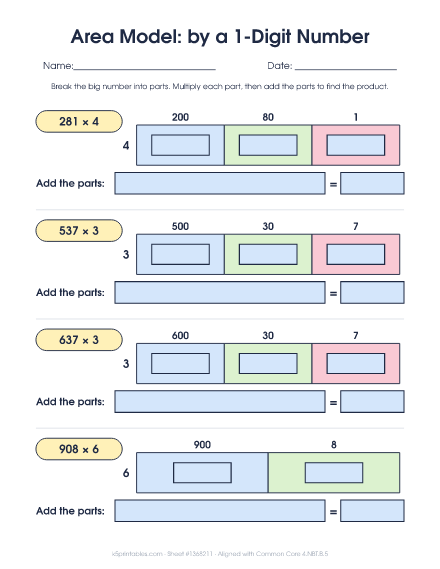 4. Area Model: by a 1-Digit NumberArea models for 2-, 3- and 4-digit numbers times a one-digit number, with each part of the rectangle to fill in.
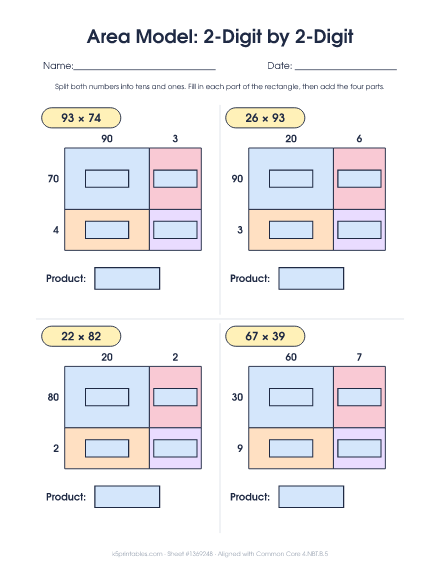 5. Area Model: 2-Digit by 2-DigitTwo-digit by two-digit area models, like 66 × 15, with four parts to fill in and the product. Fewer uses smaller numbers.
- See it all
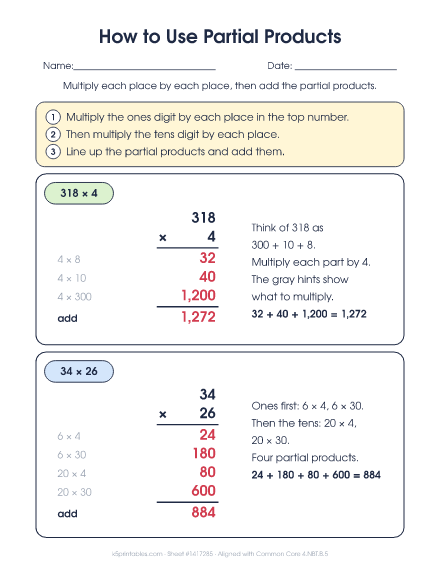 6. How to Use Partial Products318 × 4 and 34 × 26 worked out with partial products, with a gray hint beside each line.
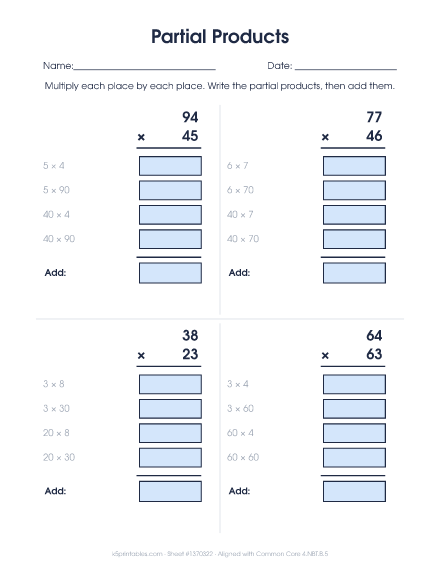 7. Partial ProductsVertical problems with a box for each partial product and a gray hint like 5 × 60. Fewer is 3-digit by 1-digit, Standard 2-digit by 2-digit, and More mixes 4-digit by 1-digit with 2-digit by 2-digit.
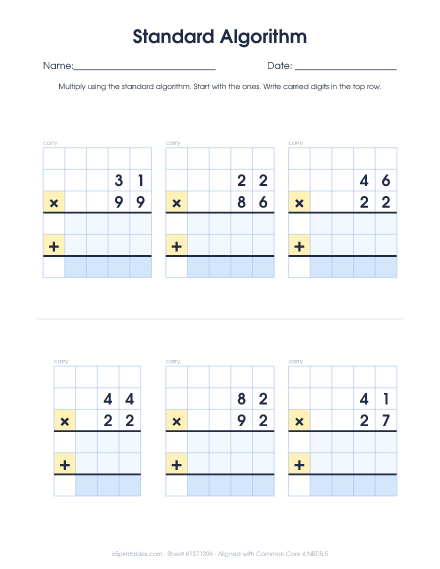 9. Standard AlgorithmMultiplication on graph paper so the digits line up. Fewer is 3-digit by 1-digit, Standard 2-digit by 2-digit, and More mixes 4-digit by 1-digit with 2-digit by 2-digit.
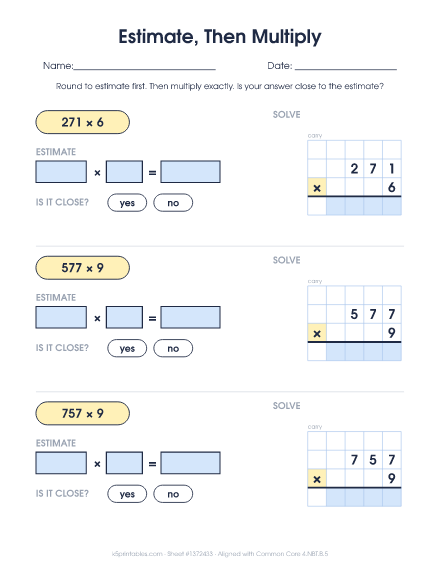 10. Estimate, Then MultiplyRound to estimate each product, then solve it exactly on graph paper and decide if the answer is close.
- See it all
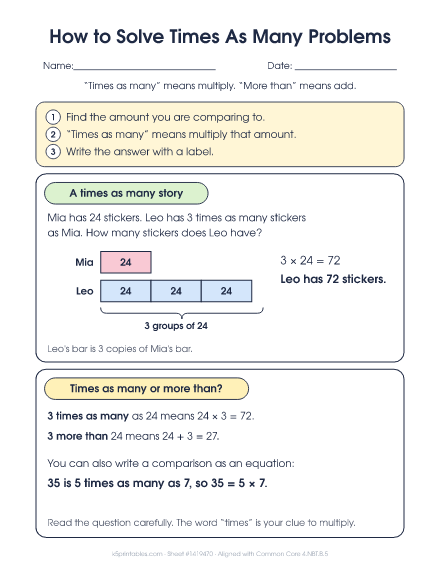 11. How to Solve Times As Many ProblemsA sticker story with a bar model for 3 times as many as 24, plus how times as many is different from more than.
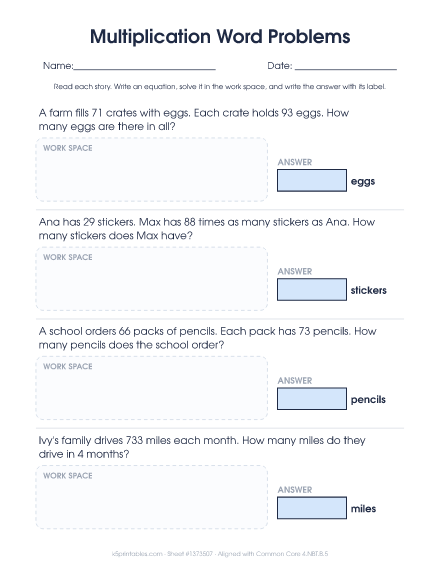 12. Multiplication Word ProblemsStory problems about seats, pages, crates and more, including "times as many" comparisons, with a work space and an answer box.