Lines and symmetry worksheets
Aligned with Common Core 4.G.A.1
Printable fourth-grade geometry worksheets and how-to teaching pages: points, lines, segments and rays, parallel and perpendicular lines, sorting shapes by sides and angles, lines of symmetry, and finishing symmetric pictures.
The worksheets
- See it all
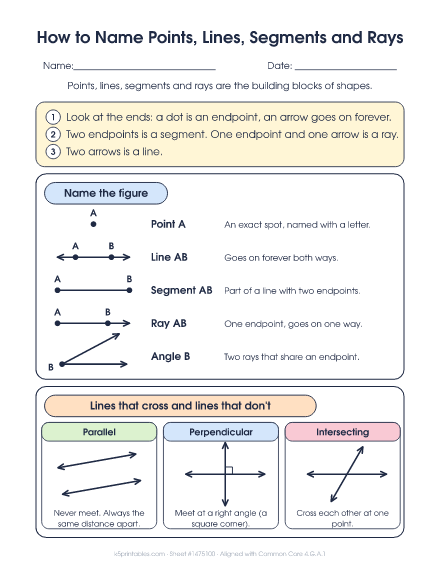
How to Name Points, Lines, Segments and Rays
Points, lines, segments, rays and angles with their names, plus parallel, perpendicular and intersecting lines.
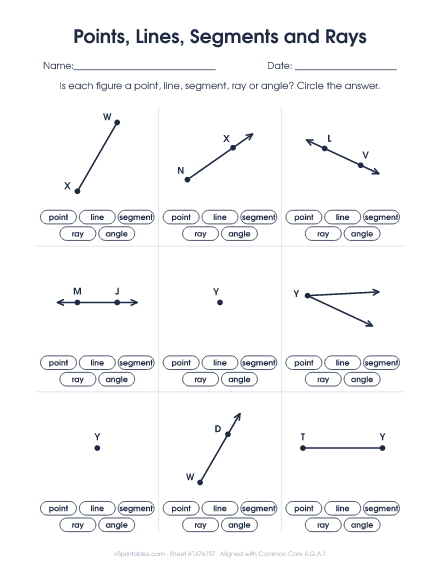
Points, Lines, Segments and Rays
Figures to name as a point, line, segment, ray or angle. Fewer uses lines, segments and rays only.
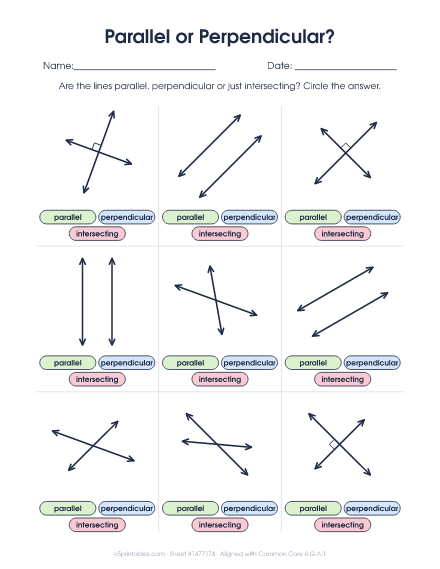
Parallel or Perpendicular?
Pairs of lines to sort as parallel, perpendicular or intersecting, turned in different directions.
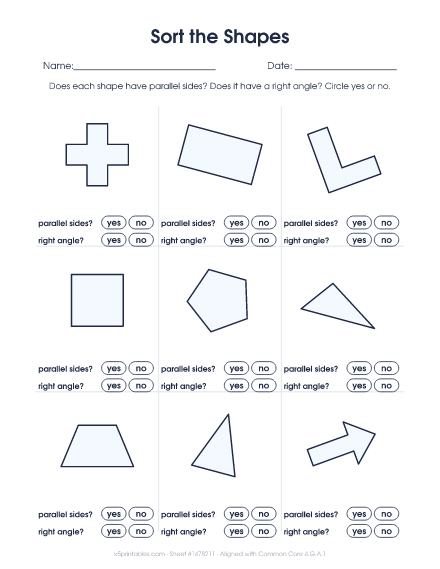
Sort the Shapes
Shapes to check for parallel sides and right angles, including triangles, quadrilaterals and more. Standard and More turn the shapes.
- See it all
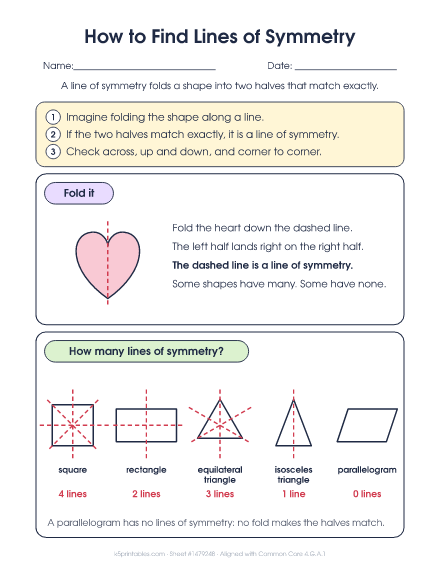
How to Find Lines of Symmetry
A heart folded on its line of symmetry, and how many lines a square, rectangle, triangles and a parallelogram have.
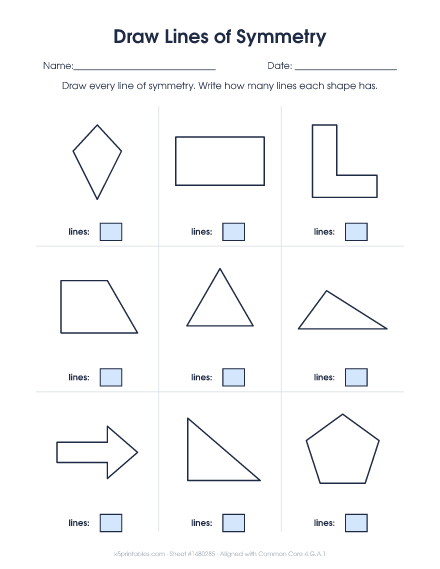
Draw Lines of Symmetry
Shapes to draw every line of symmetry on and count them. Some have none.
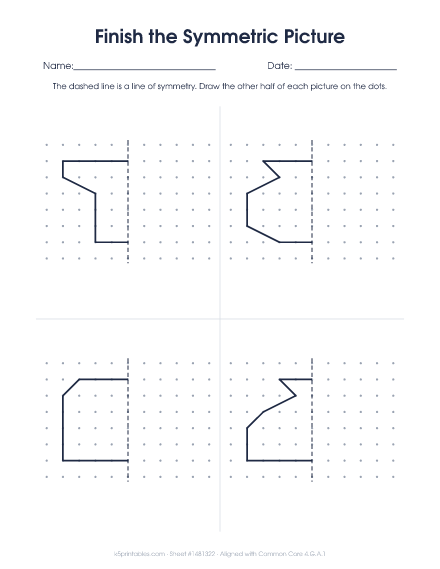
Finish the Symmetric Picture
Half pictures on dot paper to finish across a line of symmetry. More has more pictures and some sideways lines.
Print the whole packet
One copy of every sheet above, in order. Tap + for more copies (up to 10).
For the parent or teacher
What it is
Fourth graders learn the names of the building blocks of geometry: points, lines, line segments, rays and angles. They find parallel lines, which never meet, and perpendicular lines, which meet at a right angle. They sort shapes by whether they have parallel sides or right angles, and find lines of symmetry, where a shape folds into two matching halves.
What comes next
5th grade math.
How to teach it
- Look at the ends of a figure. Dots are endpoints and arrows mean it goes on forever.
- Find parallel and perpendicular lines around the house, like on windows and floor tiles.
- Cut out shapes and fold them to test for lines of symmetry.
- Use a mirror on the line of symmetry to see the other half.
- Check every direction for symmetry, including corner to corner.
Common mistakes
- Mixing up a ray and a segment, or a line and a segment.
- Calling any crossing lines perpendicular, even without a right angle.
- Drawing a diagonal line of symmetry on a rectangle that is not a square.
- Missing some lines of symmetry on shapes with many, like a square.