How to Tell Prime from Composite
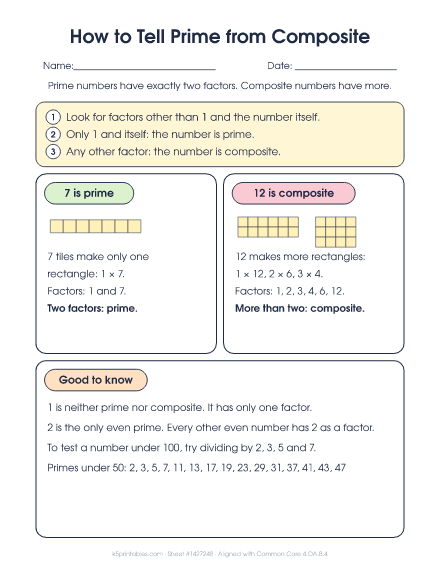
Prime numbers have exactly two factors. Composite numbers have more.
Need more than one? Tap + for extra copies (up to 10).
How to do it
- Look for factors other than 1 and the number.
- Only 1 and itself means prime.
- Any other factor means composite.
Teaching tip
Ask, "Can you make more than one rectangle with this many tiles?" This sheet is aligned with Common Core 4.OA.B.4.
About this chart
7 and 12 shown with tile rectangles, plus why 1 is neither prime nor composite, why 2 is the only even prime, and the primes under 50.
What kids practice
Factors are numbers that multiply to make another number. The factors of 24 are 1, 2, 3, 4, 6, 8, 12 and 24. Multiples are what you get when you skip count, like 6, 12, 18 and 24. A prime number has exactly two factors, 1 and itself, and a composite number has more than two. Fourth graders find factor pairs for numbers up to 100 and sort them as prime or composite.
Watch for
- Missing a factor pair, especially in the middle, like 4 × 6 for 24.
- Calling 1 a prime number. It has only one factor, so it is neither prime nor composite.
- Thinking every odd number is prime, like 9, 15 or 21.
- Mixing up the words factor and multiple.
It's free to print, as many copies as you need. See the full factors and multiples guide for 4th grade.
More sheets in this set
- See it all
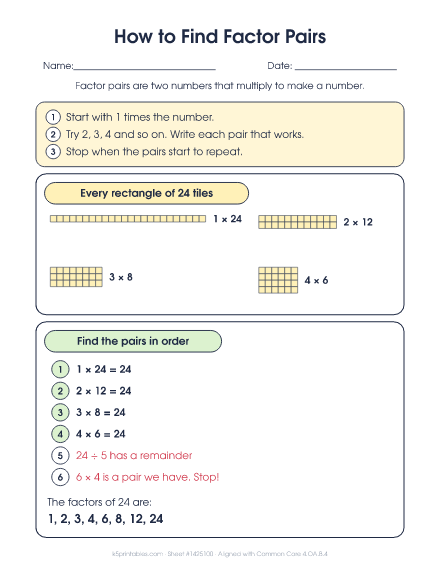 1. How to Find Factor PairsEvery rectangle that 24 tiles can make, and finding the factor pairs of 24 in order until they repeat.
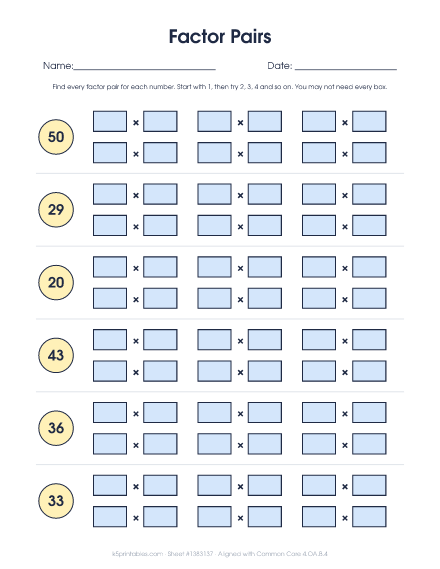 2. Factor PairsNumbers with lots of factors to find every factor pair for, plus an occasional prime. Fewer uses numbers to 36, Standard to 64 and More to 100.
- See it all
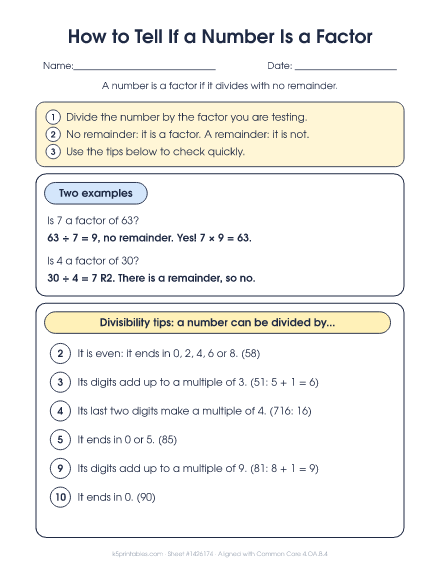 3. How to Tell If a Number Is a FactorWorked examples like "Is 7 a factor of 63?" and divisibility tips for 2, 3, 4, 5, 9 and 10, each with an example.
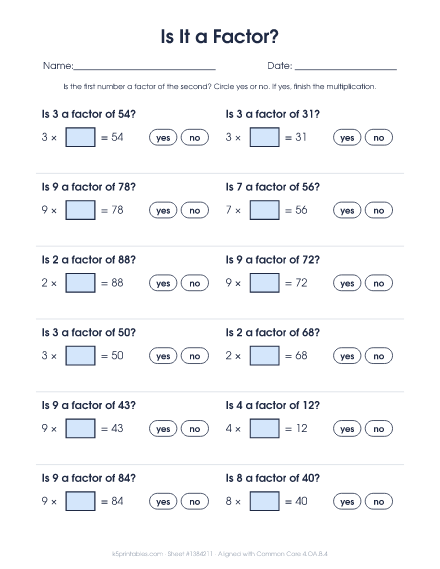 4. Is It a Factor?Questions like "Is 7 a factor of 63?" with a multiplication to finish when the answer is yes.
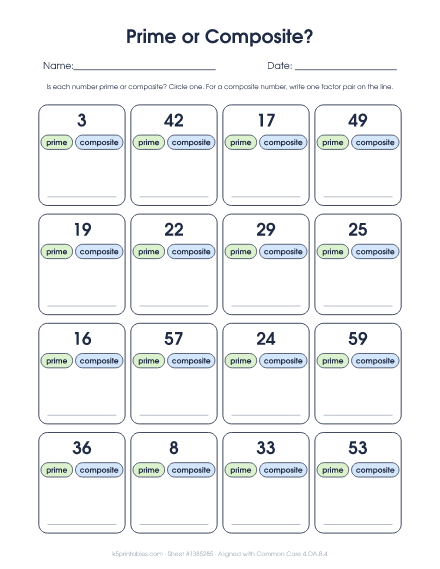 6. Prime or Composite?Cards with numbers to sort as prime or composite, with a line to write a factor pair. Fewer uses numbers to 30, Standard to 60 and More to 100.
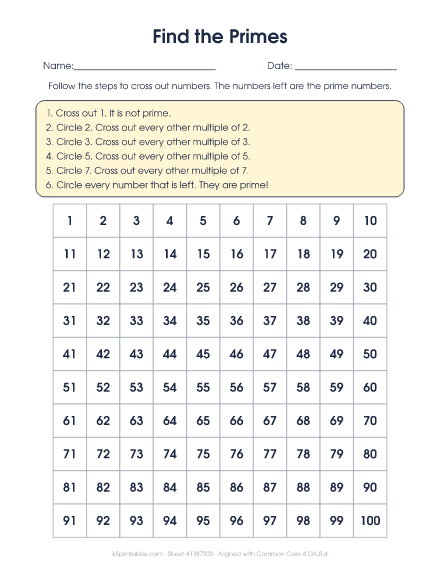 7. Find the PrimesA hundred chart to cross out multiples of 2, 3, 5 and 7 until only the prime numbers are left. Fewer uses 1 to 50.
- See it all
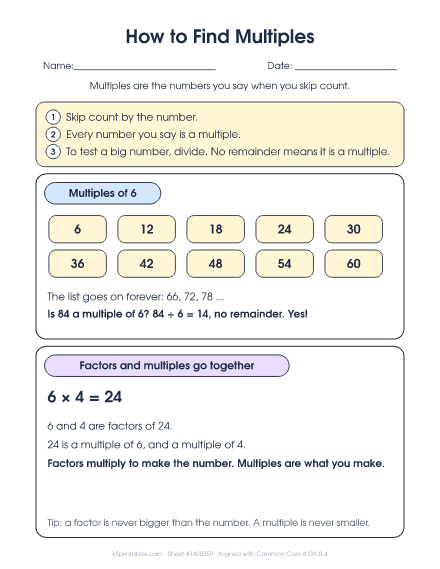 8. How to Find MultiplesThe first ten multiples of 6, testing whether 84 is a multiple, and how factors and multiples go together in 6 × 4 = 24.
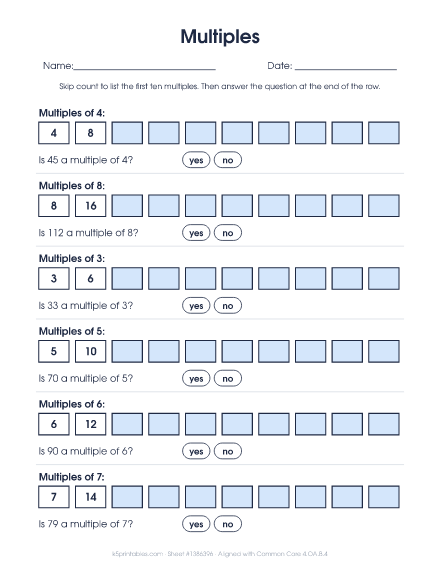 9. MultiplesRows to list the first ten multiples of a number, then decide if a bigger number is also a multiple. More uses numbers up to 12.
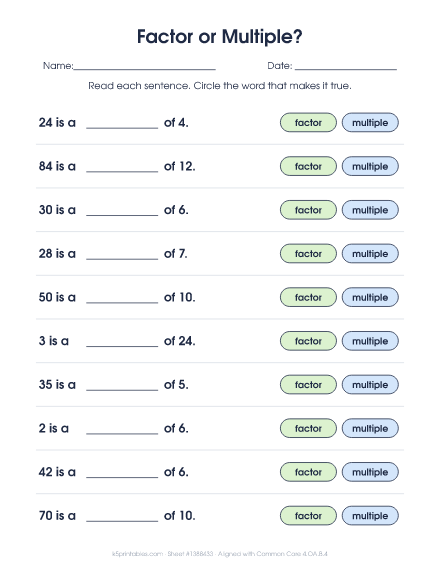 10. Factor or Multiple?Sentences like "6 is a ___ of 54" to finish with factor or multiple. More adds neither.