Equivalent and comparing fractions worksheets
Aligned with Common Core 4.NF.A.1
Printable fourth-grade equivalent fraction worksheets and how-to teaching pages: multiply or divide to make equal fractions, split the pieces, compare to 1/2, compare fractions with different bottom numbers, put fractions in order, and comparing word problems.
The worksheets
- See it all
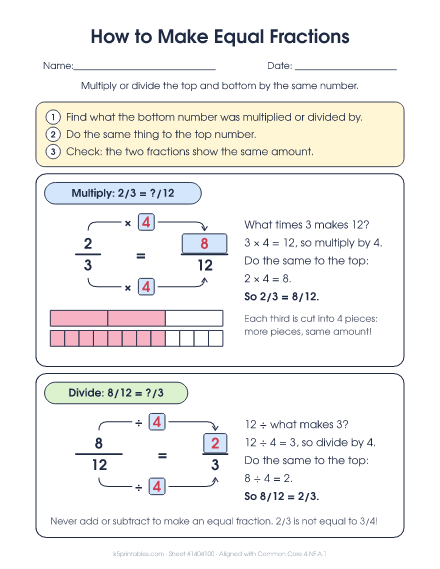
How to Make Equal Fractions
Step-by-step worked examples of 2/3 = 8/12 and 8/12 = 2/3 on graph paper, with fraction strips that show why the amount stays the same.
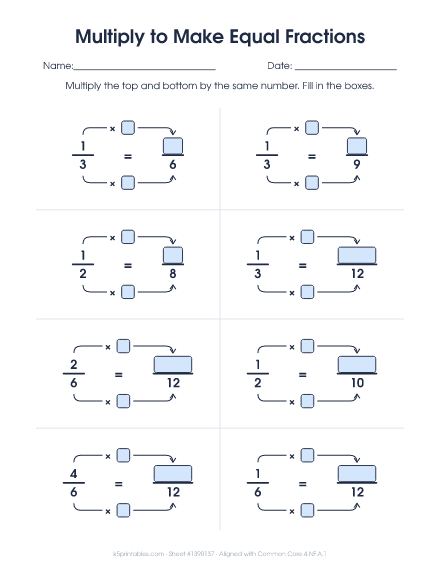
Multiply to Make Equal Fractions
Problems like 2/3 = ?/12 on graph paper, with arrow boxes to show the multiplier. Standard adds fifths and tenths, and More adds tenths to hundredths and a missing bottom number.
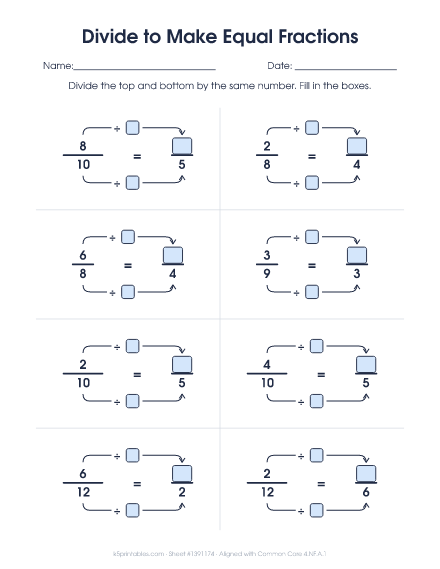
Divide to Make Equal Fractions
Problems like 8/12 = ?/3 on graph paper, with arrow boxes to show the divisor. More adds hundredths to tenths and a missing bottom number.
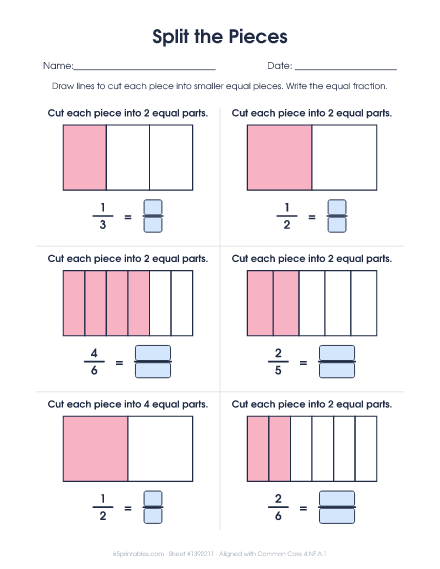
Split the Pieces
Shaded rectangles to cut into smaller pieces, showing why multiplying the top and bottom makes an equal fraction.
- See it all
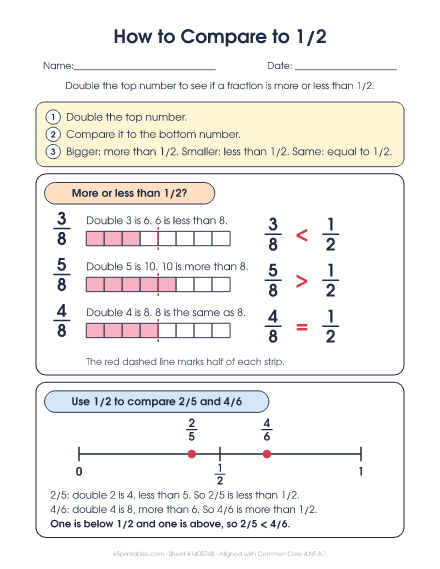
How to Compare to 1/2
How to tell if a fraction is more or less than 1/2 by doubling the top number, with strips, and how to use 1/2 to compare two fractions on a number line.
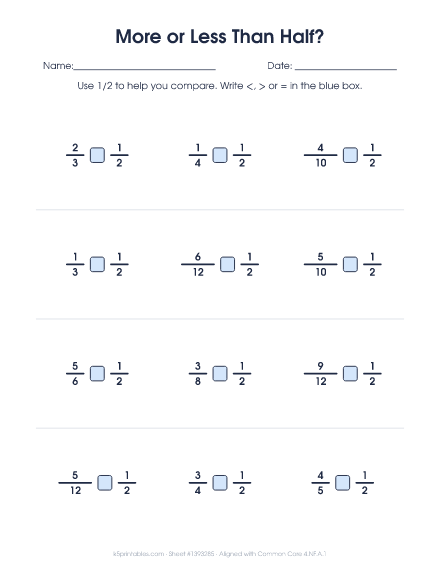
More or Less Than Half?
Fractions to compare to 1/2. Fewer has fraction strips with a line at the half. More compares two fractions using 1/2 as a guide.
- See it all
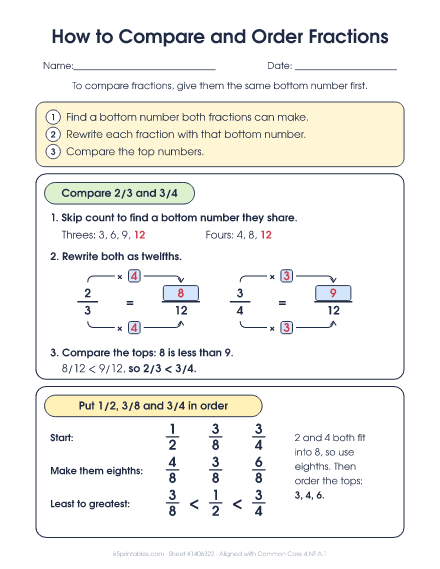
How to Compare and Order Fractions
A worked example comparing 2/3 and 3/4 by rewriting both as twelfths, and putting 1/2, 3/8 and 3/4 in order by making them eighths.
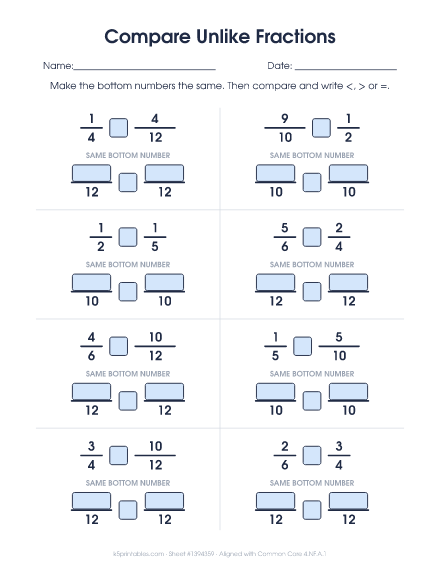
Compare Unlike Fractions
Pairs of fractions with different bottom numbers, with a second line to rewrite them with the same bottom number. More leaves the new bottom number for the child to find.
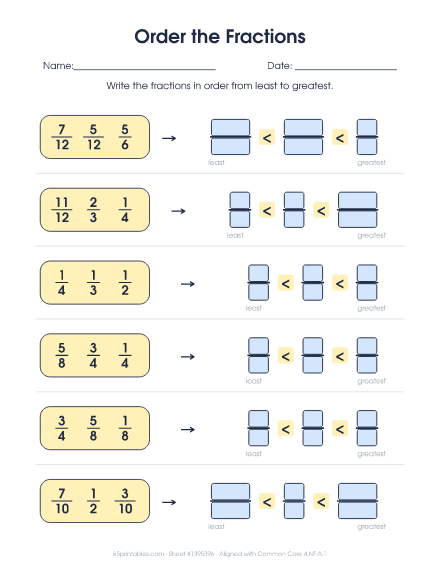
Order the Fractions
Three fractions with different bottom numbers to put in order from least to greatest. More has four fractions.
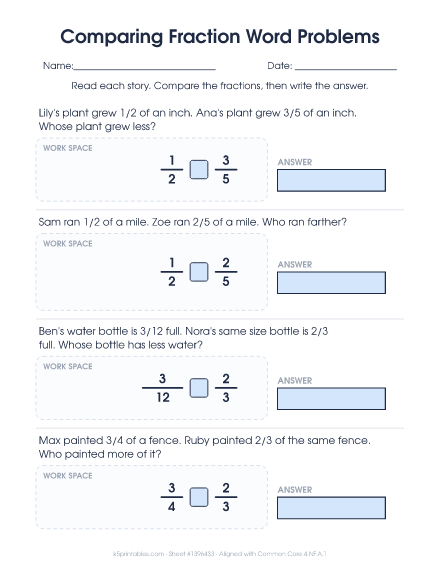
Comparing Fraction Word Problems
Stories about running, pizza, plants, recipes and paint where kids compare two fractions to answer who has more or less.
Print the whole packet
One copy of every sheet above, in order. Tap + for more copies (up to 10).
For the parent or teacher
What it is
Equivalent fractions name the same amount, like 2/3 and 8/12. Fourth graders learn why this works: if you multiply the top and bottom by the same number, you cut each piece into smaller pieces, so there are more pieces but the amount stays the same. They use this to compare fractions with different bottom numbers, like 2/3 and 3/4, and also compare fractions to 1/2.
What comes next
Adding and subtracting fractions with the same bottom number.
How to teach it
- Start with pictures. Shade 2/3 of a rectangle, then cut each piece into 4 parts to see 8/12.
- Connect the picture to the rule. Cutting each piece into 4 parts is the same as multiplying the top and bottom by 4.
- Practice going both ways. Multiply to make bigger numbers, and divide to make smaller ones.
- Compare to 1/2 first. Double the top number. If it is more than the bottom, the fraction is more than half.
- To compare two fractions, make the bottom numbers the same, then compare the top numbers.
Common mistakes
- Multiplying only the top or only the bottom number.
- Adding the same number to the top and bottom, like thinking 2/3 = 3/4.
- Thinking a bigger bottom number means a bigger fraction, like 1/8 > 1/4.
- Comparing fractions of different size wholes.