How to Name Angles
An angle is two rays that meet at a point. We measure angles in degrees.
Need more than one? Tap + for extra copies (up to 10).
How to do it
- Find the vertex.
- Compare the angle to a square corner.
- Name it acute, right, obtuse or straight.
Teaching tip
Hold up a sheet of paper's corner to compare angles around the room. This sheet is aligned with Common Core 4.MD.C.5.
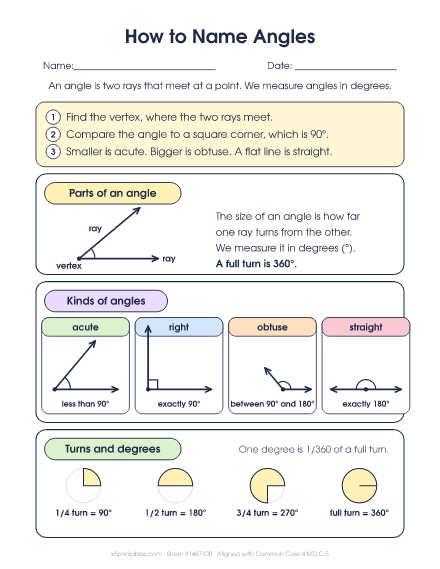
About this chart
The parts of an angle, acute, right, obtuse and straight angles, and turns in degrees.
What kids practice
An angle is two rays that share an endpoint, called the vertex. Angles are measured in degrees. A full turn is 360°, a right angle is 90° and a straight angle is 180°. Fourth graders sort angles as acute, right or obtuse, measure and draw angles with a protractor, and add or subtract angles to find a missing one.
Watch for
- Reading the wrong scale, like 130° for a 50° angle.
- Putting the edge of the protractor, not the center mark, on the vertex.
- Thinking longer rays make a bigger angle.
- Adding instead of subtracting to find a missing part.
It's free to print, as many copies as you need. See the full angles guide for 4th grade.
More sheets in this set
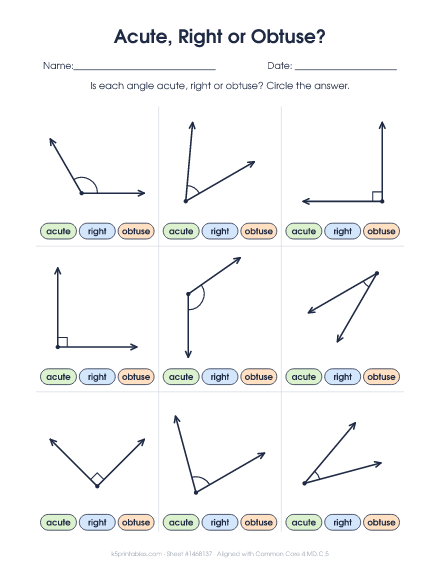 2. Acute, Right or Obtuse?Angles in many directions to sort. More adds straight angles.
- See it all
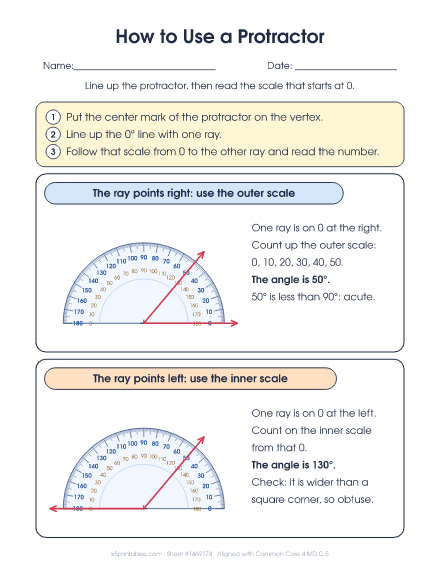 3. How to Use a ProtractorReading a 50° angle on the outer scale and a 130° angle on the inner scale.
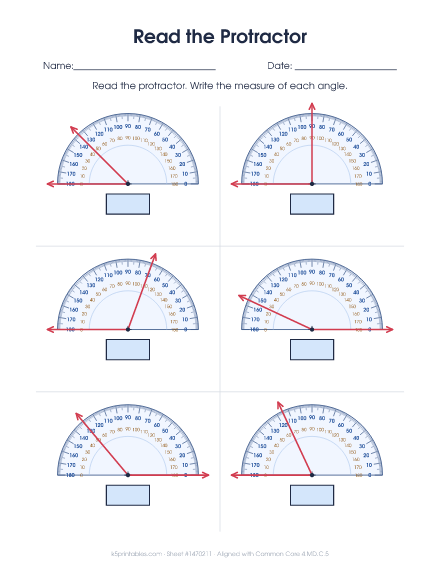 4. Read the ProtractorProtractors drawn on angles to read. Fewer uses tens, Standard uses fives on both scales, and More uses any whole degree.
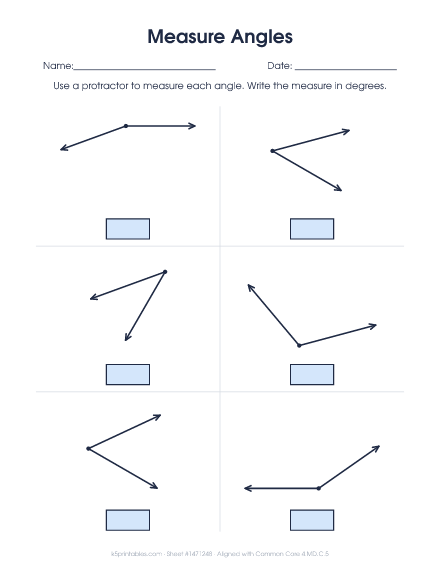 5. Measure AnglesAngles to measure with a real protractor. Fewer uses tens, and Standard and More use fives in different directions.
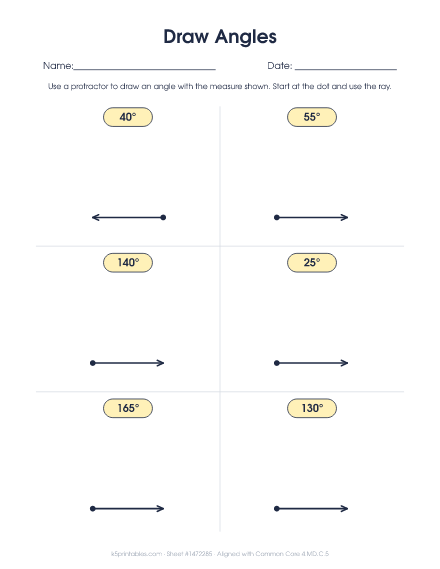 6. Draw AnglesA ray and a measure to draw each angle with a protractor.
- See it all
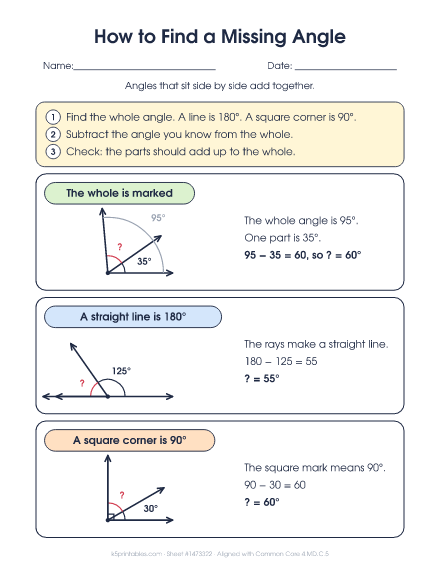 7. How to Find a Missing AngleMissing angles in a marked angle, on a straight line (180°) and in a square corner (90°).
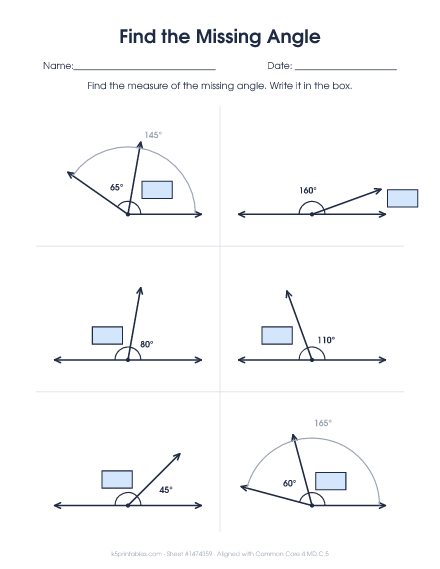 8. Find the Missing AngleAngles split into parts to find the missing one. Fewer uses marked angles and straight lines, Standard adds square corners, and More has three parts.