Parts of Speech Chart
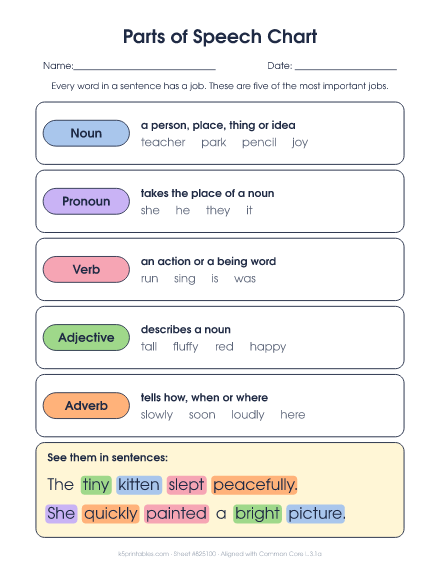
Every word in a sentence has a job. These are five of the most important jobs.
Need more than one? Tap + for extra copies (up to 10).
How to do it
- Read what each part of speech does.
- Read the example words.
- Look at the colored words in the sample sentences.
Teaching tip
Use the same five colors on the coloring sheet so the chart and the practice match. This sheet is aligned with Common Core L.3.1a.
About this chart
Nouns, pronouns, verbs, adjectives and adverbs, each with a color, a meaning and examples.
What kids practice
Every word in a sentence has a job. Nouns name people, places, things and ideas. Pronouns take the place of nouns. Verbs show action or being. Adjectives describe nouns, and adverbs tell how, when or where. Third graders learn to name these jobs and to tell concrete nouns (things you can touch) from abstract nouns (ideas and feelings).
Watch for
- Thinking every word ending in -ly is an adverb, like friendly or lovely.
- Calling a word an adjective just because it comes before a noun, like "the."
- Missing abstract nouns, because they aren't things you can see.
It's free to print, as many copies as you need. See the full parts of speech guide for 3rd grade.
More sheets in this set
- See it all
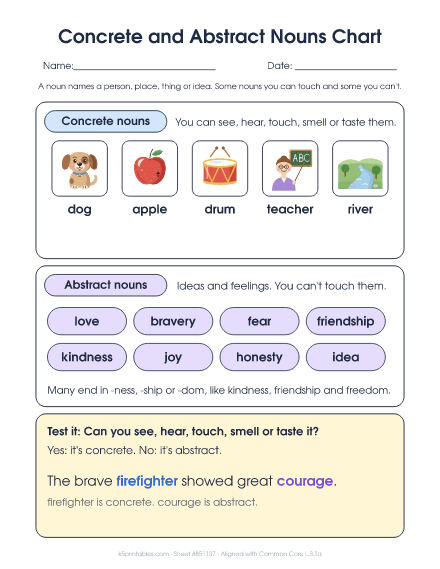 2. Concrete and Abstract Nouns ChartConcrete nouns like dog and river and abstract nouns like bravery and friendship, with a quick test to tell them apart.
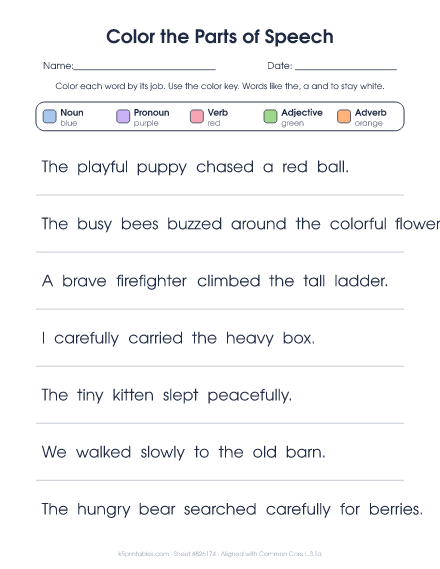 3. Color the Parts of SpeechSentences to color word by word as nouns, pronouns, verbs, adjectives and adverbs.
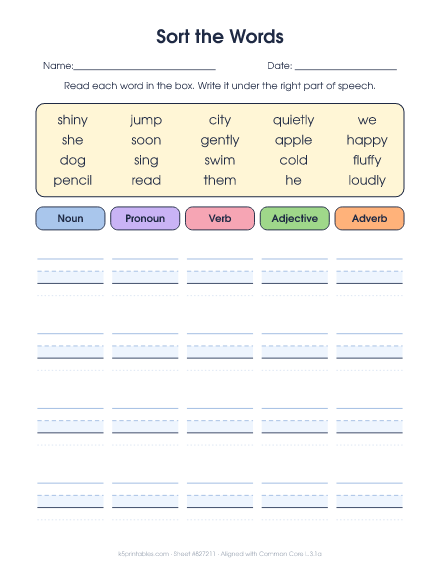 4. Sort the WordsA word bank to sort into noun, pronoun, verb, adjective and adverb columns.
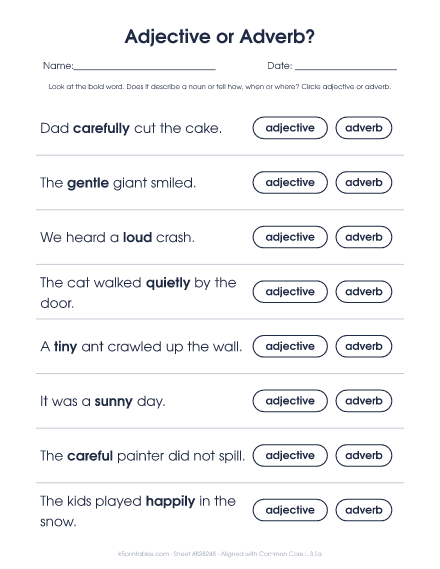 5. Adjective or Adverb?Sentences like "the quiet cat" and "walked quietly" to sort as adjective or adverb.
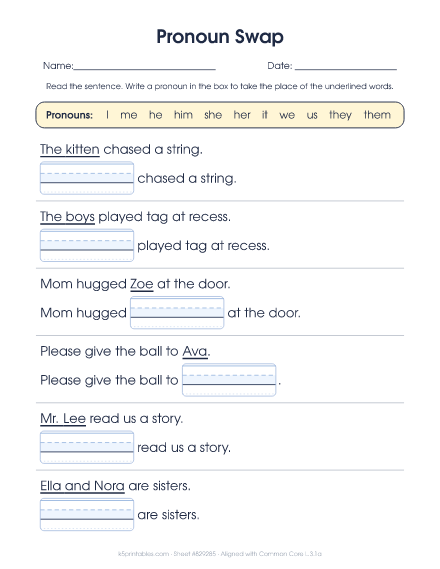 6. Pronoun SwapReplace underlined nouns, like "Mia" or "the boys," with he, she, it, we, they, him, her or them.
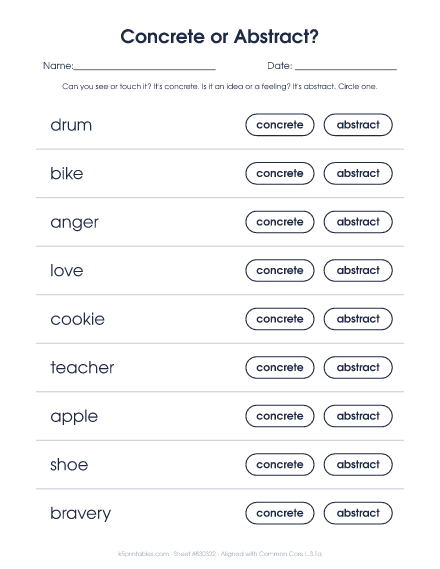 7. Concrete or Abstract?Nouns like dog, river, bravery and friendship to sort as concrete or abstract.