Opinion Writing Chart
An opinion piece tells what you think and gives reasons that back it up.
Need more than one? Tap + for extra copies (up to 10).
How to do it
- Read the four parts of an opinion piece.
- Look at the example sentence for each part.
- Pick linking words to connect your reasons.
Teaching tip
Ask your child for their opinion on something small, then ask "Why?" twice. That's two reasons. This sheet is aligned with Common Core W.3.1.
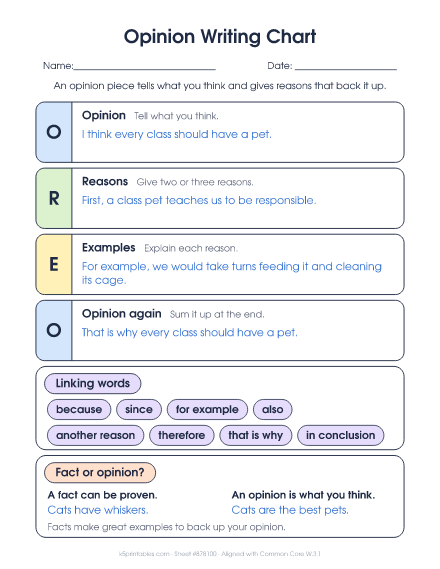
About this chart
Opinion, reasons, examples and opinion again, with an example for each part, linking words like because and for example, and fact versus opinion.
What kids practice
Third graders write three kinds of pieces. An opinion piece tells what they think and backs it up with reasons and examples (W.3.1). An informative piece teaches about a topic, with facts grouped together, definitions and a conclusion (W.3.2). A story tells events in order, with characters, dialogue, feelings and an ending (W.3.3). They also learn to plan first, then revise and edit with help (W.3.5).
Watch for
- Giving an opinion with no reasons, or reasons with no examples.
- Listing facts in random order instead of grouping them.
- Stories that list events with "and then" but no problem, feelings or ending.
- Skipping the closing sentence.
It's free to print, as many copies as you need. See the full opinion, informative and story writing guide for 3rd grade.
More sheets in this set
- See it all
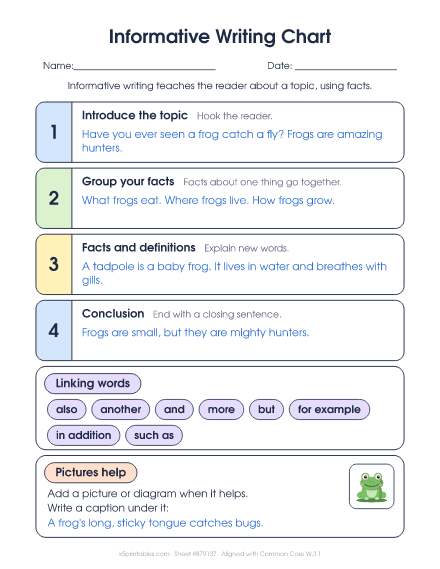 2. Informative Writing ChartIntroduce the topic, group your facts, use facts and definitions, and write a conclusion, with a frog example, linking words and a tip on pictures and captions.
- See it all
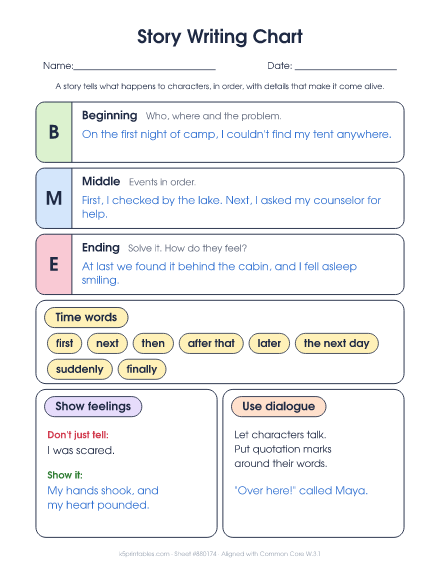 3. Story Writing ChartBeginning, middle and end with a camp story example, time words, showing feelings instead of telling, and dialogue with quotation marks.
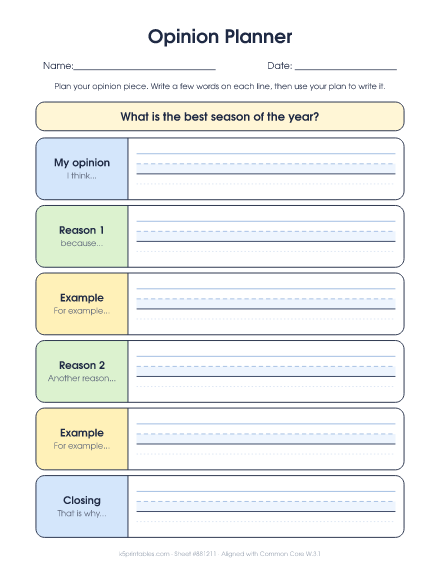 4. Opinion PlannerA planner with an opinion question, two reasons, two examples and a closing. Each copy has a different question.
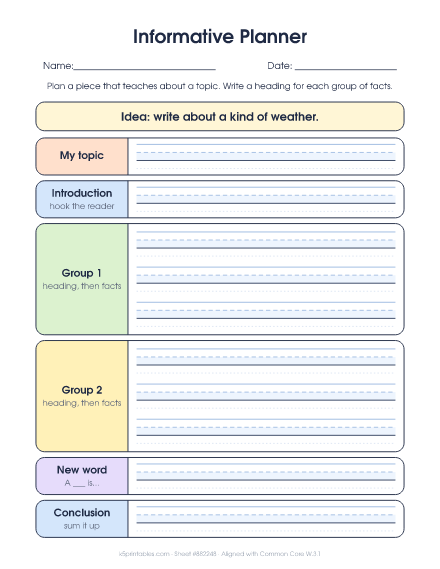 5. Informative PlannerA planner for a topic sentence, two groups of facts with headings, a definition and a conclusion.
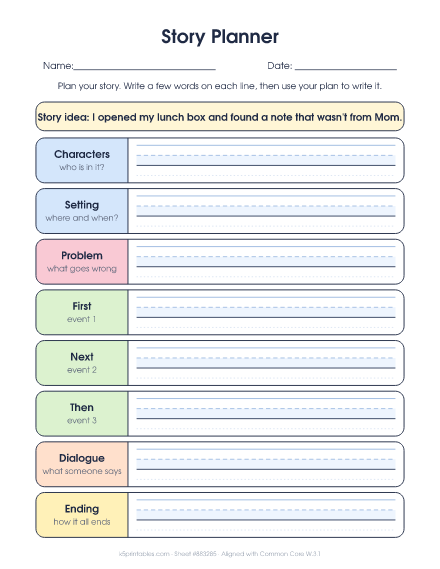 6. Story PlannerA planner for characters, setting, a problem, three events, dialogue and an ending. Each copy has a different story idea.
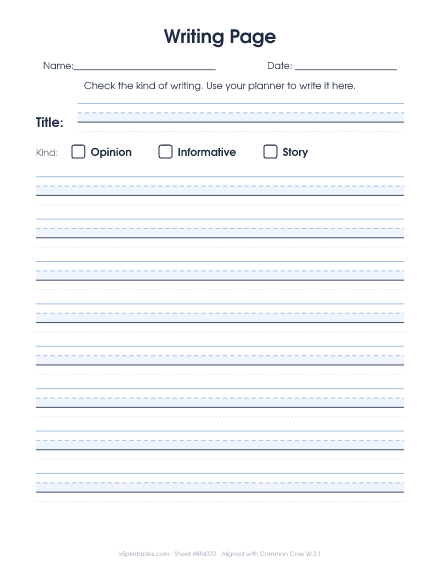 7. Writing PageA full page of handwriting lines with a title line and boxes for opinion, informative or story.
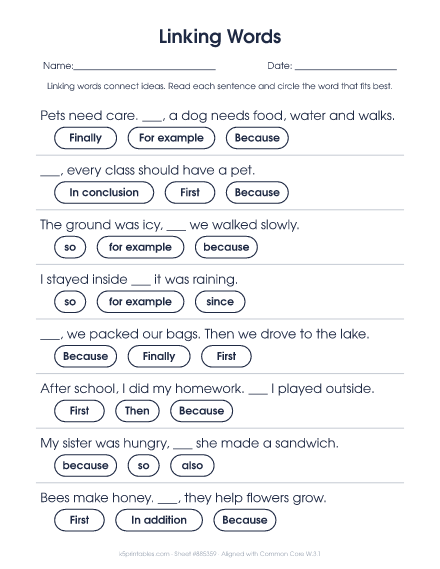 8. Linking WordsSentences with a missing linking word, like because, so, for example, also and finally. Circle the one that fits.
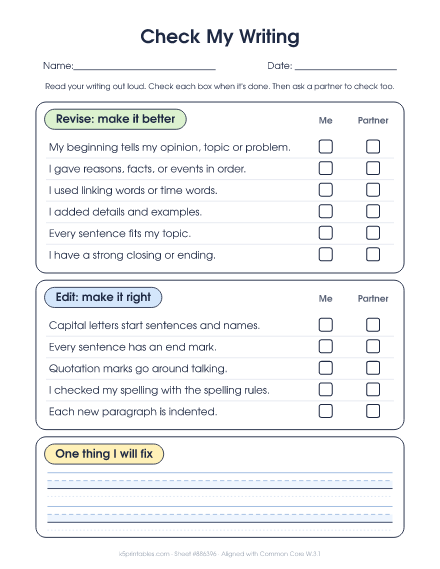 9. Check My WritingA checklist for revising (ideas, order, details, closing) and editing (capitals, end marks, quotation marks, spelling), with boxes for the writer and a partner.