Making inferences worksheets
Aligned with Common Core RL.3.1
Printable 3rd grade inference practice: a clues-plus-what-I-know chart, who-or-where riddles, reading feelings from clues, short stories with questions, an inference organizer and prove-it practice with evidence from the text.
The worksheets
- See it all
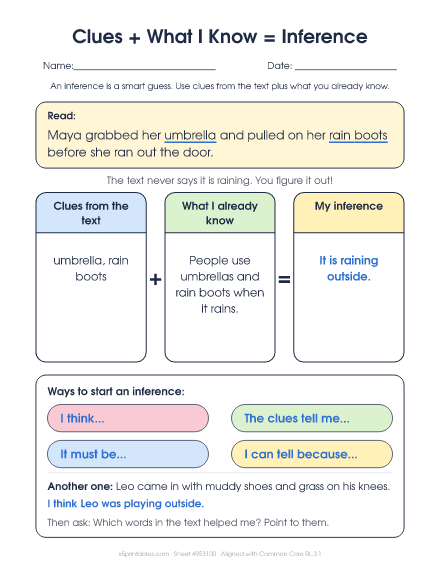
Clues + What I Know = Inference
The inference formula shown with a worked example, a second quick example and four sentence starters.
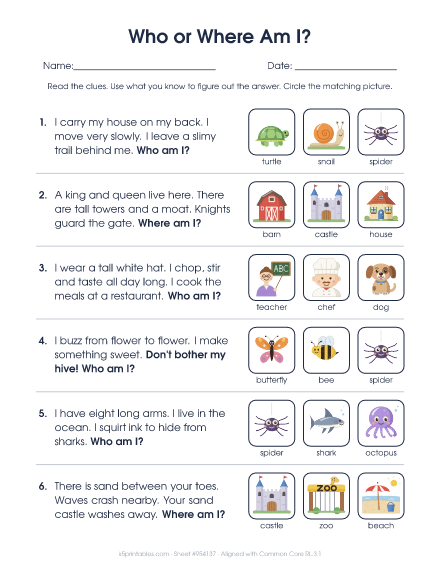
Who or Where Am I?
Six riddles about animals, people and places, each with three picture choices. Some wrong choices fit one clue but not the others. Includes an answer key.
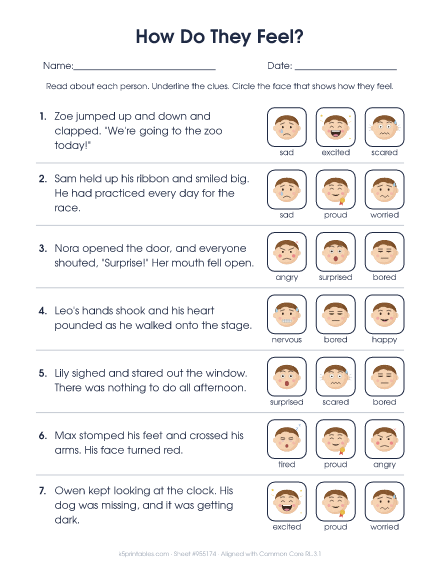
How Do They Feel?
Seven short descriptions of what someone does, with three feeling faces to choose from. The answer key shows the clue words and the right face.
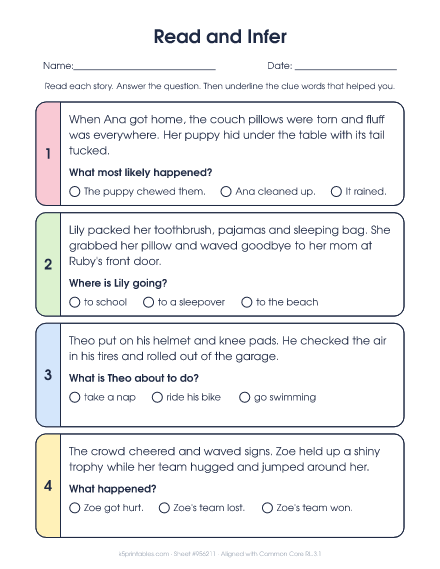
Read and Infer
Four short stories, each with a question the story doesn't answer outright and three choices. The answer key shows the clue words.
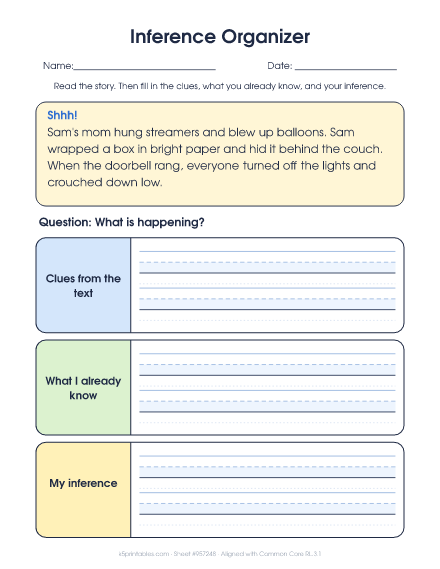
Inference Organizer
A short story and a question, with handwriting lines for clues, what I already know and my inference. The answer key has example answers.
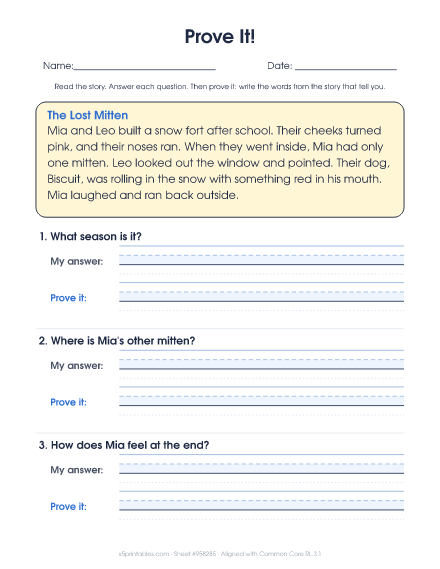
Prove It!
A short story with three questions. Each has a line for the answer and a line for the proof from the text. The answer key has example answers.
Print the whole packet
One copy of every sheet above, in order. Tap + for more copies (up to 10).
For the parent or teacher
What it is
An inference is a smart guess. The text doesn't say the answer, so readers put clues from the text together with what they already know. If a story says Maya grabbed her umbrella and rain boots, readers can infer that it's raining, even though the story never says so. In 3rd grade, kids answer questions about what they read and point to the words in the text that support their answers. Inferences also help in everyday talk, like figuring out how someone feels from what they do.
What comes next
Use inferences with longer stories and chapter books. Ask what a character might do next and why, and look for clues in the pictures too.
How to teach it
- Start with the chart. Clues from the text plus what I already know equals my inference.
- Practice out loud first. Describe a person or place in three clues and have your child guess.
- Ask "How do you know?" after every answer. Your child should point to the words that helped.
- Underline clue words. Seeing the clues on the page shows that an inference isn't just a guess.
- Use the sentence starters, like "I think..." and "I can tell because...", to answer in full sentences.
Common mistakes
- Guessing without clues. Every inference needs a reason from the text.
- Using only one clue. Look for two or three clues that point the same way.
- Picking an answer the text says outright. An inference fills in what the text leaves out.
- Ignoring what they already know. The clues only make sense when kids connect them to their own experience.