Understanding fractions worksheets
Aligned with Common Core 3.NF.A.1
Printable third-grade fraction worksheets: name and color fractions of shapes, unit fractions, fractions of a group, fractions on a number line and whole numbers written as fractions, with halves, thirds, fourths, sixths and eighths.
The worksheets
- See it all
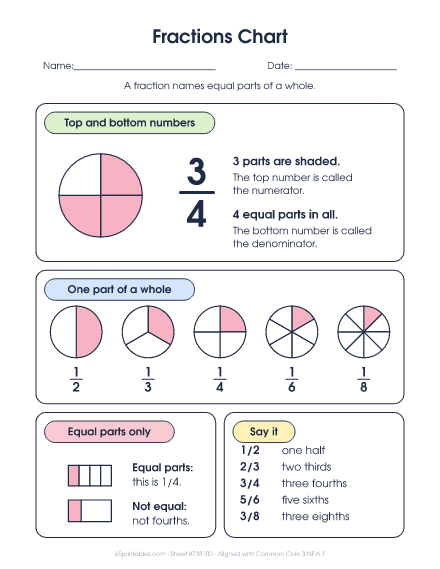
Fractions Chart
What the top and bottom numbers mean, unit fractions from 1/2 to 1/8, equal parts, and how to say fractions.
- See it all
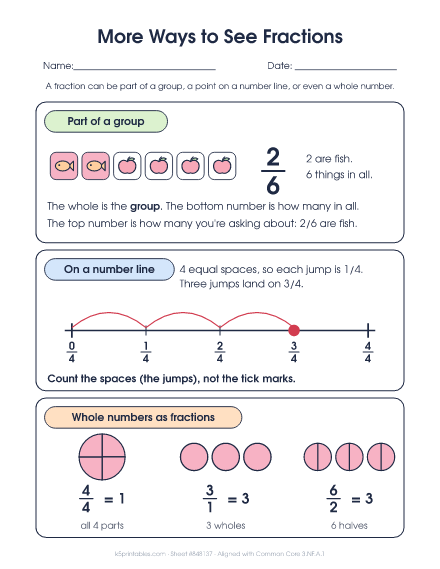
More Ways to See Fractions
Fractions of a group, fractions on a number line, and whole numbers written as fractions.
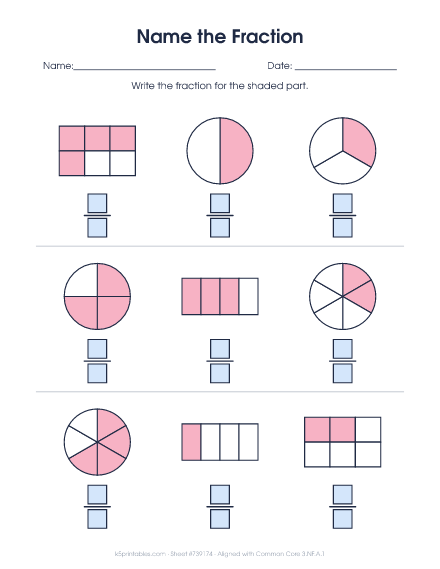
Name the Fraction
Circles and rectangles with some parts shaded. Write the fraction.
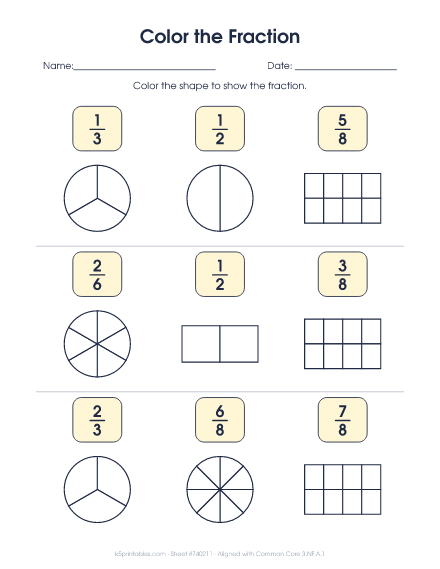
Color the Fraction
Shade each shape to show the fraction given.
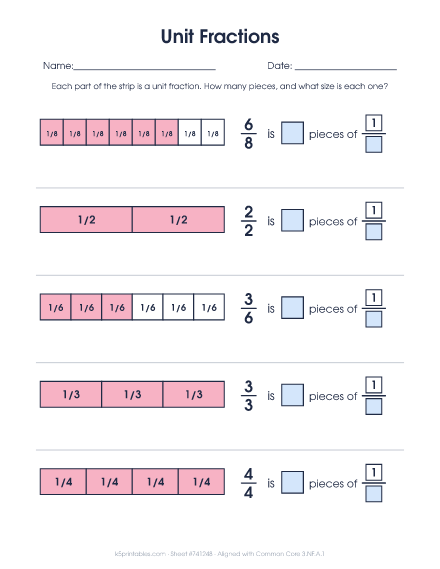
Unit Fractions
Fraction strips showing that 3/4 is three pieces that are each 1/4.
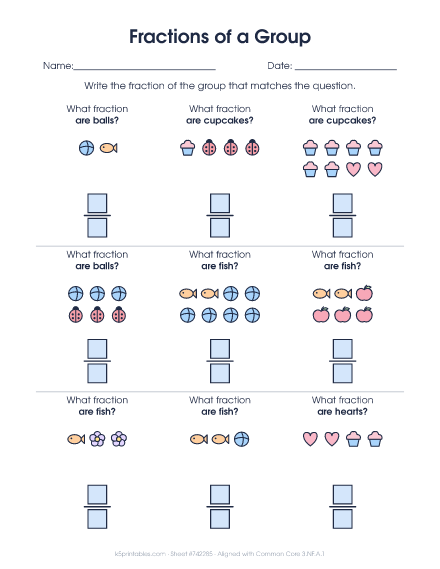
Fractions of a Group
Groups of pictures, like "What fraction are fish?" Write the fraction of the group.
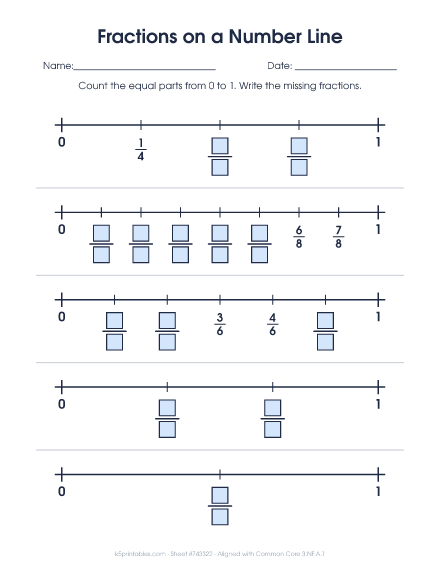
Fractions on a Number Line
Number lines from 0 to 1 cut into equal parts, with missing fractions to fill in.
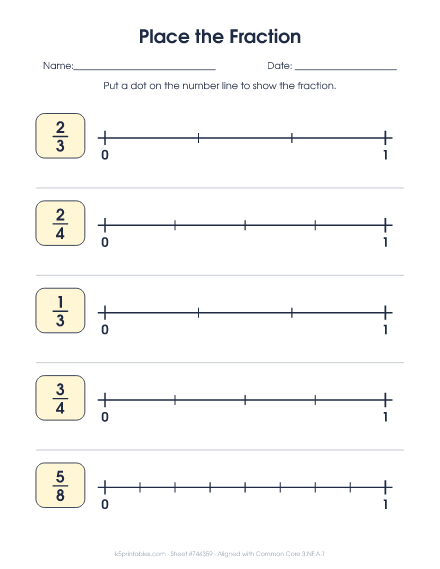
Place the Fraction
Mark each fraction with a dot on a number line from 0 to 1.
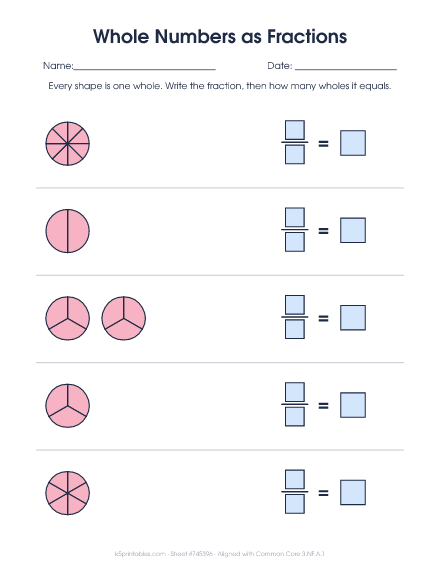
Whole Numbers as Fractions
Pictures showing that 4/4 = 1, 3/1 = 3 and 6/2 = 3.
Print the whole packet
One copy of every sheet above, in order. Tap + for more copies (up to 10).
For the parent or teacher
What it is
A fraction names equal parts of a whole. In 3/4, the bottom number (the denominator) says the whole is cut into 4 equal parts, and the top number (the numerator) says how many of those parts we have. Third graders work with halves, thirds, fourths, sixths and eighths. They see fractions as parts of shapes, parts of a group and points on a number line.
What comes next
Equivalent and comparing fractions.
How to teach it
- Cut real things into equal parts, like a sandwich, a pizza or a strip of paper.
- Say fractions out loud. 3/4 is "three fourths."
- Build fractions from unit fractions. 3/4 is three pieces that are each 1/4.
- Fold a paper strip into equal parts and label it to make a number line.
- Point out that the parts must be equal. Unequal pieces are not fourths.
Common mistakes
- Counting the unshaded parts instead of all the parts for the bottom number.
- Thinking a bigger bottom number means a bigger piece. 1/8 is smaller than 1/2.
- Counting the tick marks instead of the spaces on a number line.