Break Apart Arrays
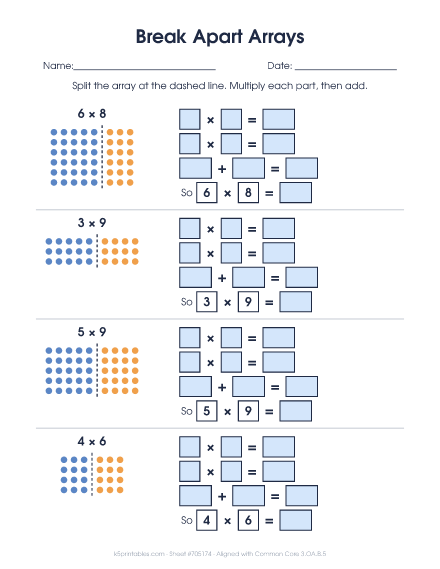
Split the array at the dashed line. Multiply each part, then add.
Fresh sheet anytime. Tap New sheet or reload for a different one. Tap + for up to 10.
This is sheet #70524601.
How to do it
- Multiply the blue part.
- Multiply the orange part.
- Add the two parts to find the whole fact.
Teaching tip
Splitting off 5 columns works well because 5s facts are easy. This sheet is aligned with Common Core 3.OA.B.5.
About this worksheet
Arrays split at a dashed line, like 6 × 7 = 6 × 5 + 6 × 2.
What kids practice
A few rules make multiplication much easier. Turn-around facts have the same product (3 × 7 = 7 × 3). A hard fact can be broken into two easy ones (6 × 7 = 6 × 5 + 6 × 2). Any number times 1 is that number, and any number times 0 is 0. Children also look for patterns in the times table, like products of 5 always ending in 0 or 5.
Watch for
- Thinking any number times 0 is that number, like 6 × 0 = 6.
- Breaking apart a fact but adding only one part back in.
- Thinking turn-around facts work for subtraction too. 7 − 3 is not 3 − 7.
It's free to print, with Fewer, Standard or More on the page and an answer key. See the full multiplication properties and patterns guide for 3rd grade.
More sheets in this set
- See it all
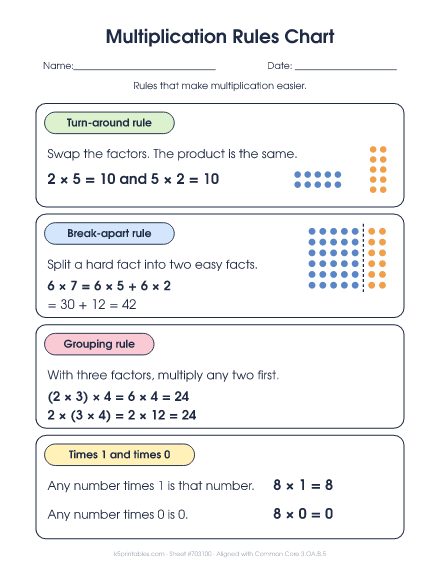 1. Multiplication Rules ChartThe turn-around, break-apart, grouping and times 1 and times 0 rules, each with an example.
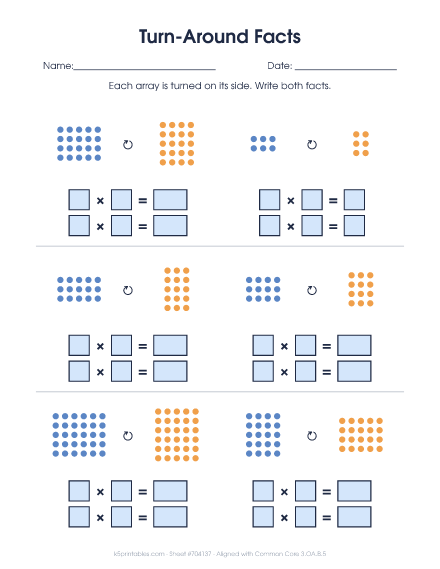 2. Turn-Around FactsArrays turned on their side, written as a pair of turn-around facts.
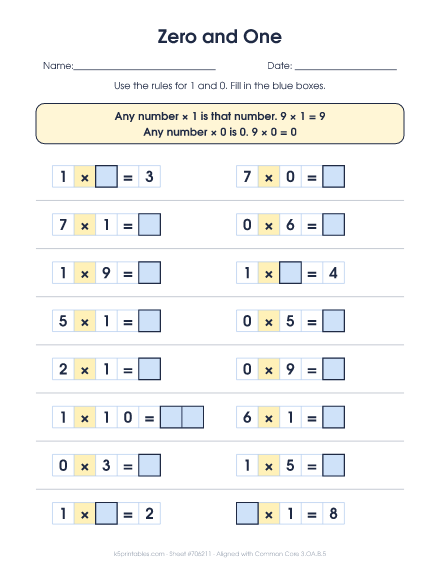 4. Zero and OneFacts with 0 and 1, including a few missing numbers, like ? × 1 = 7.
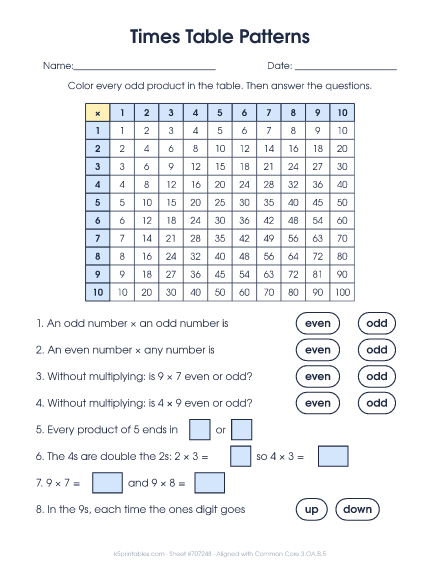 5. Times Table PatternsColor the odd products in a times table, then answer questions about even and odd products, the 5s, 4s and 9s.