How to Read a Scale or Cup
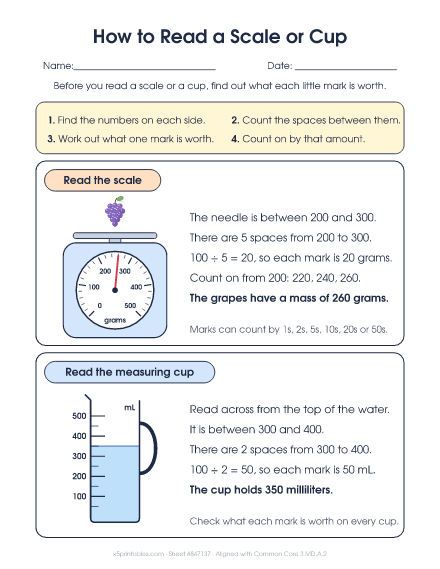
Before you read a scale or a cup, find out what each little mark is worth.
Need more than one? Tap + for extra copies (up to 10).
How to do it
- Find the numbers on each side.
- Count the spaces and work out what one mark is worth.
- Count on from the smaller number.
Teaching tip
Practice on a real kitchen scale or measuring cup and compare it with the chart. This sheet is aligned with Common Core 3.MD.A.2.
About this chart
A kitchen scale and a measuring cup read step by step, including how to find what each little mark is worth.
What kids practice
Mass is how heavy something is. Liquid volume is how much a container holds. Third graders measure mass in grams (g) and kilograms (kg), and liquid volume in milliliters (mL) and liters (L). They pick the better unit, read scales and measuring cups with marked steps, and solve one-step word problems with these units.
Watch for
- Counting each mark as 1 when the marks count by 2s, 5s, 10s or more.
- Picking the unit by the size of the thing instead of how heavy it is. A balloon is big but light.
- Mixing up mass and volume words, like saying a cup weighs 250 milliliters.
It's free to print, as many copies as you need. See the full mass and volume guide for 3rd grade.
More sheets in this set
- See it all
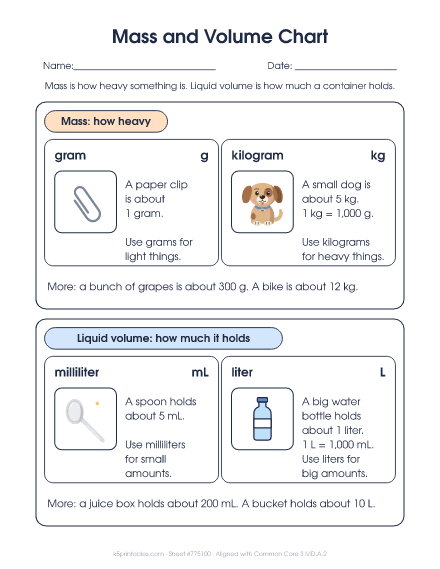 1. Mass and Volume ChartGrams and kilograms, milliliters and liters, with everyday examples like a paper clip (about 1 g) and a water bottle (about 1 L).
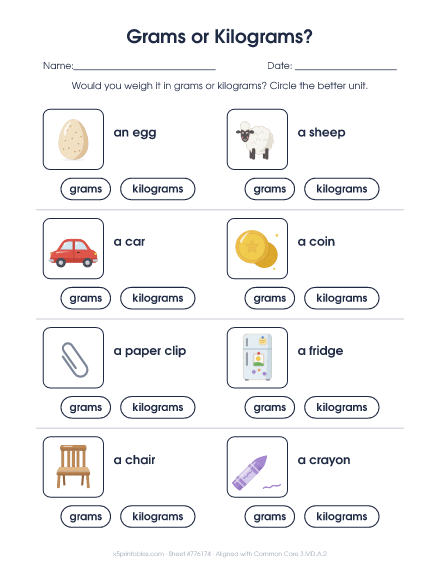 3. Grams or Kilograms?Pictures of everyday things, like a key, an egg, a bike and a horse. Circle the better unit.
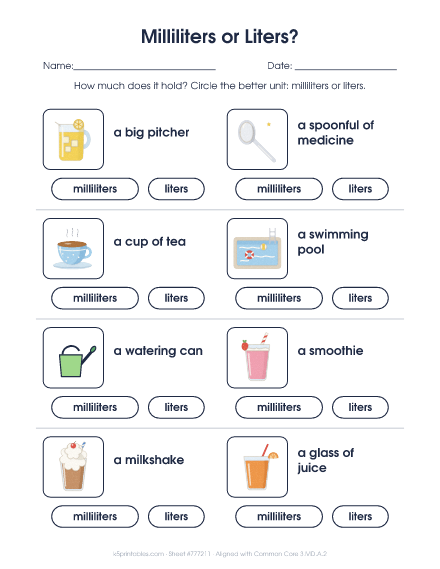 4. Milliliters or Liters?Cups, bottles, buckets, bathtubs and more. Circle the better unit for how much each one holds.
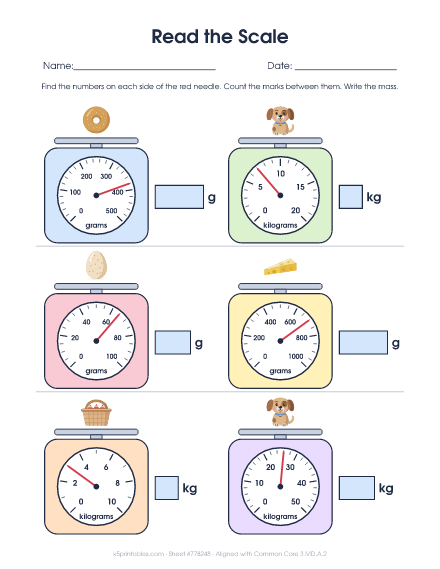 5. Read the ScaleKitchen scales with marked dials in grams and kilograms. Read where the needle points.
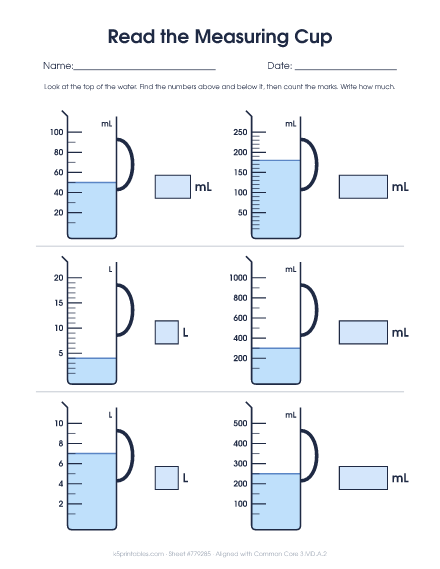 6. Read the Measuring CupMeasuring cups and jugs with marks in milliliters and liters. Write how much liquid is in each.
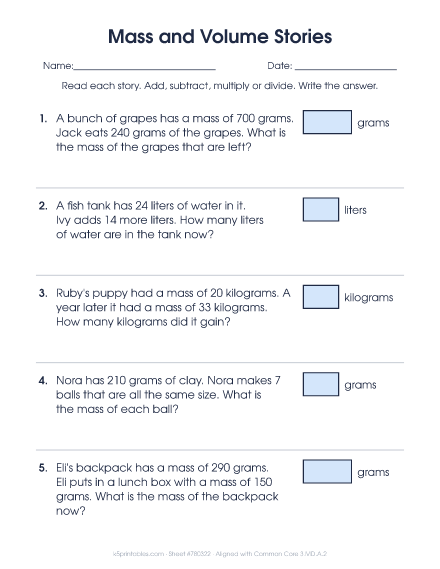 7. Mass and Volume StoriesWord problems with grams, kilograms, milliliters and liters, using all four operations.