Direction Words Chart
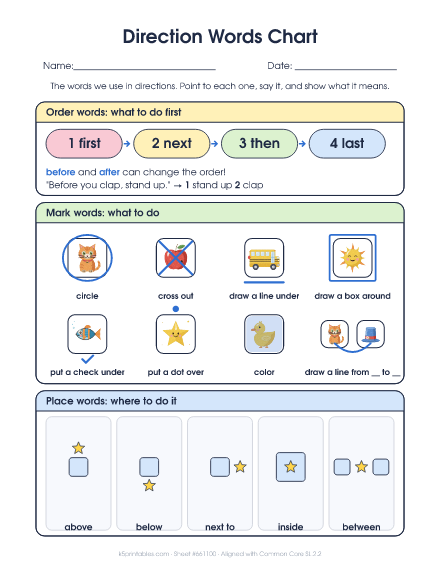
The words we use in directions. Point to each one, say it, and show what it means.
Need more than one? Tap + for extra copies (up to 10).
How to do it
- Read each order word, mark word and place word.
- Show what each mark looks like with your finger.
- Keep the chart nearby while you practice.
Teaching tip
Play a quick game. Say a mark word and have your child draw that mark on a scrap of paper. This sheet is aligned with Common Core SL.2.2.
About this chart
The words used in directions on one page. Order words (first, next, then, last, before and after), mark words with a picture of each mark, and place words like above, below and between.
What kids practice
Following multi-step directions means listening to a whole direction, holding it in memory, and doing each step in the right order. In 2nd grade, kids are expected to follow directions with two or three steps and to understand order words like first, then, before and after. On these sheets, a grown-up reads each direction out loud from a strip at the bottom of the page. The child folds that strip back, so they have to listen instead of read. This builds listening comprehension (aligned with Common Core SL.2.2 and SL.2.3).
Watch for
- Starting before the whole direction is finished. Teach "wait, listen, then go."
- Doing the right things in the wrong order. Before and after are the tricky ones. "Before you circle the bus, cross out the cat" means the cat comes first.
- Remembering only the last step. Have your child repeat the whole direction back.
- Giving too many hints. Let your child try first, then check the answer key together.
It's free to print, as many copies as you need. See the full multi-step directions guide for 2nd grade.
More sheets in this set
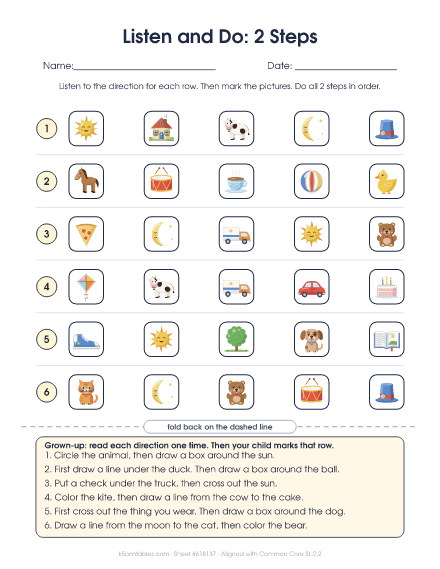 2. Listen and Do: 2 StepsSix rows of pictures with a two-step direction for each row, like "Circle the cat, then cross out the bus." The directions are on a fold-back strip. Includes an answer key.
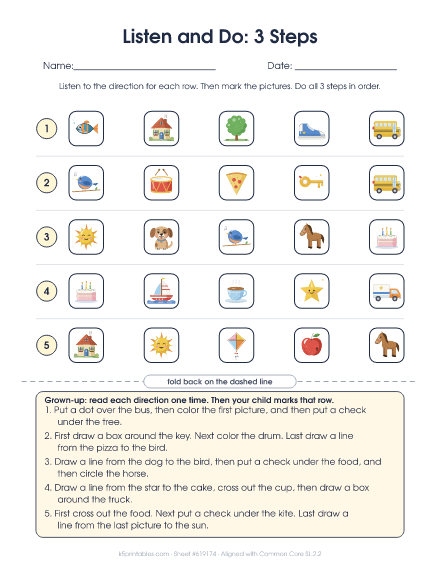 3. Listen and Do: 3 StepsFive rows of pictures with three-step directions. Some directions say "the first picture" or "the animal" instead of a name, so kids have to think as they listen. Includes an answer key.
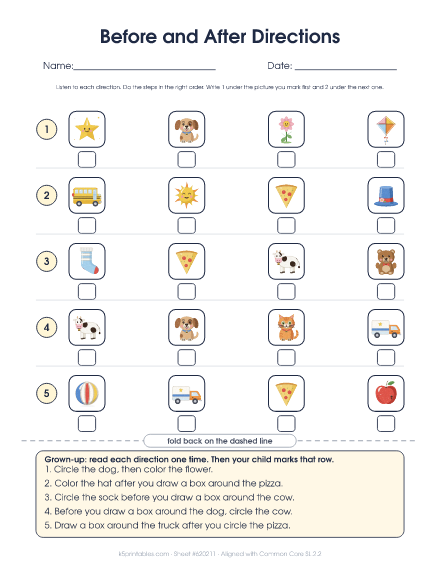 4. Before and After DirectionsFive rows of tricky directions like "Before you circle the bus, cross out the cat." The numbers show which step your child did first. Includes an answer key.
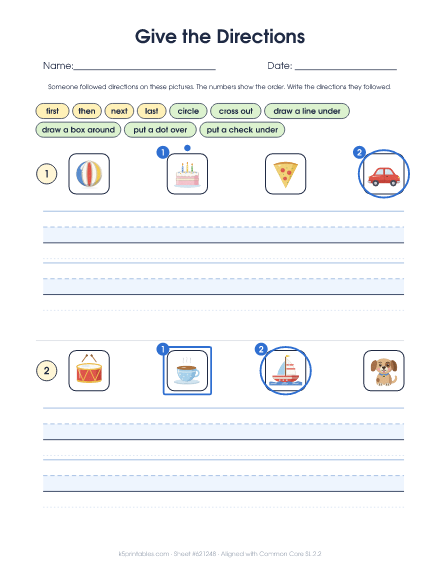 5. Give the DirectionsThe marks are already done. Kids write the two-step direction that would make them, on big writing lines, using a word bank of order words and mark words. Includes an answer key.