Carry and Regroup Chart
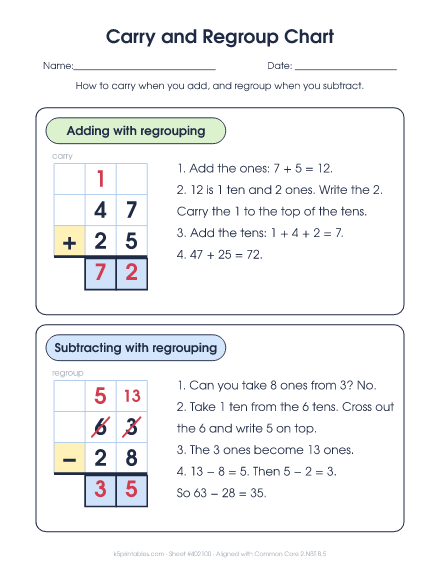
How to carry when you add, and regroup when you subtract.
Need more than one? Tap + for extra copies (up to 10).
How to do it
- Read the adding example, one step at a time.
- Read the subtracting example.
- Keep the chart out while you practice.
Teaching tip
Cover the answer and have them talk you through each step. This sheet is aligned with Common Core 2.NBT.B.5.
About this chart
One worked example of carrying in addition and one of regrouping in subtraction, step by step.
What kids practice
Adding and subtracting two-digit numbers, like 47 + 25 and 63 - 28. The ones are added or subtracted first, then the tens. When the ones add up to 10 or more, 10 of them become 1 ten (carrying). When there aren't enough ones to take away, 1 ten becomes 10 ones (regrouping). Every problem in this topic uses two-digit numbers on both lines.
Watch for
- Writing 12 in the ones place instead of carrying the 1 ten.
- Subtracting the smaller digit from the bigger one in the ones (63 - 28 becomes 45).
- Forgetting to take 1 away from the tens after regrouping.
- Adding when the sign says subtract on the mixed page.
It's free to print, as many copies as you need. See the full adding and subtracting within 100 guide for 2nd grade.
More sheets in this set
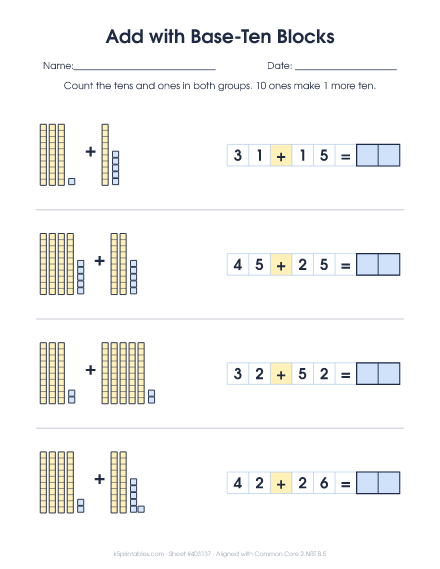 2. Add with Base-Ten BlocksTwo-digit addition shown with ten rods and one cubes, so kids can see a new ten being made.
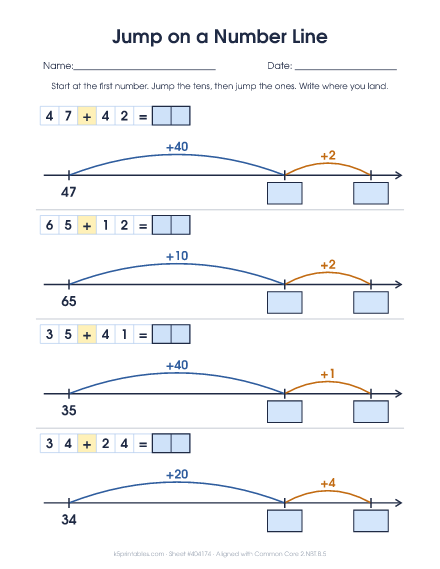 3. Jump on a Number LineAdd a two-digit number by jumping the tens, then the ones, on an open number line.
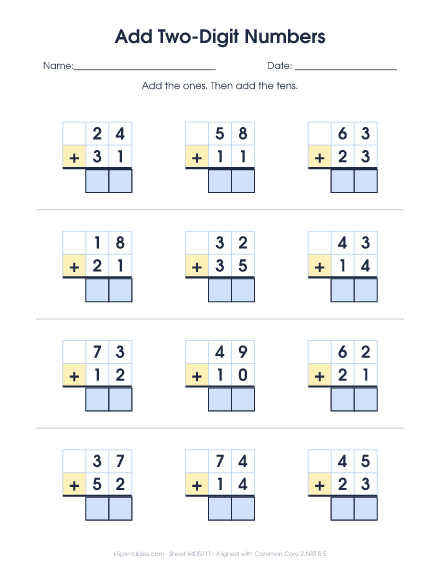 4. Add Two-Digit NumbersTwo-digit addition on graph paper where the ones never add up to 10 or more.
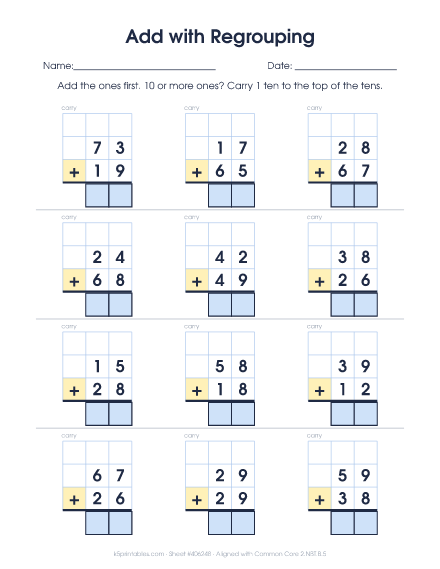 5. Add with RegroupingTwo-digit addition on graph paper where every problem needs a carried ten.
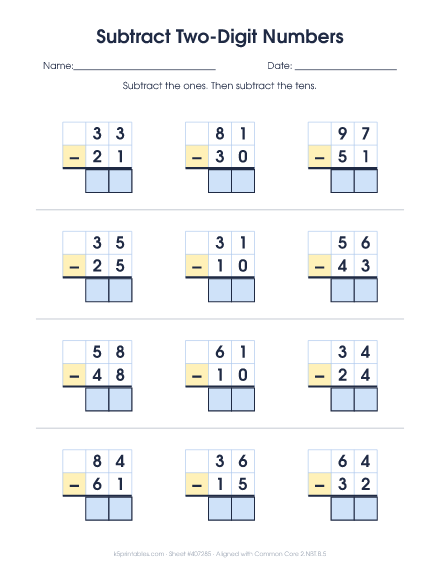 6. Subtract Two-Digit NumbersTwo-digit subtraction on graph paper where the top ones digit is always big enough.
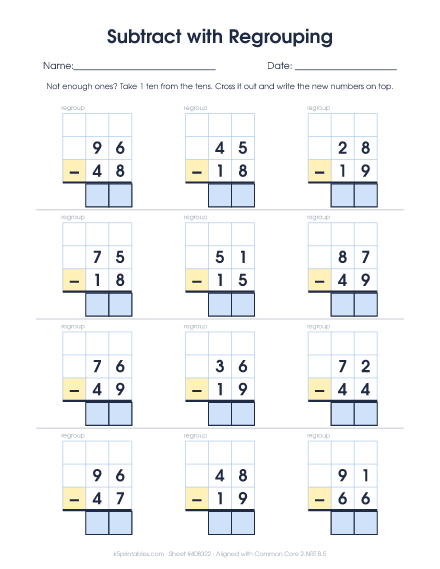 7. Subtract with RegroupingTwo-digit subtraction on graph paper where every problem needs regrouping, with a row on top for the new numbers.
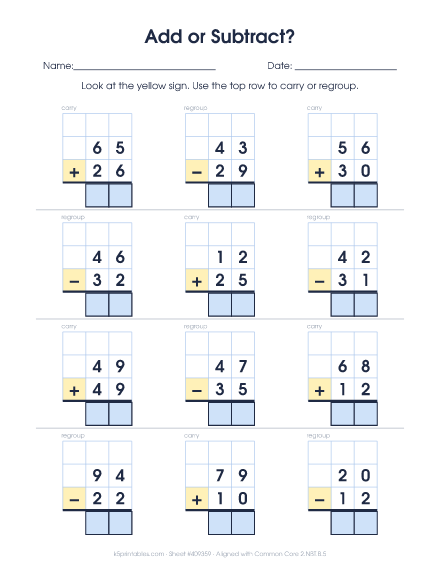 8. Add or Subtract?Two-digit addition and subtraction mixed on one page, some with regrouping and some without.