Nouns, verbs and adjectives worksheets
Aligned with Common Core L.1.1
Printable grammar worksheets for first grade: sorting nouns, finding nouns and verbs, one and more than one, past and present verbs, and describing words.
The worksheets
- See it all
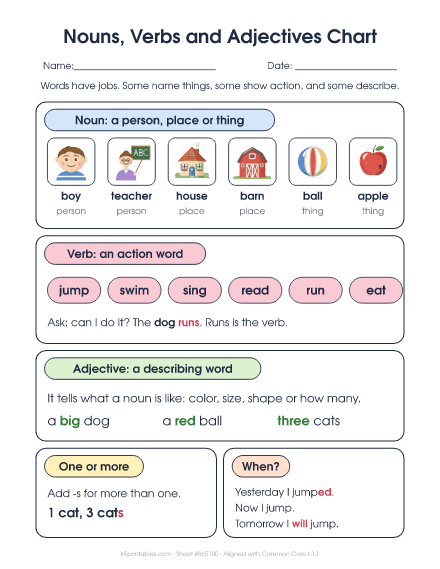
Nouns, Verbs and Adjectives Chart
Nouns with pictures, action verbs, describing words, adding -s for more than one, and yesterday, now and tomorrow verbs.
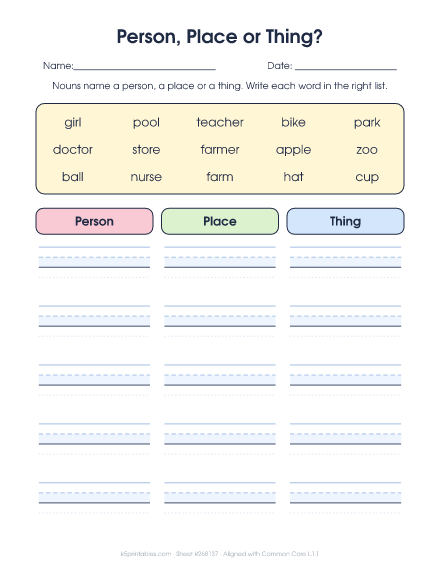
Person, Place or Thing?
Fifteen nouns to sort into person, place and thing lists. Matches L.1.1b.
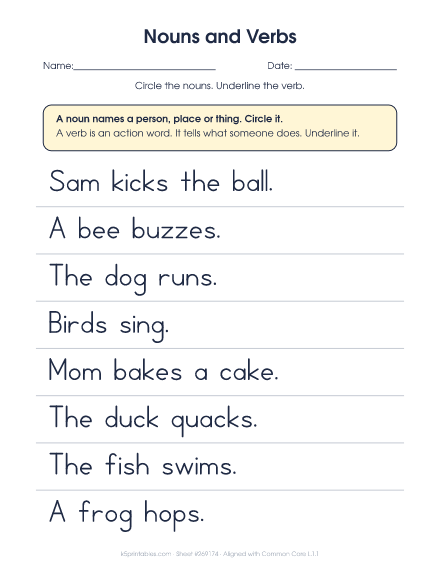
Nouns and Verbs
Eight short sentences. Circle the nouns and underline the verb.
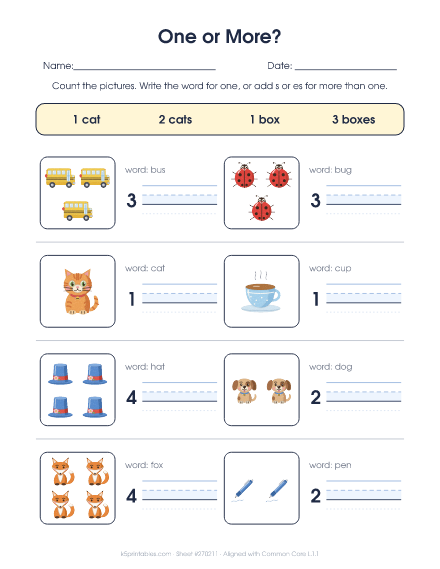
One or More?
Picture groups to count, with the base word given. Write the word for one or more than one. Matches L.1.1c.
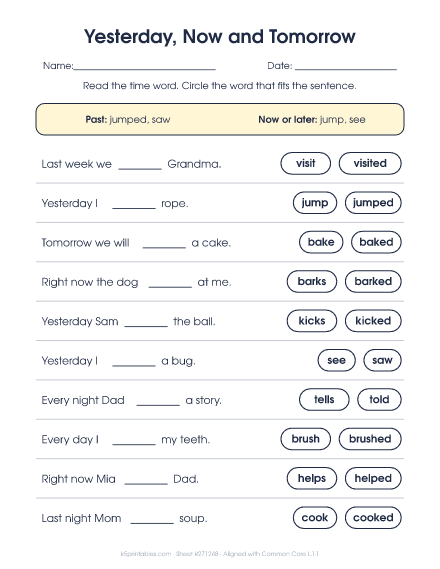
Yesterday, Now and Tomorrow
Ten sentences with a time word. Circle the verb that matches the time. Matches L.1.1e.
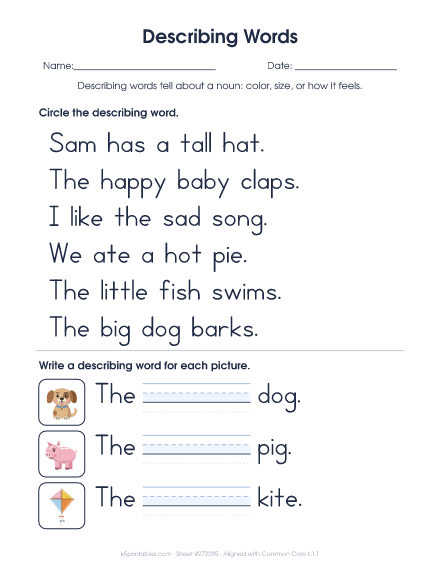
Describing Words
Circle describing words in sentences, then write your own describing words for pictures. Matches L.1.1f.
Print the whole packet
One copy of every sheet above, in order. Tap + for more copies (up to 10).
For the parent or teacher
What it is
Nouns, verbs and adjectives are the building blocks of sentences. A noun names a person, place or thing. A verb is an action word that tells what someone does. An adjective is a describing word that tells about a noun, like its color, size or how it feels. First graders also learn to add s or es for more than one, and to add -ed for something that already happened.
What comes next
Telling and asking sentences, putting these words together into full sentences.
How to teach it
- Play "I spy" with nouns around the house. "I spy a thing you sit on."
- Act out verbs. Your child jumps, claps or hops, and you name the action word.
- Describe snacks together. Crunchy, sweet, cold and red are all adjectives.
- Use time words. "Yesterday I walked. Today I walk. Tomorrow I will walk."
Common mistakes
- Calling every word in a sentence a noun.
- Adding s when there is only one, or forgetting it when there are more.
- Adding -ed to words that change instead, like "runned" for ran.
- Mixing up adjectives and nouns, as in thinking "red" is a thing.