Minimal Pairs Chart
Change one sound and you get a new word. Listen first, then say it.
Need more than one? Tap + for extra copies (up to 10).
How to do it
- Talk about how one sound changes a word, like key and tea.
- Find the sound swap your child is working on.
- Practice listening first, then saying.
Teaching tip
Start with listening. Hearing the difference comes before saying it. This sheet is aligned with Common Core RF.1.2c.
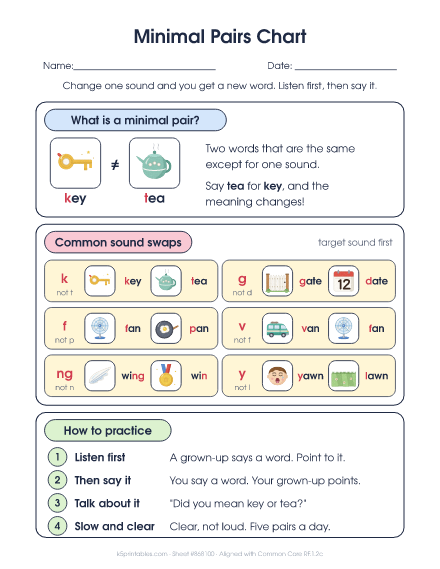
About this chart
What a minimal pair is, six common sound swaps with pictures (k and t, g and d, f and p, v and f, ng and n, y and l) and how to practice.
What kids practice
Minimal pairs are two words that are the same except for one sound, like key and tea or wing and win. When a child swaps sounds, they can change the meaning of what they say without noticing. Practicing pairs helps kids hear the difference first, and then say it. These pairs focus on the swaps first graders make most: t for k, d for g, p for f, b or f for v, n for ng, and l for y.
Watch for
- Getting the listening right but not the saying. That's a normal step. Keep practicing both.
- Exaggerating the sound so much that the word sounds strange. Aim for clear, not loud.
- If sound swaps make your child hard to understand, ask a speech-language pathologist to take a look.
It's free to print, as many copies as you need. See the full minimal pairs guide for 1st grade.
More sheets in this set
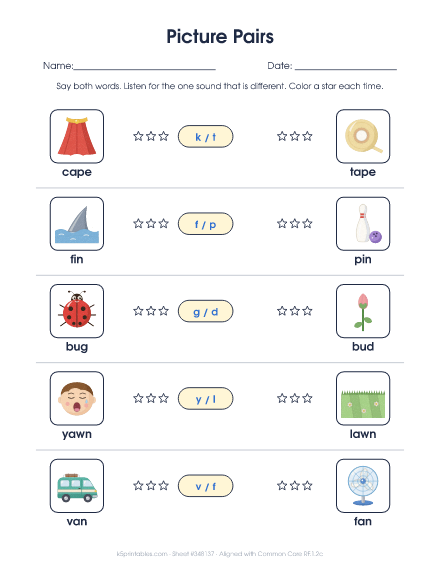 2. Picture PairsFive pairs of picture words that differ by one sound, like cape and tape, with the two sounds shown in the middle.
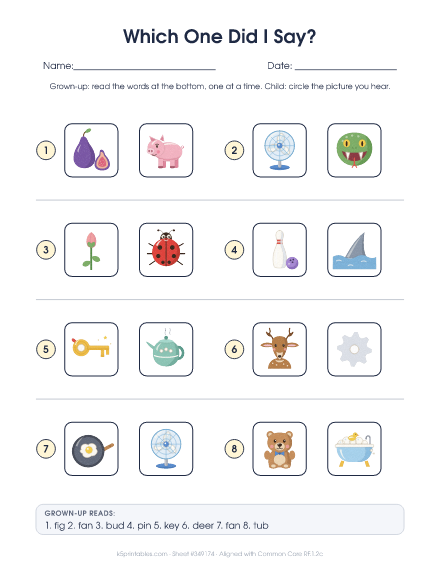 3. Which One Did I Say?A listening game. A grown-up reads the list at the bottom and the child circles the picture they hear.
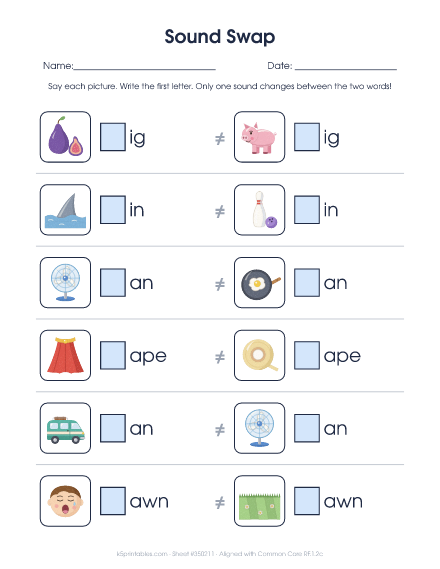 4. Sound SwapSix picture pairs where the rest of the word is given. Write the first letter that makes each word.