Tens and ones to 120 worksheets
Aligned with Common Core 1.NBT.B.2
Printable place value worksheets for first grade: counting tens and ones with base-ten blocks, a tens and ones chart, a 120 chart with missing numbers, and 10 more and 10 less.
The worksheets
- See it all
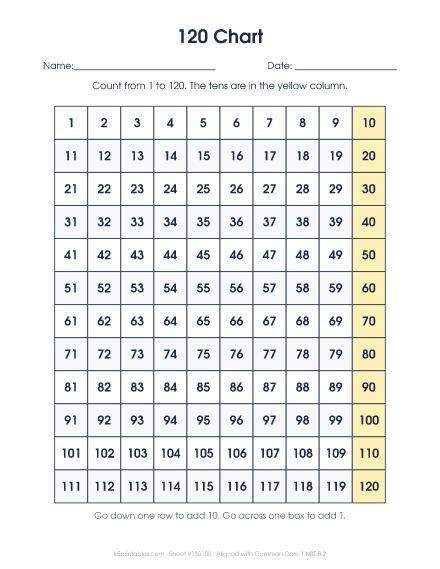
120 Chart
Every number from 1 to 120, with the tens column highlighted.
- See it all
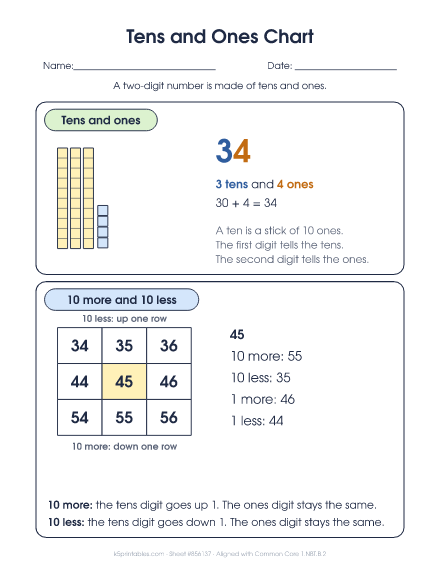
Tens and Ones Chart
34 shown as 3 tens and 4 ones, plus 10 more, 10 less, 1 more and 1 less on a piece of the 120 chart.
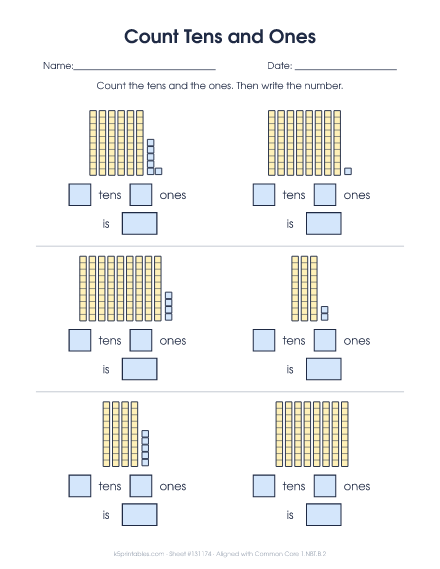
Count Tens and Ones
Base-ten block pictures to count as tens and ones, then write as a two-digit number.
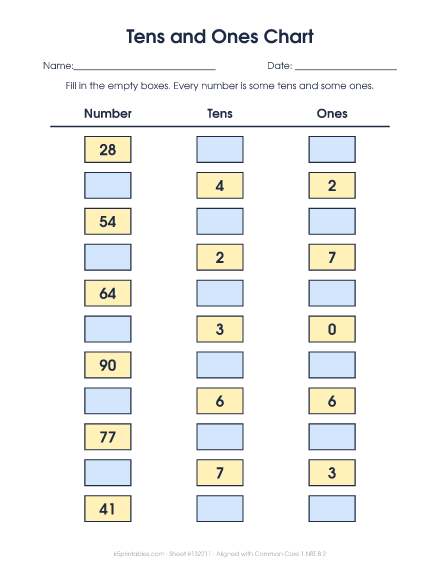
Tens and Ones Chart
A chart where some rows give the number and some give the tens and ones. Fill in the missing part.
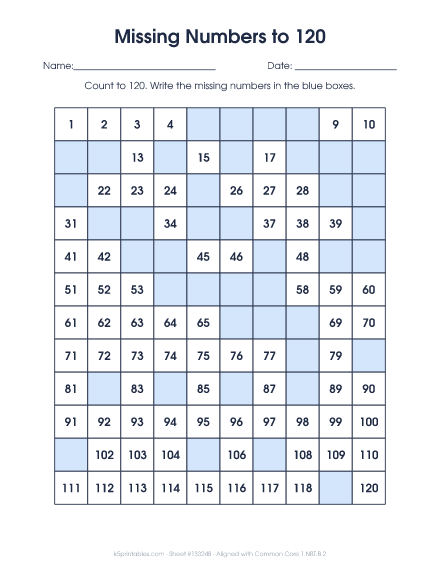
Missing Numbers to 120
A 1 to 120 chart with some numbers left out. Matches 1.NBT.A.1.
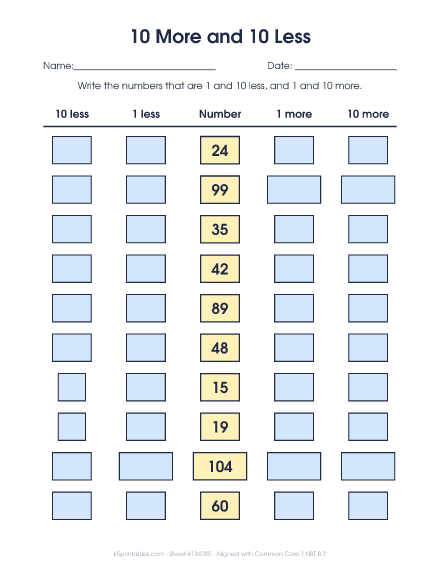
10 More and 10 Less
Find 1 less, 10 less, 1 more and 10 more than each number without counting one by one. Matches 1.NBT.C.5.
Print the whole packet
One copy of every sheet above, in order. Tap + for more copies (up to 10).
For the parent or teacher
What it is
Place value is knowing that in 34, the 3 means 3 tens (30) and the 4 means 4 ones. It's the idea that makes every bigger math topic work, from adding two-digit numbers to money. In first grade, kids count to 120 and learn to see a number as tens and ones.
What comes next
Comparing two-digit numbers with greater than and less than.
How to teach it
- Bundle things into tens. Rubber-band straws or popsicle sticks in groups of 10 and count the bundles.
- Use base-ten blocks or drawings of them. A long rod is 10, a small cube is 1.
- Say numbers two ways. "Forty-two is 4 tens and 2 ones."
- On a 120 chart, show that going down one row adds 10 and going up one row takes 10 away.
Common mistakes
- Writing the number the way it sounds, so "forty-two" becomes 402.
- Mixing up teen numbers, like writing 71 for seventeen.
- Counting the rods as ones (counting 3 rods as 3 instead of 30).