Subtraction to 20 Chart
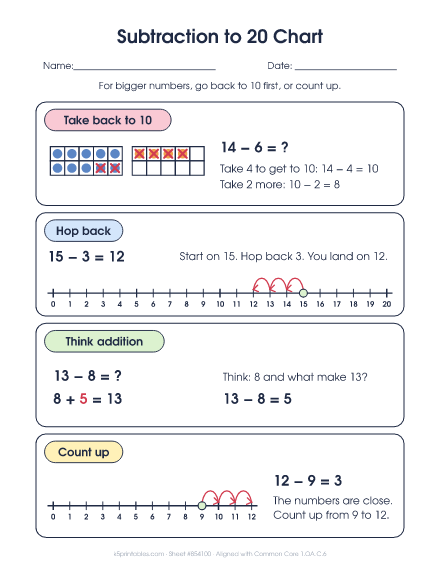
For bigger numbers, go back to 10 first, or count up.
Need more than one? Tap + for extra copies (up to 10).
How to do it
- Take back to 10 first.
- Hop back on a number line.
- Count up when the numbers are close.
Teaching tip
Count up works best when the two numbers are close, like 12 − 9. This sheet is aligned with Common Core 1.OA.C.6.
About this chart
Four ways to subtract within 20: take back to 10, hop back, think addition and count up.
What kids practice
Subtraction within 20 means taking away from a number that is 20 or less, like 15 - 7. These facts are harder than the ones within 10 because kids can't see them on two hands. Ten frames, number lines and addition facts they already know are what make them easy.
Watch for
- Counting the starting number as the first hop, which gives an answer one too small.
- Taking the smaller ones digit from the bigger one (13 - 5 becomes 12, because 5 - 3 = 2).
- Losing track while counting back a long way. Counting up from the small number is usually shorter.
It's free to print, as many copies as you need. See the full subtraction within 20 guide for 1st grade.
More sheets in this set
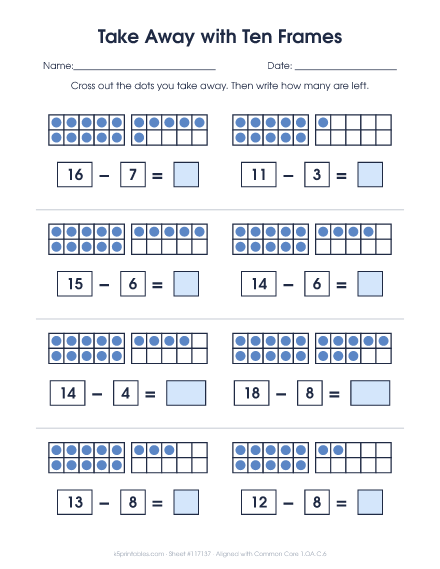 2. Take Away with Ten FramesTeen numbers shown on two ten frames. Cross out dots to take away, then count what is left.
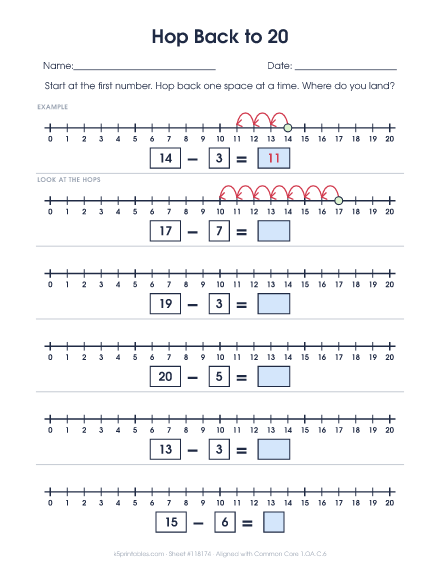 3. Hop Back to 20A 0 to 20 number line for each problem. Start on the big number and hop back.
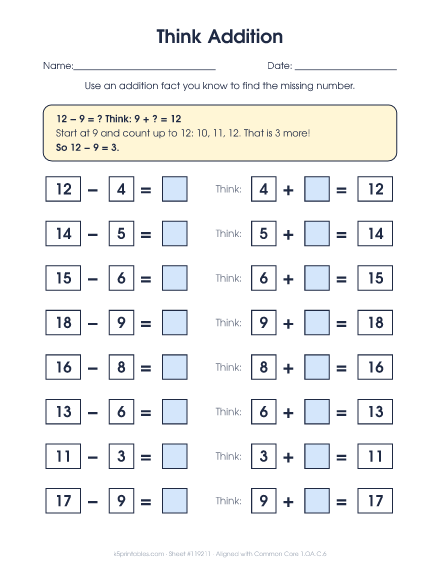 4. Think AdditionEach subtraction fact is paired with an addition fact that has a missing number, so kids can count up.
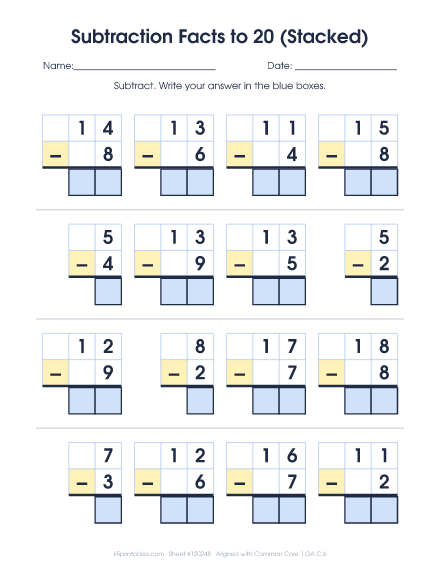 5. Subtraction Facts to 20 (Stacked)Sixteen subtraction facts from numbers up to 20, written top to bottom.
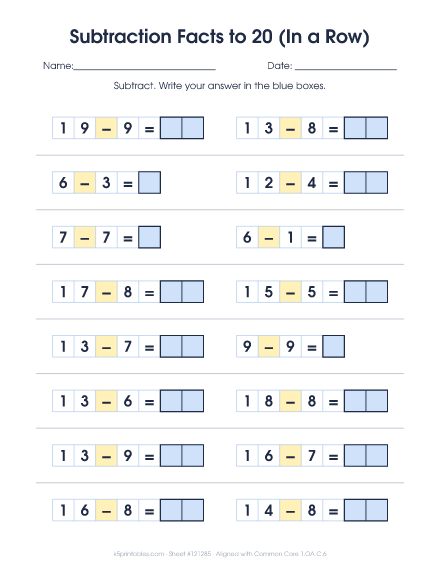 6. Subtraction Facts to 20 (In a Row)Sixteen subtraction facts from numbers up to 20, written across the page.