Pre-writing strokes and tracing worksheets
Printable kindergarten pre-writing worksheets: a strokes chart, trace the path from an animal to its treat, finish the picture with dotted lines, and big stroke warm-ups.
The worksheets
- See it all
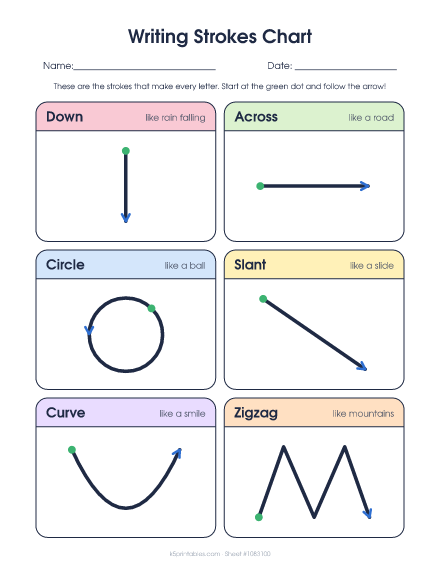
Writing Strokes Chart
The six strokes that make every letter, with start dots and arrows.
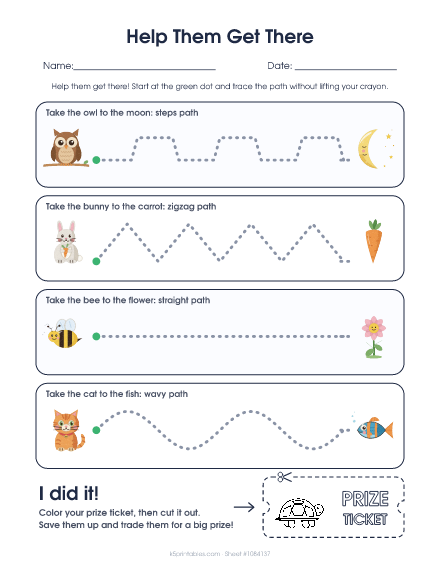
Help Them Get There
Dotted paths from an animal to its treat, like a bee to a flower. Paths are straight, wavy, zigzag, hills, steps or loopy. More has the trickiest paths.
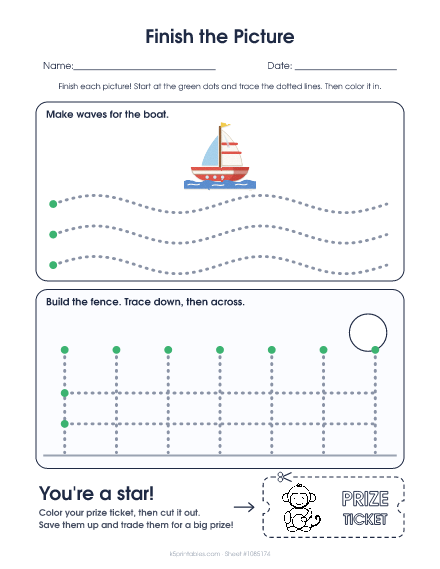
Finish the Picture
Two scenes to finish by tracing, like rain from a cloud, a fence, waves, balloon strings, grass or a kite string.
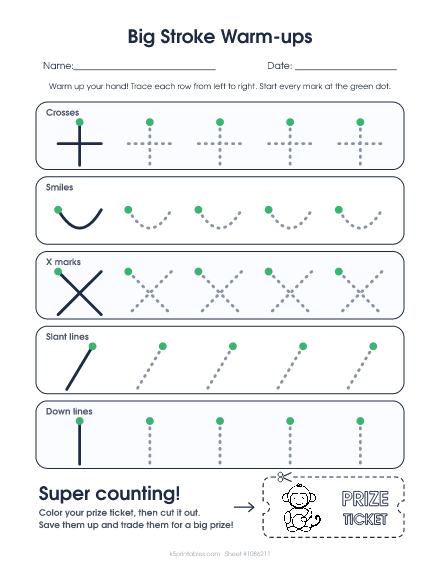
Big Stroke Warm-ups
Rows of big strokes to trace, like down lines, circles, crosses and X marks.
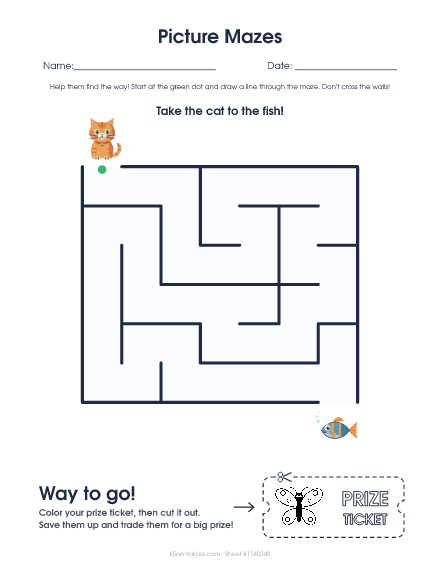
Picture Mazes
Mazes from an animal to its treat, like a cat to a fish. Fewer mazes are small and wide open, More mazes are bigger.
Print the whole packet
One copy of every sheet above, in order. Tap + for more copies (up to 10).
For the parent or teacher
What it is
Every letter is made from a few simple strokes: down, across, circles, slants, curves and zigzags. Practicing these big strokes builds the hand control kids need before letters feel easy.
What comes next
Uppercase and lowercase letters.
How to teach it
- Go big first. Draw the strokes in the air, in sand or on a whiteboard before paper.
- Start at the green dot every time. Starting in the right place makes letters easier later.
- Use short, chunky crayons. They help small hands hold a good grip.
- Keep it short. A few minutes of tracing is plenty at this age.
Common mistakes
- Starting at the bottom instead of the top.
- Gripping the crayon in a fist. Show how to pinch it with the thumb and first finger.
- Going too fast and skipping off the dotted line. Slow and steady wins.