Stories with dialogue worksheets
Aligned with Common Core W.5.3
Printable fifth-grade story writing worksheets: a chart, punctuating dialogue, picking the dialogue tag, starting a new paragraph for each speaker, showing feelings with details, time transitions, and a story planner with dialogue.
The worksheets
- See it all
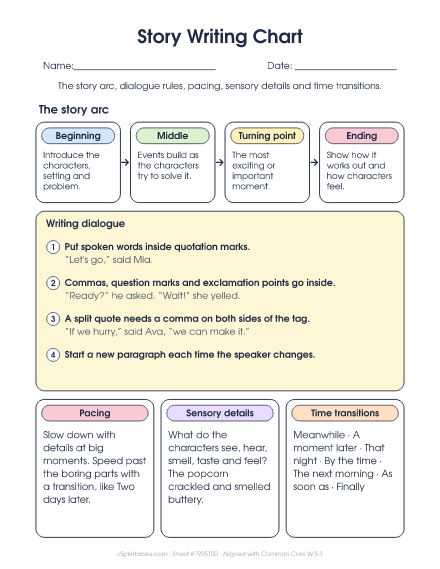
Story Writing Chart
The story arc, four rules for writing dialogue with examples, and tips on pacing, sensory details and time transitions.
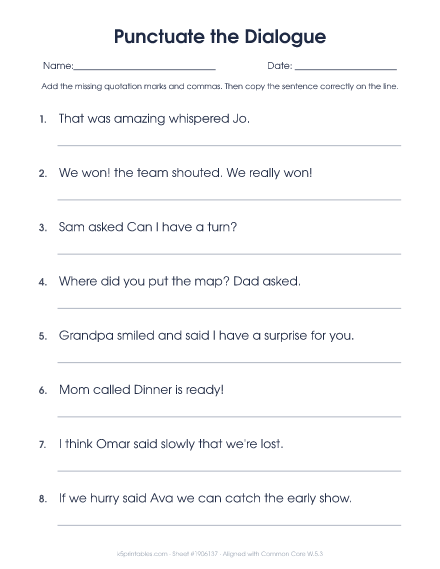
Punctuate the Dialogue
Lines of dialogue missing their quotation marks and commas, including split quotes and questions or exclamations inside the quotes. Fewer, Standard or More give 6, 8 or 10. Includes an answer key.
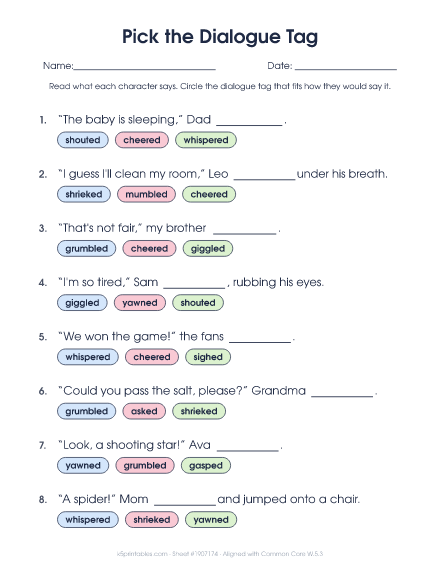
Pick the Dialogue Tag
Lines of dialogue with a blank for a tag like whispered, shouted, mumbled or gasped. Fewer, Standard or More give 6, 8 or 10. Includes an answer key.
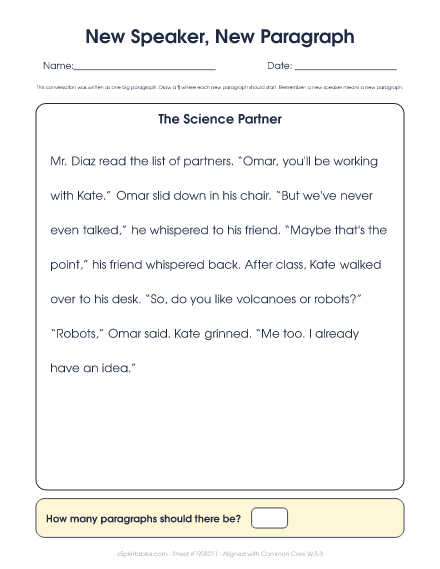
New Speaker, New Paragraph
Three short original conversations written as one long paragraph, to mark where each new paragraph should start. New sheet gives a different conversation. Includes an answer key.
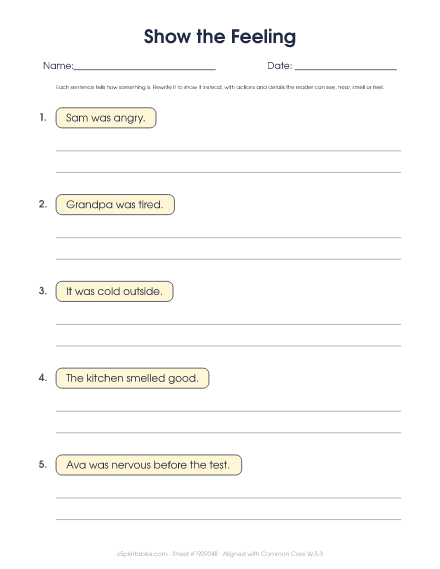
Show the Feeling
Telling sentences like "Maya was scared" to rewrite with actions and sensory details. Fewer, Standard or More give 4, 5 or 6. The answer key shows sample sentences.
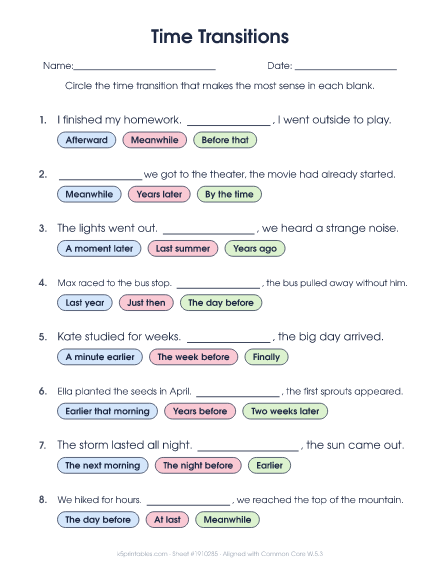
Time Transitions
Sentences with a blank for a time transition like meanwhile, at last or by the time. Fewer, Standard or More give 6, 8 or 10. Includes an answer key.
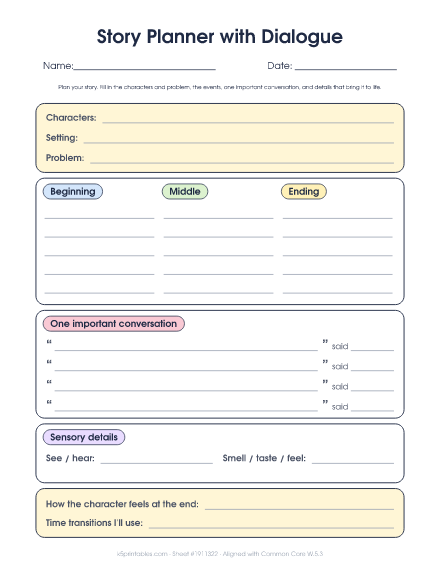
Story Planner with Dialogue
A one-page planner with room for characters, setting and problem, the beginning, middle and end, one important conversation, sensory details, and how the story ends.
Print the whole packet
One copy of every sheet above, in order. Tap + for more copies (up to 10).
For the parent or teacher
What it is
In fifth grade, students write stories with a clear beginning, middle and end, and they bring them to life with dialogue, description and pacing. They learn to punctuate dialogue, including split quotes, to start a new paragraph when the speaker changes, to show feelings through actions and sensory details, and to move through time with transitions.
What comes next
Opinion with evidence and research reports use the same planning skills.
How to teach it
- Teach in order or jump to whatever your student needs. A student may write exciting events and still be building the habit of punctuating dialogue correctly.
- Look at how dialogue is set up in a favorite book, then try the same patterns.
- Act out a short conversation, then write it down with a new paragraph for each speaker.
- When a sentence tells a feeling, ask what the character would do, say or notice.
- Slow down at the most important moment of the story and speed up through the rest.
Common mistakes
- Putting commas and end marks outside the quotation marks.
- Leaving out the comma after the tag in a split quote.
- Running two speakers together in one paragraph.
- Telling every feeling, like "she was sad," instead of showing it.
Helpful supplies (affiliate links)
Simple supplies that go with these sheets.
Speech bubble sticky notes
Write what each character says.
Find it on AmazonBlank comic book
Empty panels to draw and write your own comics.
Find it on AmazonStory starter cards
Pick a card and start writing.
Find it on AmazonChildren's thesaurus
Find words that mean the same, the opposite, or something stronger.
Find it on Amazon