Self-advocacy and group conversation worksheets
Aligned with Common Core SL.5.1
Printable fifth-grade self-advocacy and group conversation worksheets for speech and language: a speaking up chart, choosing what to say, ask-for-help scripts, group role cards, building on others' ideas, disagreeing kindly and a group talk self-check.
The worksheets
- See it all
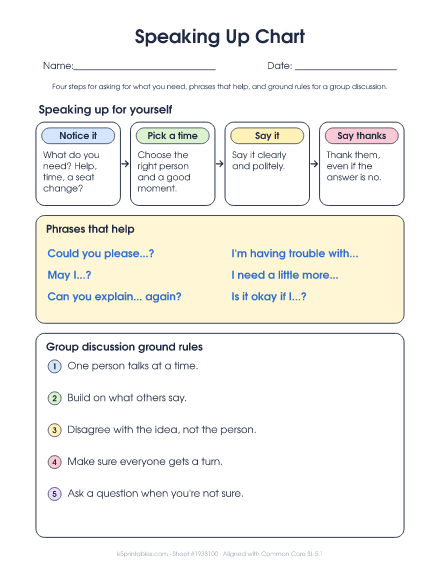
Speaking Up Chart
Four steps for asking for what you need, six helpful phrases, and five ground rules for a group discussion.
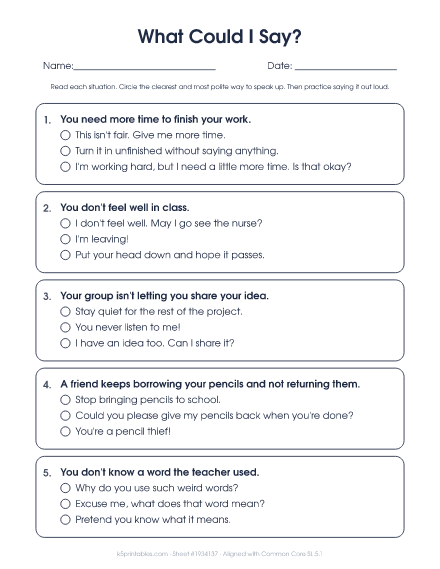
What Could I Say?
School and home situations, like not being able to see the board, with three ways to respond. Fewer, Standard or More give 4, 5 or 6. Includes an answer key.
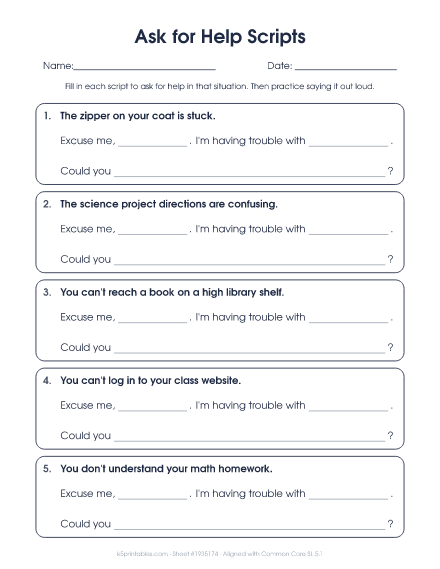
Ask for Help Scripts
Fill-in scripts like "Excuse me, ___. I'm having trouble with ___. Could you ___?" for different situations. Fewer, Standard or More give 4, 5 or 6. The answer key shows samples.
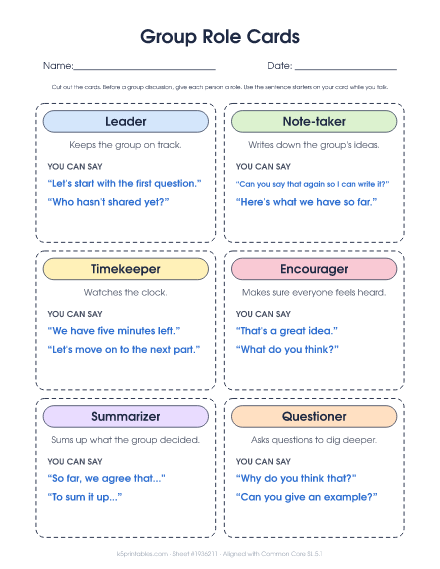
Group Role Cards
Six cut-apart role cards: leader, note-taker, timekeeper, encourager, summarizer and questioner, each with what the role does and things to say.
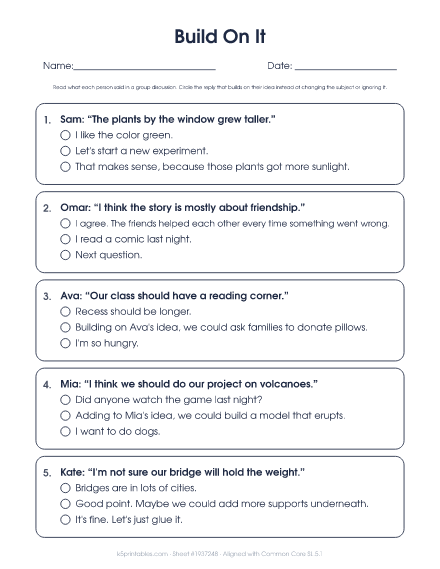
Build On It
Things people say in a group discussion, each with three replies: one that builds on the idea, one off topic and one that ignores it. Fewer, Standard or More give 4, 5 or 6. Includes an answer key.
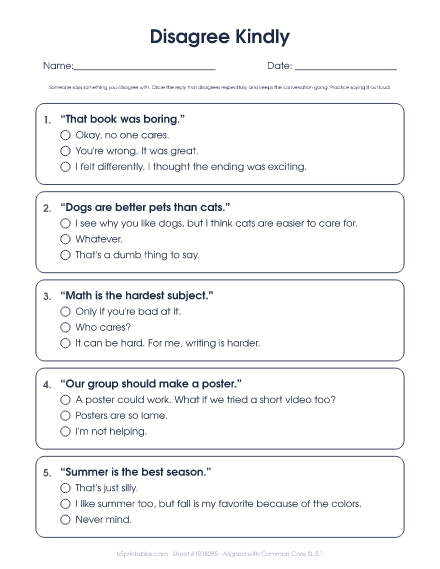
Disagree Kindly
Statements to disagree with, each with a respectful reply, a rude reply and a reply that shuts the conversation down. Fewer, Standard or More give 4, 5 or 6. Includes an answer key.
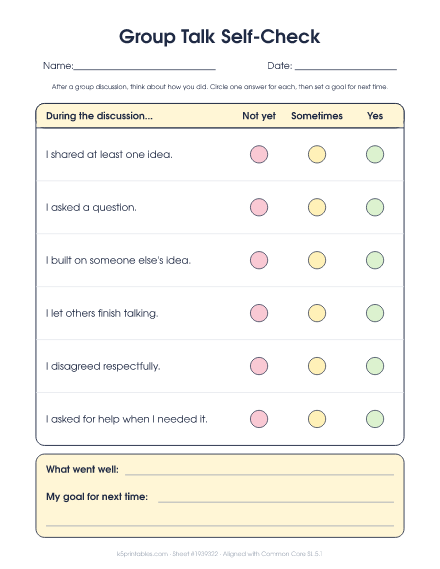
Group Talk Self-Check
A self-check for after a group discussion, with six skills to rate and space for what went well and a goal.
Print the whole packet
One copy of every sheet above, in order. Tap + for more copies (up to 10).
For the parent or teacher
What it is
Self-advocacy means asking for what you need, like help, more time or a better seat, clearly and politely. Group conversation means taking part in a discussion: sharing ideas, building on what others say, disagreeing respectfully and making sure everyone gets a turn. These skills help students in class, in groups and in everyday life.
What comes next
The 4th grade Fixing a conversation topic practices staying on topic, asking clarifying questions and fixing misunderstandings.
How to teach it
- Teach in order or jump to whatever your student needs. A student may know what they need and still be building the confidence to ask for it.
- Role-play common situations, like asking a teacher to repeat directions, before they happen.
- Praise your student when they speak up for themselves, even when the answer is no.
- Practice group skills at the dinner table, where everyone takes turns and builds on each other.
Common mistakes
- Staying quiet instead of asking for help.
- Asking in a way that sounds rude or demanding.
- Changing the subject instead of building on what someone said.
- Disagreeing with the person instead of the idea.
Helpful supplies (affiliate links)
Simple supplies that go with these sheets.
Conversation starter cards
Prompts for back-and-forth talk.
Find it on AmazonSocial skills game
Practice what to say in everyday moments.
Find it on AmazonConversation ball
Toss, catch and answer the question under your thumb.
Find it on AmazonBooks about speaking up
Stories about asking for help and sharing ideas.
Find it on Amazon