Advanced roots and affixes worksheets
Aligned with Common Core L.5.4b
Printable fifth-grade roots and affixes worksheets: a chart of new Greek and Latin roots, prefixes and suffixes, matching pages, splitting long words into parts, choosing the right word from a word family, using roots to work out new words, and building word families.
The worksheets
- See it all
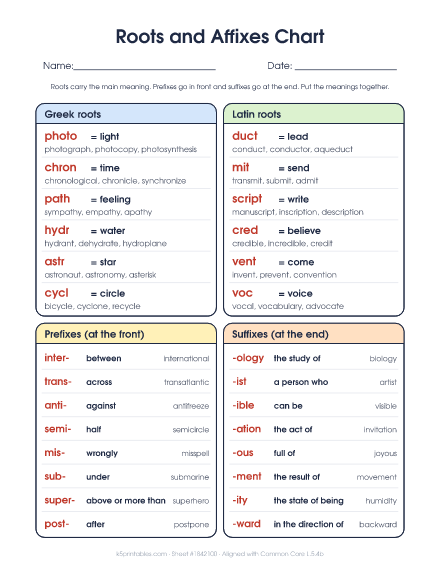
Roots and Affixes Chart
Six Greek and six Latin roots, each with its meaning and three example words, plus eight prefixes and eight suffixes with their meanings and an example.
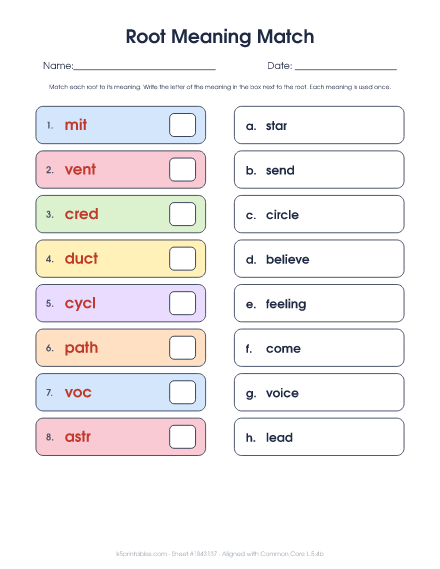
Root Meaning Match
Roots in one column and their meanings in the other, to match by letter. Fewer, Standard or More give 6, 8 or 10 roots. Includes an answer key.
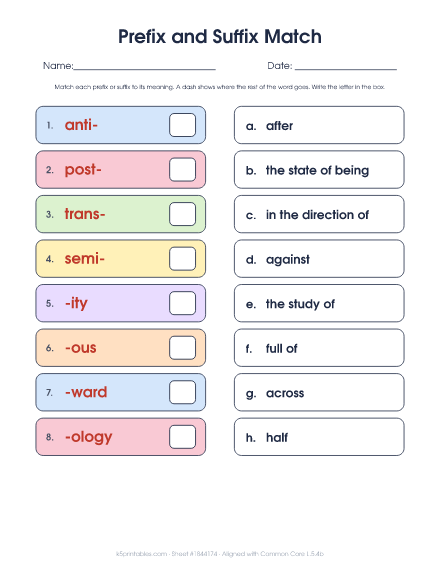
Prefix and Suffix Match
Prefixes and suffixes in one column and their meanings in the other, to match by letter. Fewer, Standard or More give 6, 8 or 10. Includes an answer key.
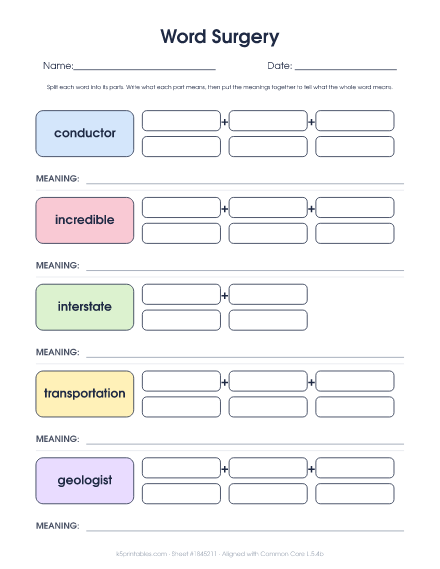
Word Surgery
Long words like transportation and postscript to split into parts and explain. Fewer gives 4 words already split, Standard 5 and More 6. The answer key shows the parts, their meanings and the meaning of the whole word.
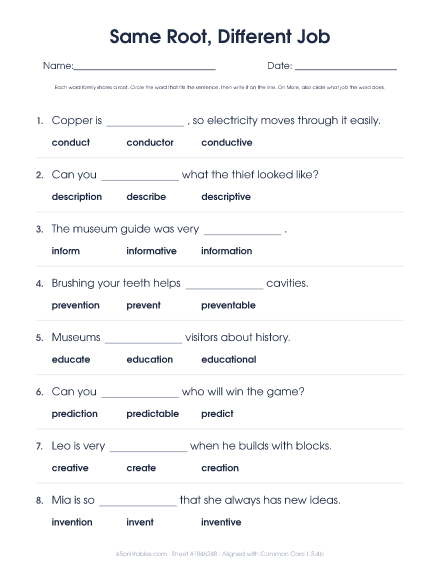
Same Root, Different Job
Sentences with a blank and three words from one family, like predict, prediction and predictable. Fewer gives 6 sentences, Standard 8, and More 8 with the word's job to circle too. Includes an answer key.
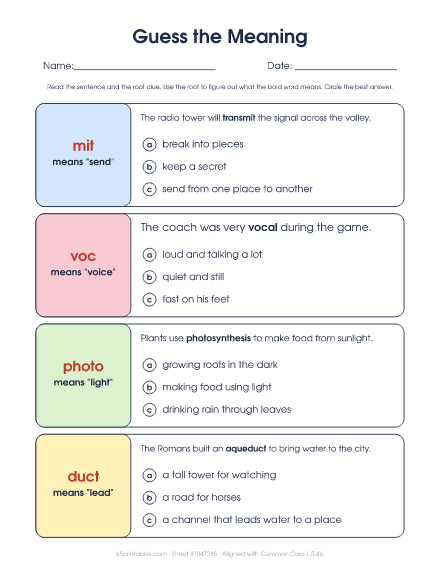
Guess the Meaning
Harder words like chronological, aqueduct and empathy in real sentences, with a root clue to figure out each meaning. Fewer, Standard or More give 3, 4 or 5 words. Includes an answer key.
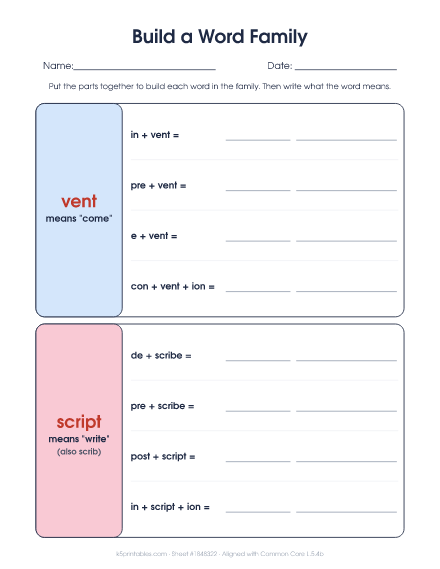
Build a Word Family
A root with parts to add, like con + vent + ion, to build each word in the family and explain it. Fewer gives 1 family, Standard 2 and More 3. Includes an answer key.
Print the whole packet
One copy of every sheet above, in order. Tap + for more copies (up to 10).
For the parent or teacher
What it is
In 4th grade, students learned 20 common Greek and Latin roots. This topic adds 12 new roots, like chron (time), cred (believe) and mit (send), along with prefixes like trans- and semi- and suffixes like -ology and -ous. Students take long words apart, put the meanings of the parts together, and notice how a suffix changes a word's job, like predict, prediction and predictable.
What comes next
Reading with expression.
How to teach it
- Teach in order or jump to whatever your student needs. A student may know the roots well and still be building the habit of using the prefix and suffix too.
- Take long words apart together. Find the root first, then the prefix and suffix around it.
- Put the part meanings in order to make a definition, then check that it fits the sentence.
- When a new long word comes up in reading, ask "what parts can you find?"
Common mistakes
- Guessing from the root alone without using the prefix or suffix.
- Splitting a word in the wrong place, like seeing "cycle" in "encyclopedia" and stopping there.
- Thinking every word with the same letters shares a root, like "path" in "pathway."
- Choosing a word from the right family but with the wrong job, like "Can you prediction who will win?"