Volume worksheets
Aligned with Common Core 5.MD.C.5
Printable fifth-grade volume worksheets and how-to teaching pages: counting unit cubes, finding volume layer by layer, using V = length × width × height, adding the volumes of combined shapes, and volume word problems.
The worksheets
- See it all
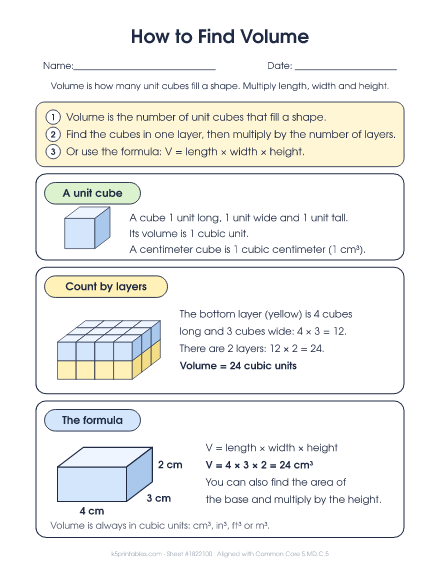
How to Find Volume
A unit cube and what 1 cm³ means, a 4 × 3 × 2 box counted layer by layer, and the same box with V = 4 × 3 × 2 = 24 cm³.
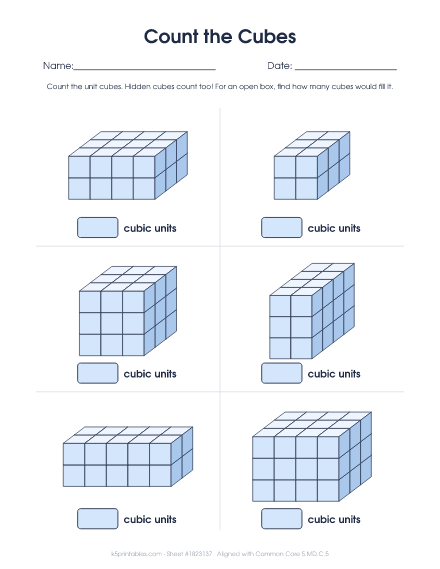
Count the Cubes
Boxes built from unit cubes to count. Fewer has 4 boxes up to 3 × 3 × 3, Standard has 6 up to 5 × 4 × 4, and More has 6 that include open boxes with only some cubes inside. Includes an answer key.
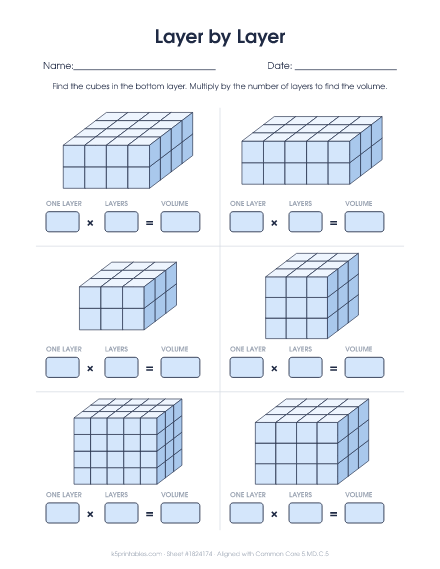
Layer by Layer
Boxes made of cubes with spaces for one layer × layers = volume. Fewer has 4 boxes with the bottom layer shaded, Standard has 6, and More has 6 that include open boxes. Includes an answer key.
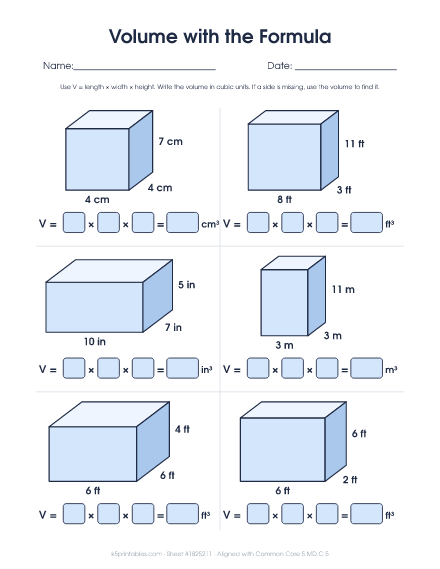
Volume with the Formula
Boxes labeled in centimeters, inches, feet and meters to find the volume with V = length × width × height. Fewer has 4 with sides up to 6, Standard has 6 with sides up to 12, and More has 6 where some give the volume and ask for a missing side. Includes an answer key.
- See it all
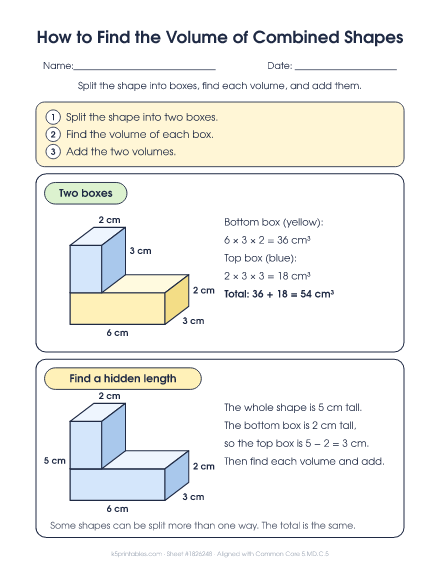
How to Find the Volume of Combined Shapes
An L-shaped solid split into a yellow box and a blue box, 36 + 18 = 54 cm³, and the same shape with a hidden height to find by subtracting.
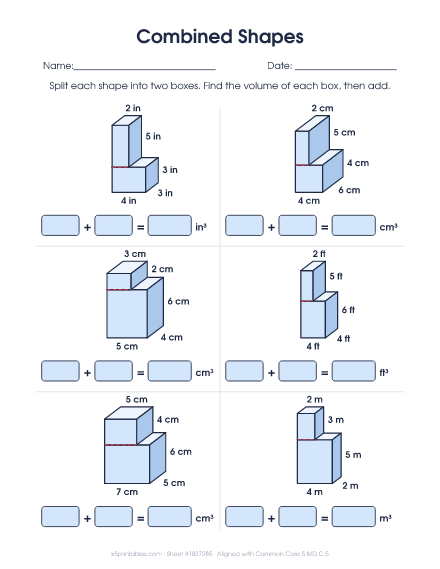
Combined Shapes
Solids made of two boxes with labeled sides, to find the total volume. Fewer has 4 shapes with the two boxes in different colors, Standard has 6 with a dashed line where they split, and More has 6 with no split line and a hidden height to find. Includes an answer key.
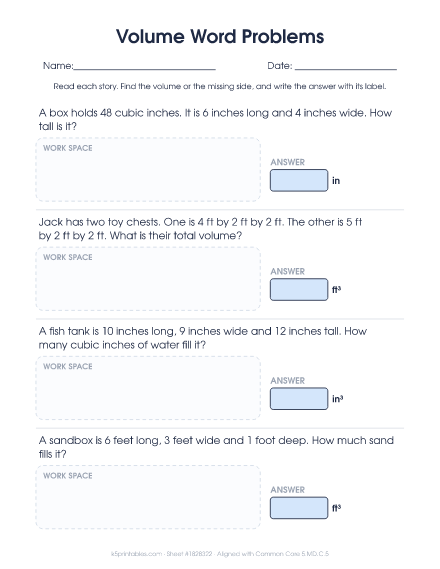
Volume Word Problems
Stories about fish tanks, sandboxes, garden beds, toy chests and cereal boxes. Fewer has 3 problems, Standard has 4, and More has 5, including finding three different boxes with a volume of 24. Includes an answer key.
Print the whole packet
One copy of every sheet above, in order. Tap + for more copies (up to 10).
For the parent or teacher
What it is
Volume is how much space a solid shape takes up, measured by how many unit cubes fill it. Students start by counting cubes, then see that a box is made of layers: the cubes in the bottom layer times the number of layers. That leads to the formula V = length × width × height, with answers in cubic units like cm³ or ft³. Last, they find the volume of shapes made of two boxes by splitting them apart and adding.
What comes next
Converting units.
How to teach it
- Teach in order or jump to whatever your student needs. A student may use the formula easily and still be building an understanding of what volume means.
- Build boxes with sugar cubes, dice or blocks, then count them layer by layer.
- Point out that hidden cubes in the back and middle still count.
- Compare area and volume. Area covers a flat space in square units, and volume fills a space in cubic units.
Common mistakes
- Counting only the cubes you can see.
- Adding the length, width and height instead of multiplying.
- Writing square units, like cm², instead of cubic units, like cm³.
- Counting the cubes on the edges twice.
- Using the total height for the top box of a combined shape instead of finding its own height.