The coordinate plane worksheets
Aligned with Common Core 5.G.A.1
Printable fifth-grade coordinate plane worksheets and a how-to teaching page: reading and plotting ordered pairs, connecting points to make shapes, graphing two number patterns, and solving problems on a map grid.
The worksheets
- See it all
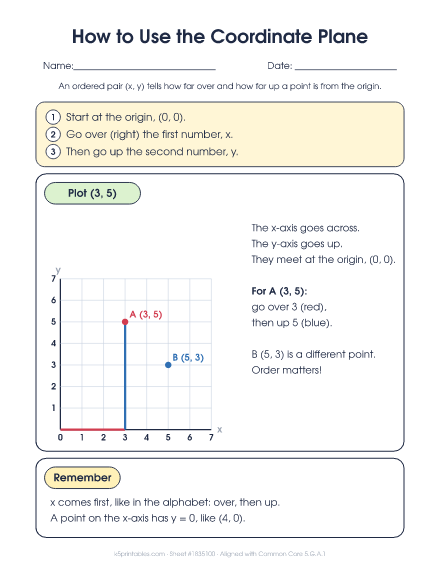
How to Use the Coordinate Plane
The x-axis, the y-axis and the origin, with (3, 5) plotted by going over 3 and up 5, and (5, 3) shown to see why order matters.
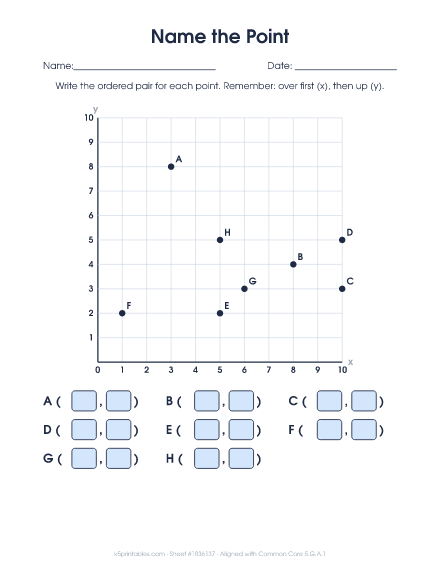
Name the Point
Lettered points on a grid to name with ordered pairs. Fewer has 6 points on a 0 to 6 grid, Standard has 8 on a 0 to 10 grid, and More has 12, including points on the axes. Includes an answer key.
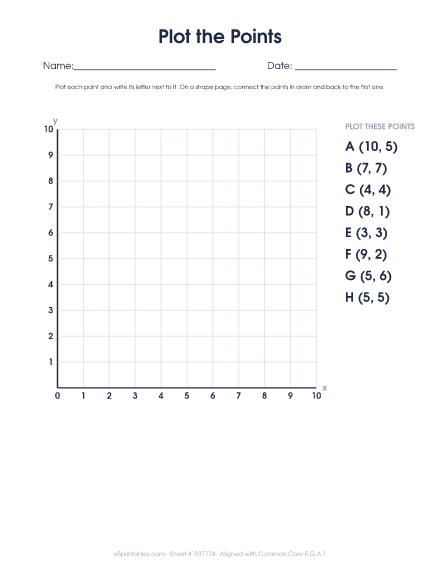
Plot the Points
Ordered pairs to plot and label on a grid. Fewer has 6 points on a 0 to 6 grid, Standard has 8 on a 0 to 10 grid, and More has points to connect in order to make a shape. The answer key shows every point.
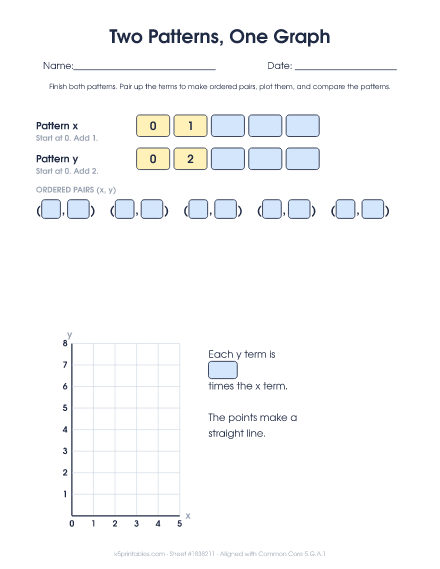
Two Patterns, One Graph
Two number patterns with different rules, like add 2 and add 4, to finish, turn into ordered pairs and graph. Fewer gives the first three terms, Standard gives the first two, and More gives one and has six terms. Includes an answer key.
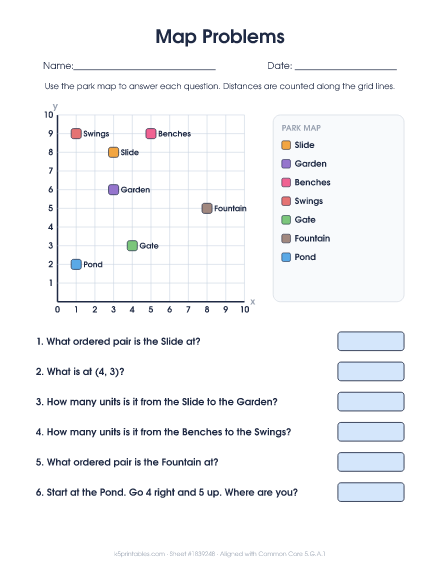
Map Problems
A park map on a coordinate grid with questions about where places are, what is at a point, and how far apart two places are. Fewer has 4 questions, Standard has 6 and More has 8. Includes an answer key.
Print the whole packet
One copy of every sheet above, in order. Tap + for more copies (up to 10).
For the parent or teacher
What it is
The coordinate plane is a grid made by two number lines, the x-axis going across and the y-axis going up. They meet at the origin, (0, 0). An ordered pair like (3, 5) tells how to find a point: go over 3, then up 5. Students name and plot points, graph two patterns as ordered pairs, and use a grid map to find places and distances.
What comes next
Line plots.
How to teach it
- Teach in order or jump to whatever your student needs. A student may plot points easily and still be building the habit of always going over first, then up.
- Say "over, then up" every time, or "walk, then climb."
- Point out that (3, 5) and (5, 3) are different points.
- Make a grid on the floor with tape and have your student walk to points.
Common mistakes
- Going up first and then over, so (3, 5) lands at (5, 3).
- Counting the lines from 1 instead of 0.
- Putting a point in a square instead of where two lines cross.
- Forgetting that a point on an axis has a 0, like (4, 0).