Syllable types worksheets
Aligned with Common Core RF.3.3c
Printable third-grade syllable worksheets: the six syllable types, open and closed syllables, sorting words by type, splitting and labeling longer words, building words from syllables and consonant-le words.
The worksheets
- See it all
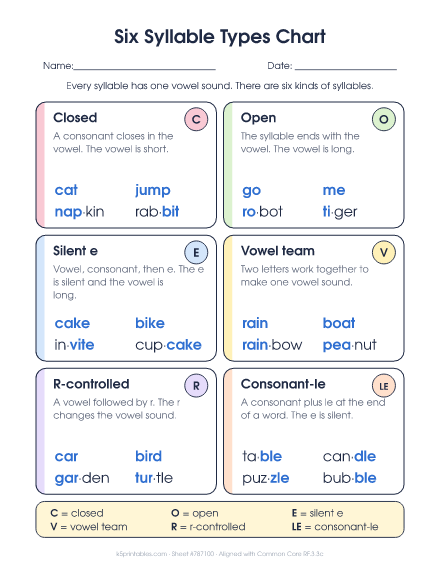
Six Syllable Types Chart
Closed, open, silent e, vowel team, r-controlled and consonant-le, with a rule and example words for each.
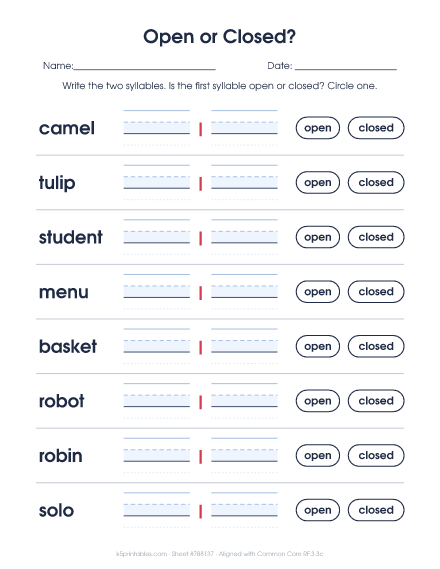
Open or Closed?
Words like ro-bot and rab-bit. Split each word, then decide if the first syllable is open or closed.
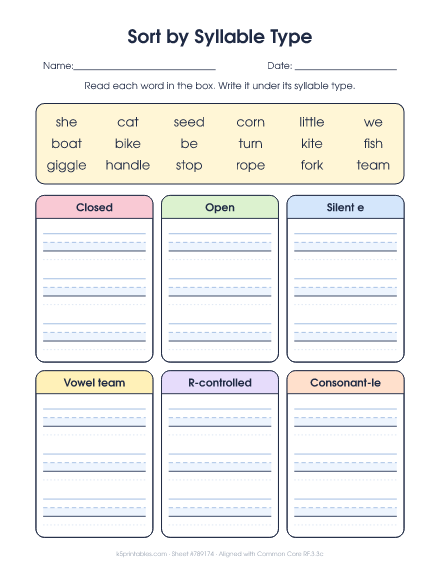
Sort by Syllable Type
A word bank to sort into closed, open, silent e, vowel team, r-controlled and consonant-le.
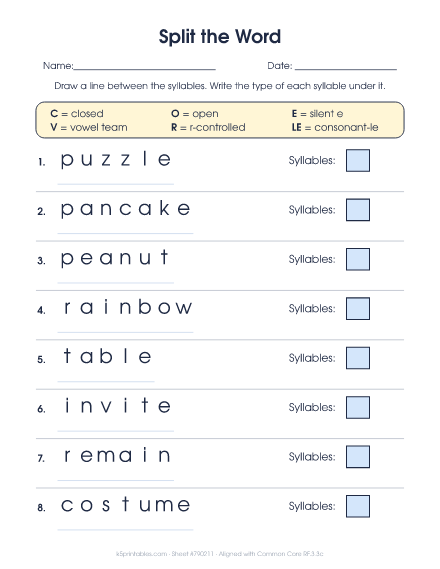
Split the Word
Two- and three-syllable words like fan-tas-tic to split and label with each syllable's type.
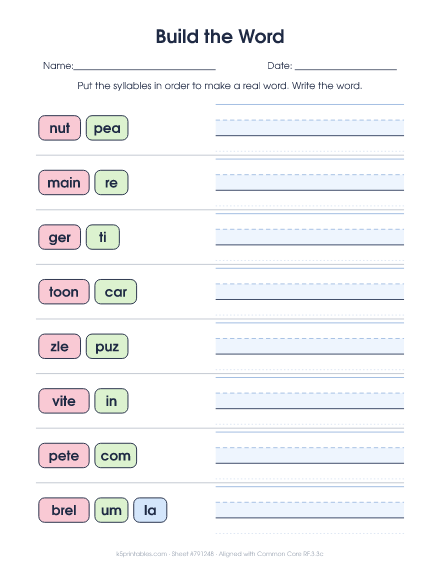
Build the Word
Mixed-up syllable cards like "der spi" to put in order and write as a word.
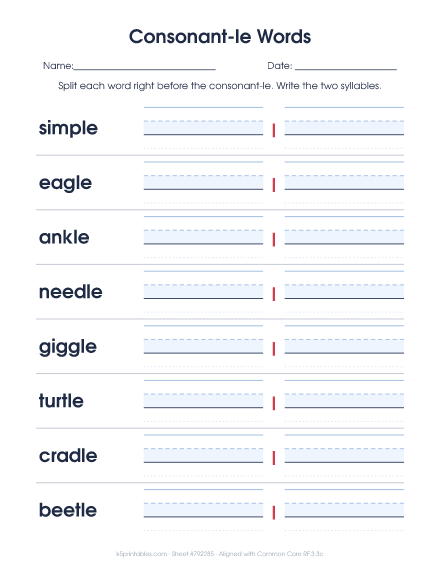
Consonant-le Words
Words like ta-ble, can-dle and puz-zle to split before the consonant-le.
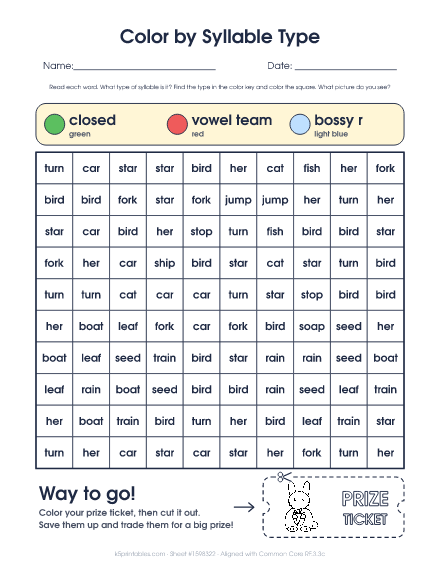
Color by Syllable Type
A hidden picture made of one-syllable words: closed, open, silent e, vowel team and bossy r. Includes an answer key.
Print the whole packet
One copy of every sheet above, in order. Tap + for more copies (up to 10).
For the parent or teacher
What it is
Every syllable has one vowel sound, and there are six kinds of syllables: closed, open, silent e, vowel team, r-controlled and consonant-le. Knowing the type tells a reader what sound the vowel makes. Third graders use syllable types to break long words into parts they can read, like fan-tas-tic and tor-na-do.
What comes next
Prefixes, suffixes and roots.
How to teach it
- Start with closed and open syllables. Compare "hi" and "him."
- Find the vowels in a long word first, then look for where to split.
- Say each syllable on its own, then blend them together.
- Label each part with its type. It helps your child decide on a short or long vowel.
- If a split sounds wrong, try splitting after the next letter instead, like lem-on instead of le-mon.
Common mistakes
- Making every first syllable long. In lemon and camel, the first syllable is closed and short.
- Splitting off just the le in consonant-le words. The consonant goes with it, like ta-ble.
- Counting silent letters as their own syllable, like the e in cake.