Rounding to 10 and 100 worksheets
Aligned with Common Core 3.NBT.A.1
Printable third-grade rounding worksheets: round numbers to the nearest 10 and 100 on number lines and with the "5 or more" rule, round the same number both ways, and solve rounding riddles.
The worksheets
- See it all
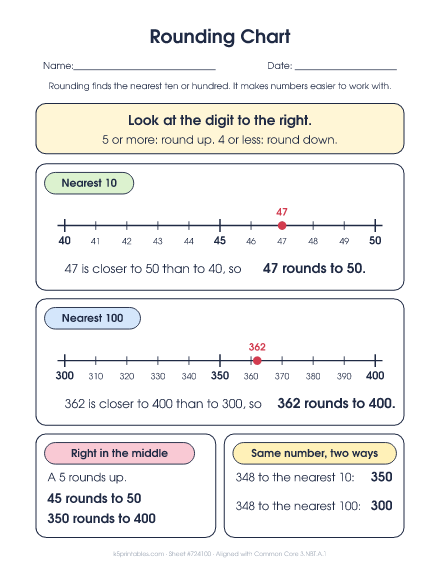
Rounding Chart
Number lines showing 47 rounds to 50 and 362 rounds to 400, the "5 or more" rule, and one number rounded two ways.
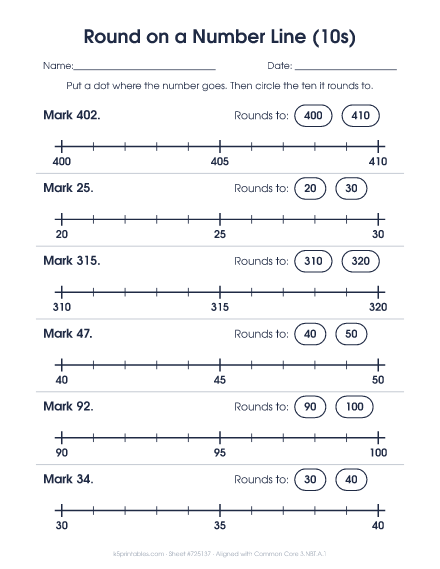
Round on a Number Line (10s)
Number lines between two tens. Mark the number, then circle the nearest ten.
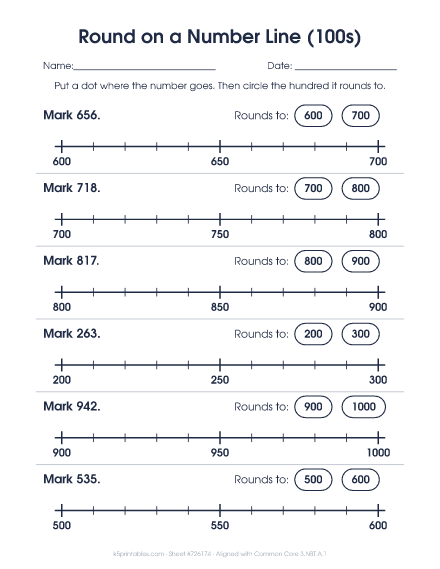
Round on a Number Line (100s)
Number lines between two hundreds, with a tick every 10. Mark the number, then circle the nearest hundred.
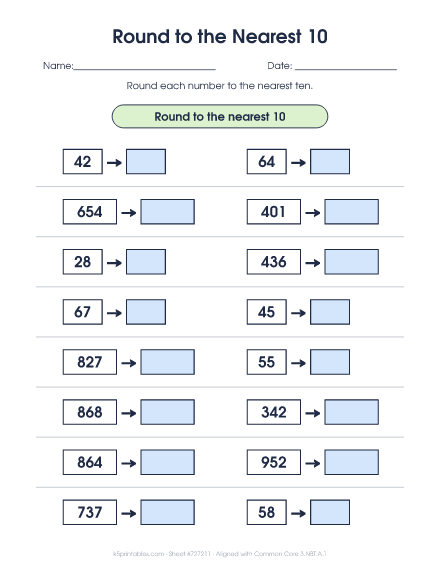
Round to the Nearest 10
Two- and three-digit numbers to round to the nearest ten, like 63 → 60 and 347 → 350.
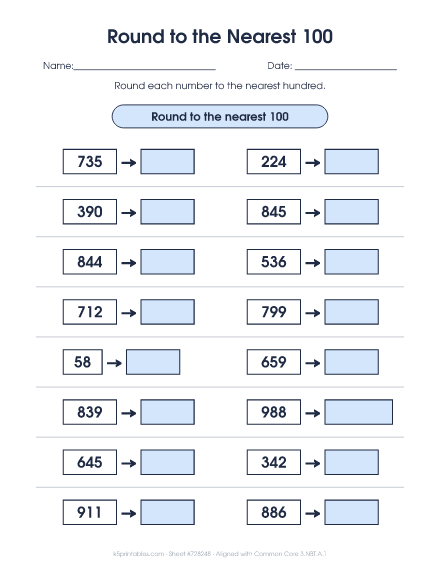
Round to the Nearest 100
Numbers to round to the nearest hundred, like 348 → 300 and 750 → 800.
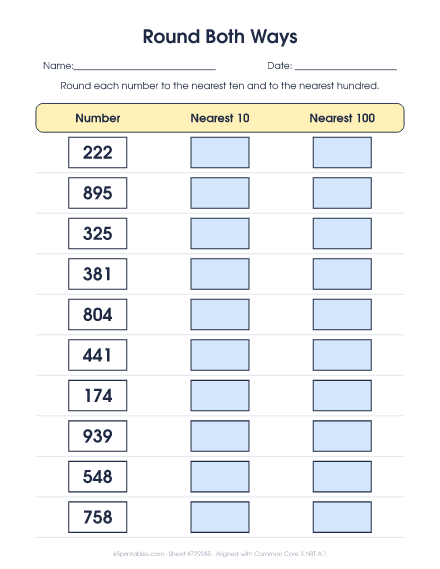
Round Both Ways
A table to round each three-digit number to the nearest 10 and the nearest 100.
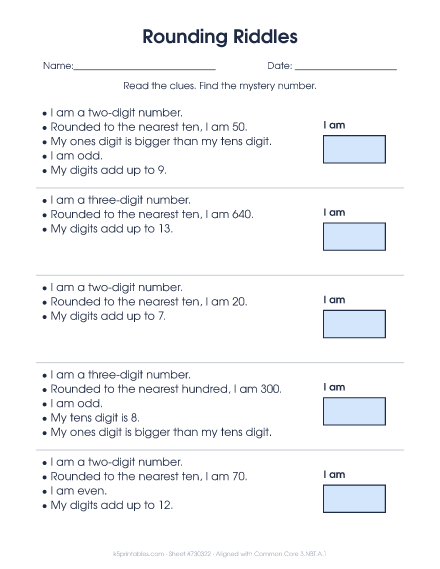
Rounding Riddles
Mystery number riddles with rounding, odd and even, and digit clues.
Print the whole packet
One copy of every sheet above, in order. Tap + for more copies (up to 10).
For the parent or teacher
What it is
Rounding finds the nearest ten or hundred, so 47 rounds to 50 and 362 rounds to 400. Third graders round numbers up to 1,000 by thinking about which ten or hundred a number is closer to on a number line. Rounding makes numbers easier to work with, and children use it to estimate answers and check that they make sense.
What comes next
Three-digit addition and subtraction, where rounding helps estimate and check answers.
How to teach it
- Start with a number line. Ask "Which ten is it closer to?"
- Look at the digit just to the right of the place you are rounding to. 5 or more rounds up, 4 or less rounds down.
- Practice the tricky middle numbers, like 45 and 350, which round up.
- Round the same number to the nearest 10 and the nearest 100 and compare the answers.
- Use rounding in real life, like "about how much" at the store.
Common mistakes
- Looking at the wrong digit, like the ones digit when rounding to the nearest 100.
- Changing the digits that should stay, like rounding 348 to 400 when rounding to the nearest 10.
- Rounding 45 down to 40. A 5 rounds up.