Division concepts worksheets
Aligned with Common Core 3.OA.A.2
Printable third-grade division worksheets: sharing equally, making equal groups, arrays, fact family triangles, missing numbers and division facts to 90 ÷ 9.
The worksheets
- See it all
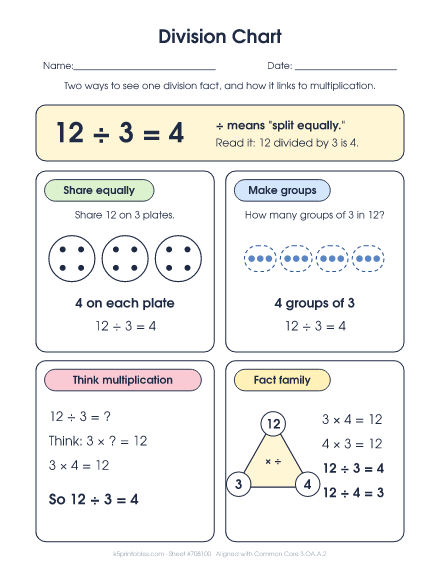
Division Chart
12 ÷ 3 = 4 shown as sharing equally, making groups, thinking multiplication and a fact family.
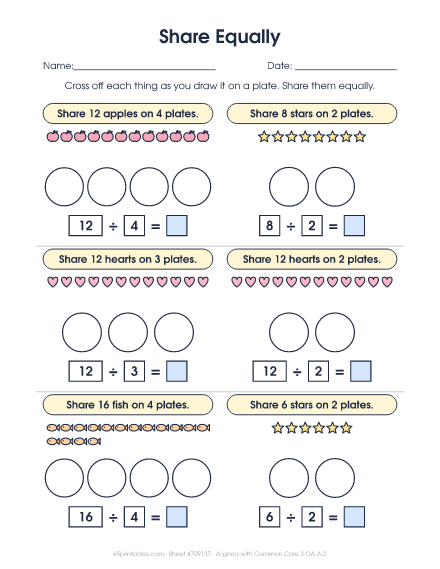
Share Equally
Share pictures equally onto plates, then write the division.
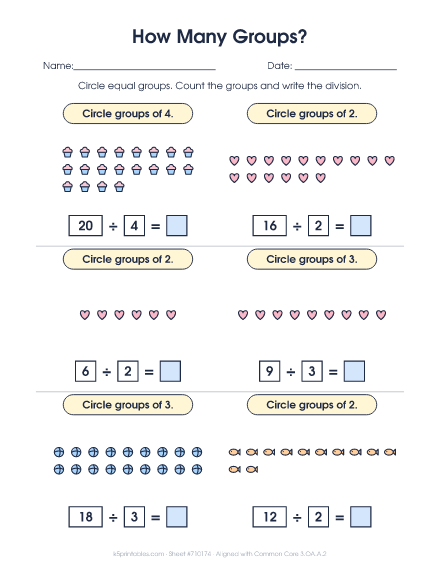
How Many Groups?
Circle equal groups of pictures, then write how many groups as a division.
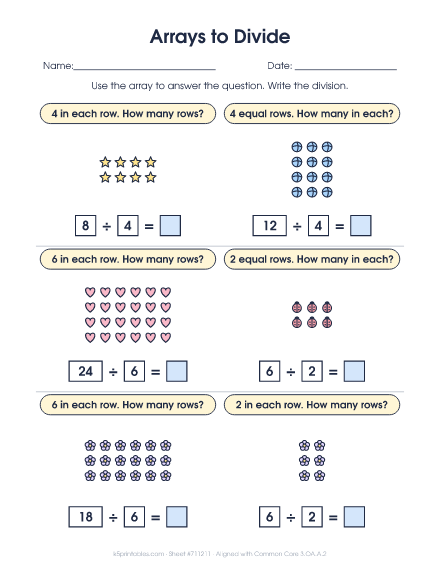
Arrays to Divide
Arrays with a question about rows or how many in each row, written as division.
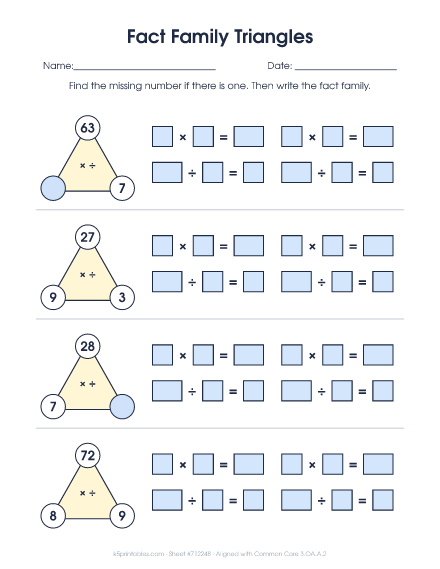
Fact Family Triangles
Triangles with a product and two factors, written as four facts. Some have a missing number.
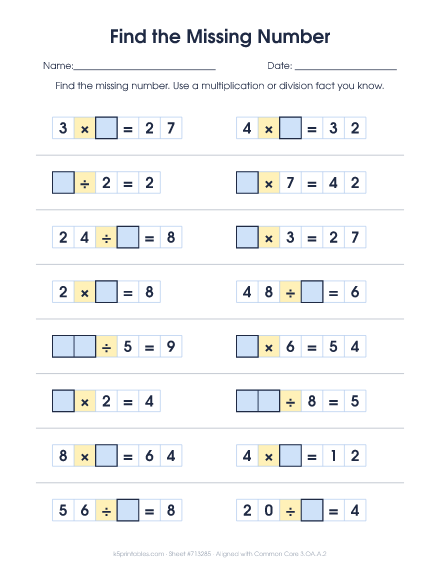
Find the Missing Number
Missing numbers in multiplication and division, like ? × 4 = 28 and 28 ÷ ? = 7.
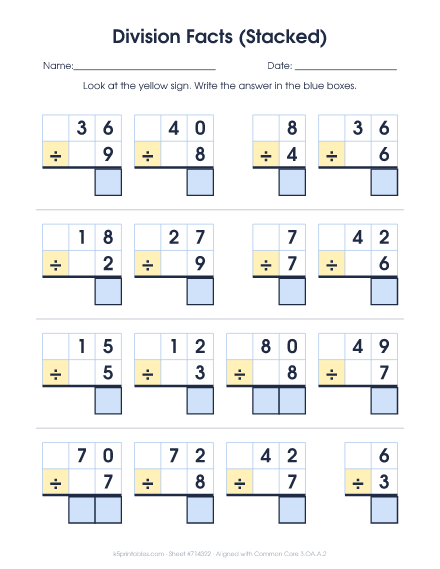
Division Facts (Stacked)
Division facts to 90 ÷ 9 written top to bottom on graph paper.
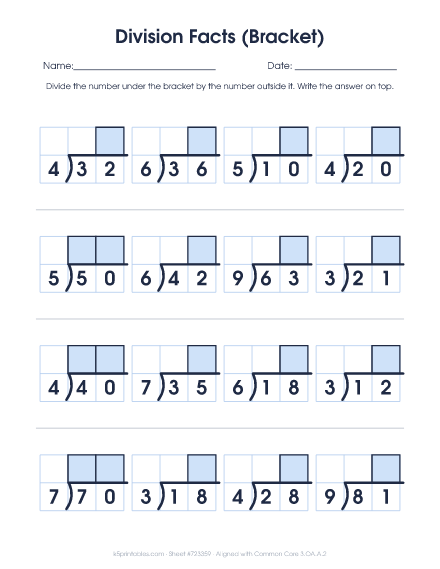
Division Facts (Bracket)
Division facts to 90 ÷ 9 written in the bracket shape, like 7 ⟌ 56, to get ready for long division.
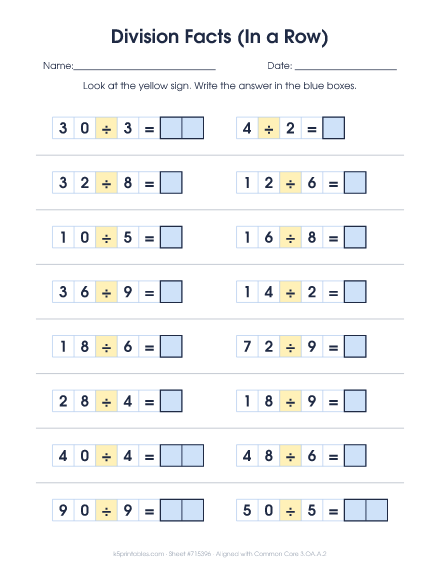
Division Facts (In a Row)
Division facts to 90 ÷ 9 written across, like 56 ÷ 7 = 8.
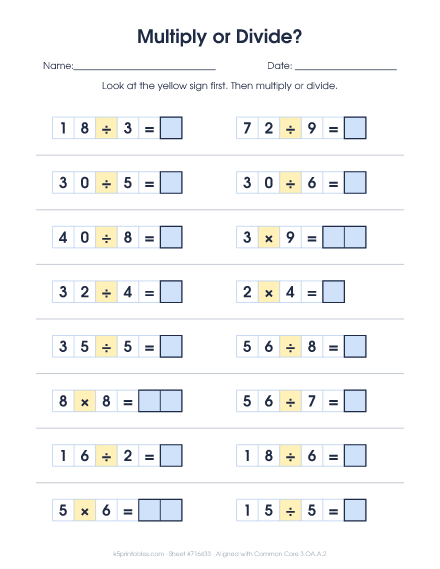
Multiply or Divide?
Multiplication and division facts mixed on one page.
Print the whole packet
One copy of every sheet above, in order. Tap + for more copies (up to 10).
For the parent or teacher
What it is
Division splits a total into equal groups. 12 ÷ 3 can mean sharing 12 things equally among 3 groups (4 in each), or making groups of 3 from 12 things (4 groups). Third graders learn that division is linked to multiplication. To find 12 ÷ 3, think "3 times what is 12?"
What comes next
Two-step word problems that use all four operations.
How to teach it
- Share real things, like dealing out cards or crackers one at a time.
- Read 12 ÷ 3 as "12 split into 3 equal groups."
- Turn every division into a multiplication question. 28 ÷ 4 asks "4 times what is 28?"
- Practice fact families together, so each multiplication fact gives two division facts.
Common mistakes
- Sharing unequally, or leaving some things out.
- Switching the numbers, like writing 3 ÷ 12 instead of 12 ÷ 3.
- Mixing up the number of groups and the number in each group.