Taking turns in conversation worksheets
Aligned with Common Core SL.2.1
Printable 2nd grade conversation skills worksheets: a turn-taking chart, pick the best reply, ask a follow-up question, and conversation cards, with answer keys.
The worksheets
- See it all
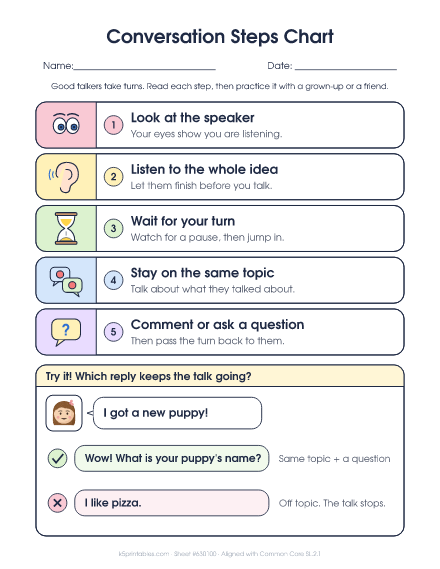
Conversation Steps Chart
Five picture steps for taking turns (look, listen, wait, stay on topic, comment or ask) and an example of a reply that keeps the talk going.
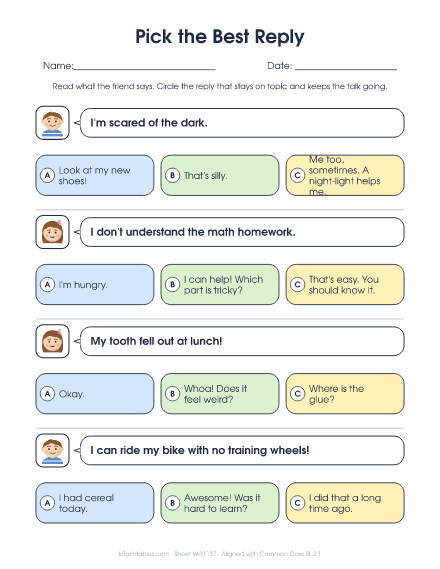
Pick the Best Reply
Four friends share something, each with three replies to choose from. One stays on topic and asks or comments, one is off topic, and one is unkind or ends the talk. Fewer and More change how many. Includes an answer key.
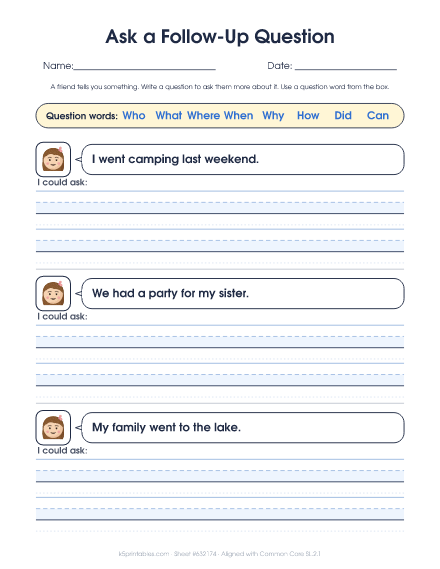
Ask a Follow-Up Question
Three friends share something, and kids write a follow-up question on big blue writing lines, with a box of question words to help. Fewer gives two with more writing room, and More gives four. Includes example answers.
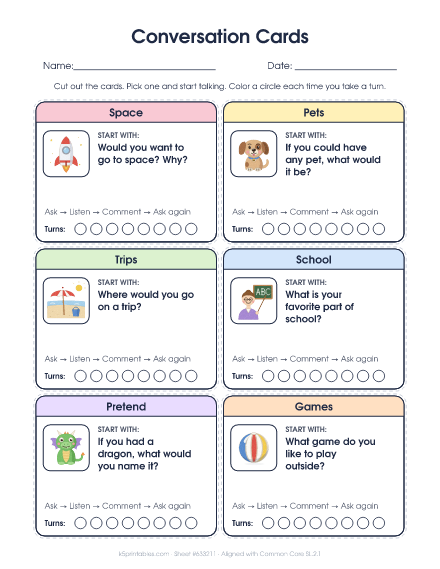
Conversation Cards
Six topic cards with a picture and a question to start the talk, like "If you had a dragon, what would you name it?" Each card has a turn tracker. Every version has different topics.
Print the whole packet
One copy of every sheet above, in order. Tap + for more copies (up to 10).
For the parent or teacher
What it is
A conversation is like a game of catch. One person says something, and the other person catches it and tosses it back by staying on the same topic. Good talkers look at the speaker, listen to the whole idea, wait for their turn, add a comment or ask a question, and then pass the turn back. These skills help kids make friends, work in groups at school, and learn from the people around them (aligned with Common Core SL.2.1).
What comes next
Practice in small groups, like with siblings or friends, or go back to retelling stories to practice telling things in order.
How to teach it
- Start with the chart. Practice each step in a short, silly conversation.
- Play conversation catch with a real ball. You can only talk when you're holding the ball, and you have to stay on the same topic.
- Model follow-up questions at dinner. When someone shares, ask "What happened next?" or "How did that feel?"
- Praise on-topic replies. "You asked a great question about my day!"
- Use the conversation cards for short daily practice, like on the way to school.
Common mistakes
- Changing the topic to something your child wants to talk about. Gently say, "Let's stay on this topic first."
- Interrupting. Practice waiting for a pause before talking.
- Answering with one word, like "Okay." Ask "Can you add a comment or a question?"
- Asking a question that was already answered. Remind your child to listen to the whole idea.