Same and opposite words worksheets
Aligned with Common Core L.2.5
Printable 2nd grade synonym and antonym worksheets: a same-and-opposite chart, match the synonyms, write the opposite, same or opposite, and shades of meaning, all with answer keys.
The worksheets
- See it all
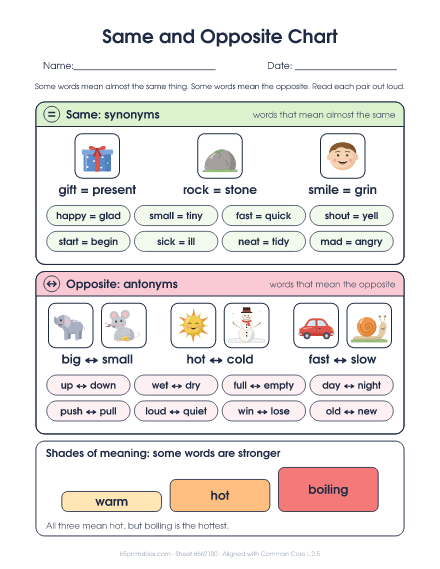
Same and Opposite Chart
Synonyms and antonyms on one page, with picture examples, 16 word pairs, and a shades-of-meaning bar (warm, hot, boiling).
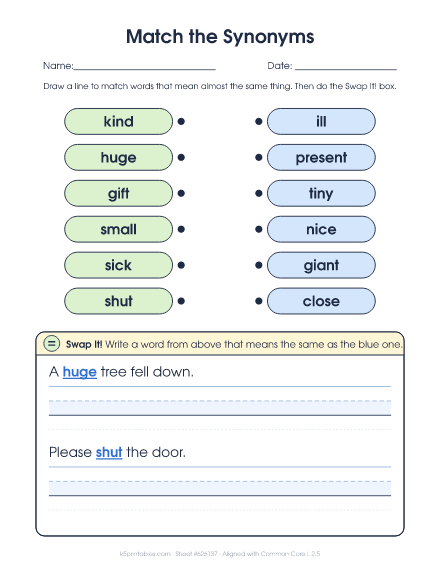
Match the Synonyms
Six synonym pairs to match with lines, plus two Swap It! sentences where kids write a synonym on big writing lines. Includes an answer key.
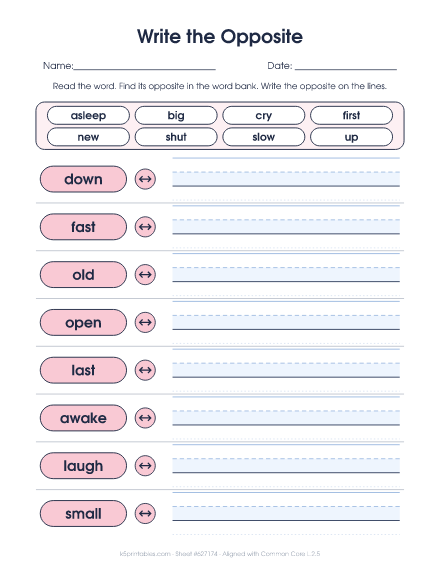
Write the Opposite
Eight words with a word bank of their opposites and big writing lines. Includes an answer key.
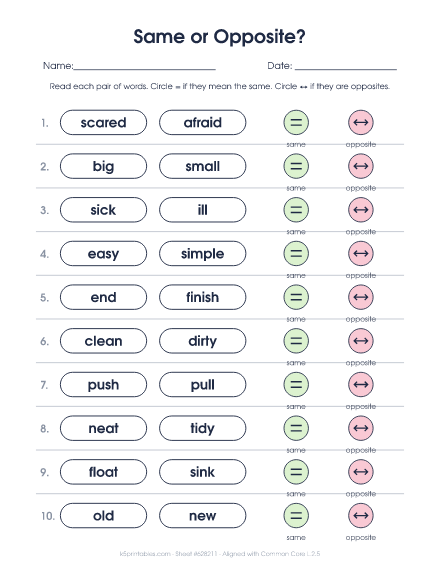
Same or Opposite?
Ten mixed word pairs, half synonyms and half antonyms, in a different order each time. Includes an answer key.
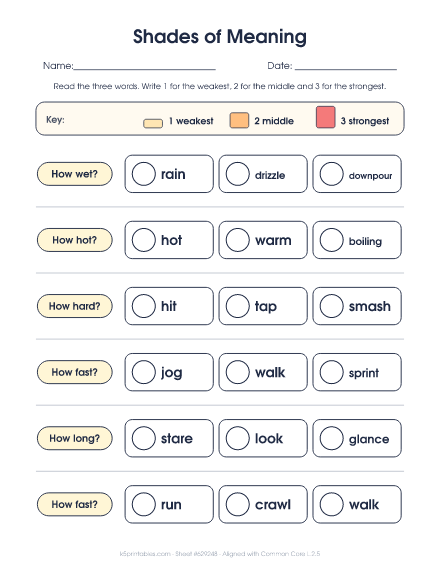
Shades of Meaning
Six groups of three words, like warm, hot and boiling, with a question that tells kids what is changing (How hot? How loud?). Includes an answer key.
Print the whole packet
One copy of every sheet above, in order. Tap + for more copies (up to 10).
For the parent or teacher
What it is
Synonyms are words that mean almost the same thing, like big and large. Antonyms are words that mean the opposite, like hot and cold. Shades of meaning are words that are alike but stronger or weaker, like warm, hot and boiling. Knowing these word relationships helps kids understand what they read, explain their ideas, and pick the best word when they talk and write. In 2nd grade, kids also start comparing how strong similar words are (aligned with Common Core L.2.5b).
What comes next
Use stronger, more exact words in writing, or move on to taking turns in conversation.
How to teach it
- Start with the chart. Read each pair out loud and talk about how the words are alike or different.
- Use a hand signal. Hold two fingers together for same and point your hands apart for opposite.
- Try the swap test. Put the new word in the sentence. If the sentence still means the same thing, the words are synonyms.
- Act out shades of meaning. Whisper, talk, then shout. Walk, jog, then sprint. Kids remember what they do.
- Look for synonyms and opposites in books you read together.
Common mistakes
- Thinking synonyms always mean exactly the same thing. Huge is bigger than big, even though both mean large.
- Mixing up synonyms and antonyms. Ask, "Do these words mean the same thing or the opposite?"
- Picking a synonym that doesn't fit the sentence. Always read the sentence again with the new word in it.
- Ordering shades of meaning backwards. Ask the question first, like "How hot?", then start with the weakest word.