Adding and subtracting within 1,000 worksheets
Aligned with Common Core 2.NBT.B.7
Printable second-grade worksheets for three-digit addition and subtraction on graph paper, without and with regrouping, a mixed plus-or-minus page, and 10 more, 100 more.
The worksheets
- See it all
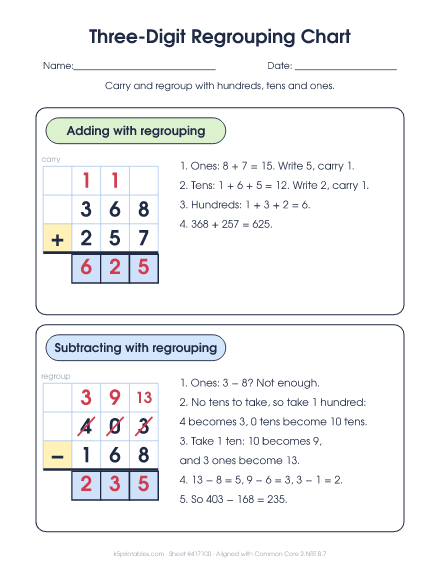
Three-Digit Regrouping Chart
Worked examples of carrying twice in addition, and regrouping across a 0 in subtraction.
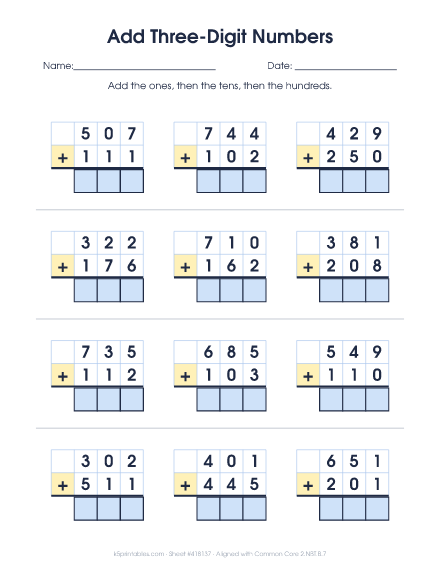
Add Three-Digit Numbers
Three-digit addition on graph paper where no column adds up to 10 or more.
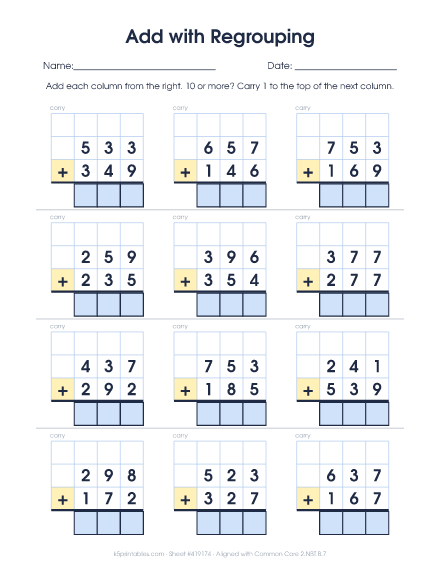
Add with Regrouping
Three-digit addition where at least one column needs a carry, sometimes two.
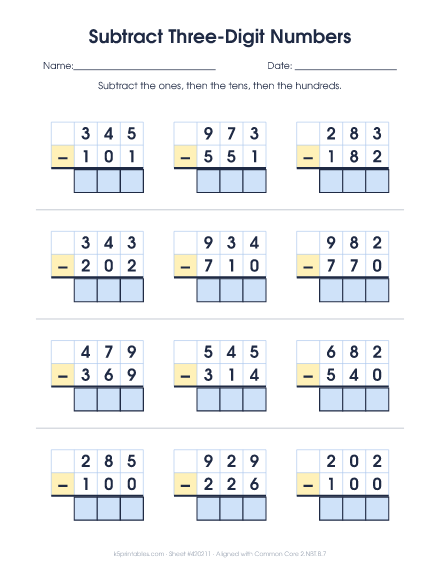
Subtract Three-Digit Numbers
Three-digit subtraction where every top digit is big enough.
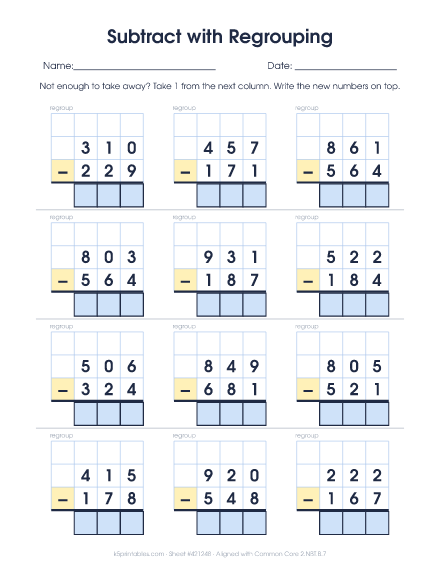
Subtract with Regrouping
Three-digit subtraction with regrouping, including numbers with a 0 in the tens.
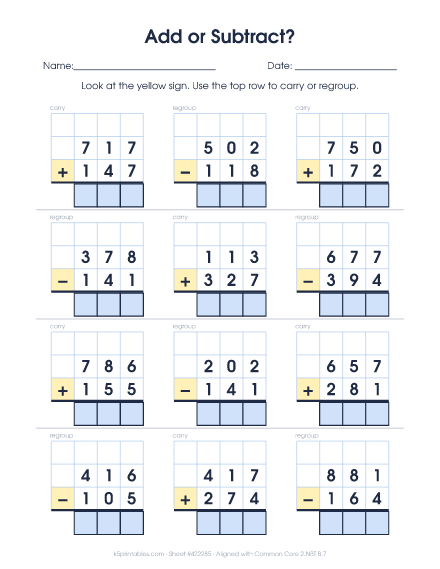
Add or Subtract?
Three-digit addition and subtraction mixed on one page.
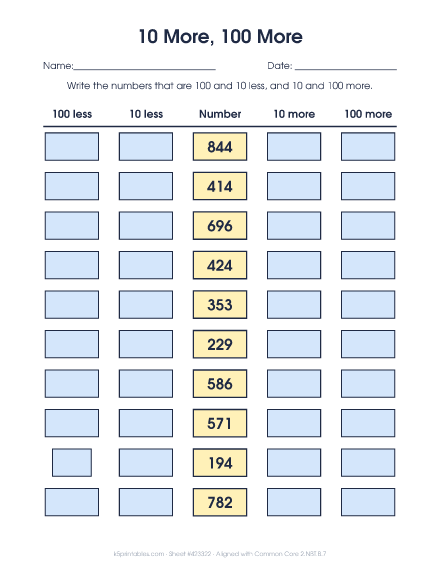
10 More, 100 More
Find 100 less, 10 less, 10 more and 100 more than three-digit numbers, in your head.
Print the whole packet
One copy of every sheet above, in order. Tap + for more copies (up to 10).
For the parent or teacher
What it is
The same column-by-column method as two-digit problems, now with hundreds. Kids add or subtract the ones, then the tens, then the hundreds. Carrying and regrouping can happen in more than one column, and subtracting from a number with a 0, like 403 - 168, means regrouping a hundred into tens first.
What comes next
Money, measuring and time, where these skills are used in real problems.
How to teach it
- Make sure two-digit regrouping is solid before starting.
- Always start in the ones column, on the right, and move left one column at a time.
- For numbers with a 0 in the middle, model it with blocks. Trade a hundred for 10 tens, then a ten for 10 ones.
- Use 10 more and 100 more to practice changing just one digit in your head.
Common mistakes
- Forgetting a carried 1 when there are two carries in one problem.
- In 403 - 168, trying to borrow from the 0 tens instead of going to the hundreds.
- Lining up the numbers wrong when one has fewer digits.