Articulation: the V sound worksheets
A complete printable v sound articulation set: how-to cue card, picture cards for the start, middle and end of words, phrases, sentences, bingo, a board game, roll and say and spin and say games and a practice tracker.
The worksheets
- See it all
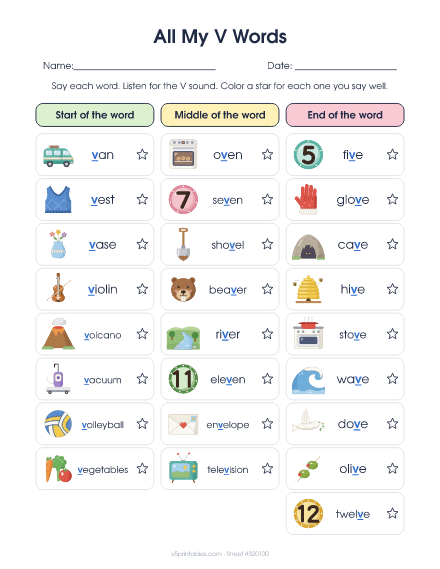
All My V Words
Every v practice word on one page, sorted by where the sound is: start, middle or end.
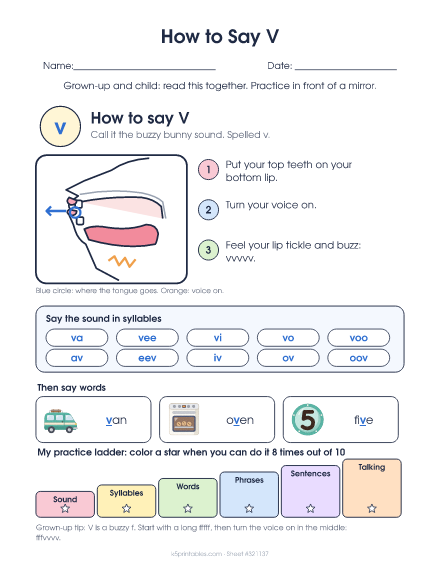
How to Say V
A cue card with a mouth picture, three simple steps, syllables to practice, and a practice ladder from sound to talking.
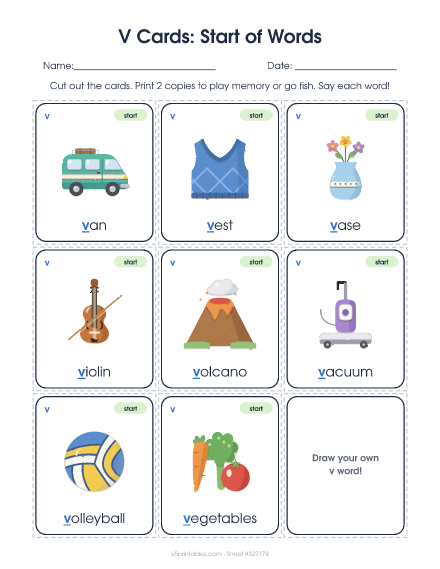
V Cards: Start of Words
Nine picture cards with v at the start of the word. The sheet is the same every time, so two copies make matching pairs.
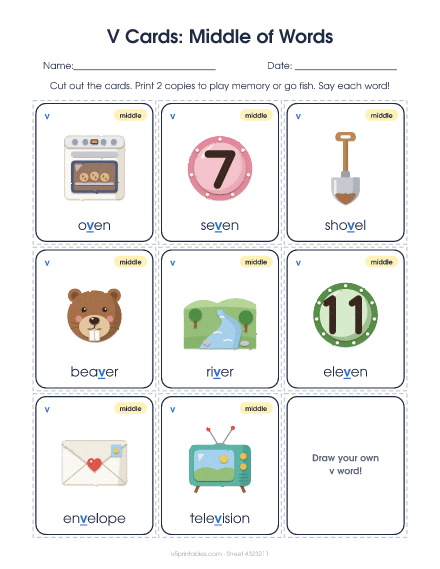
V Cards: Middle of Words
Nine picture cards with v at the middle of the word. The sheet is the same every time, so two copies make matching pairs.
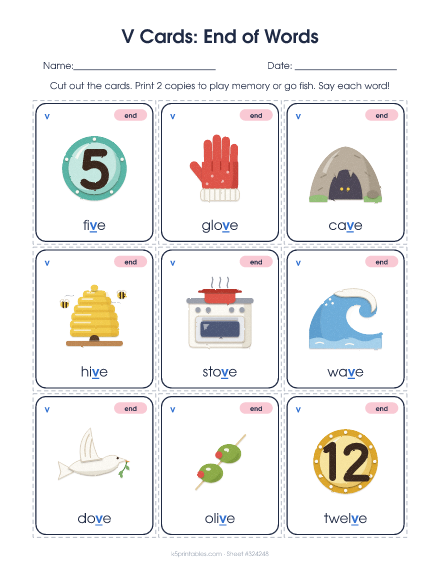
V Cards: End of Words
Nine picture cards with v at the end of the word. The sheet is the same every time, so two copies make matching pairs.
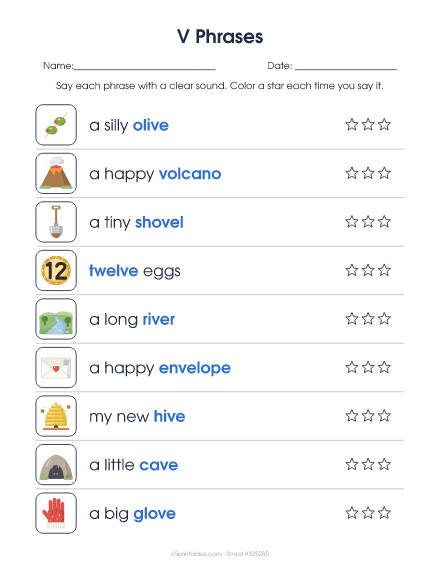
V Phrases
Nine short phrases like "a big ___" with v words. A new set every time.
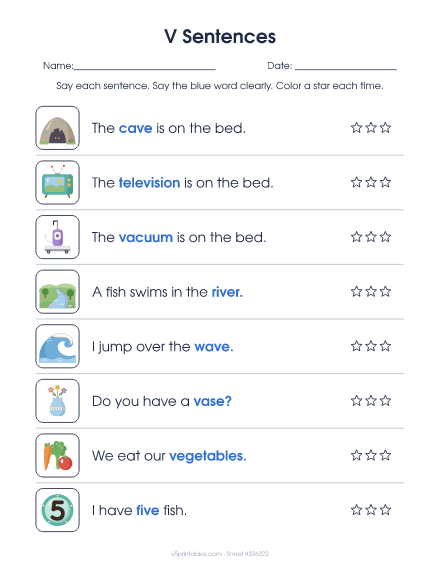
V Sentences
Eight simple sentences with a v word in each. A grown-up can read first if needed.
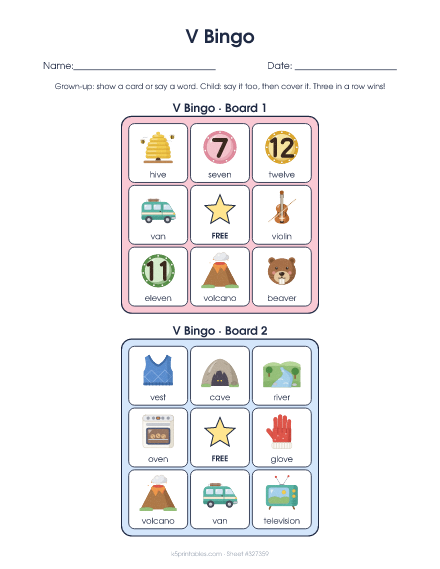
V Bingo
Two bingo boards with v pictures. Use coins, cereal or buttons as markers.
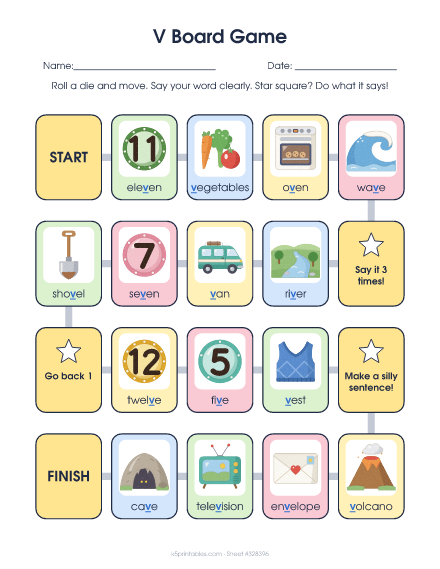
V Board Game
A board game with 15 v words and three special squares. New words every time.
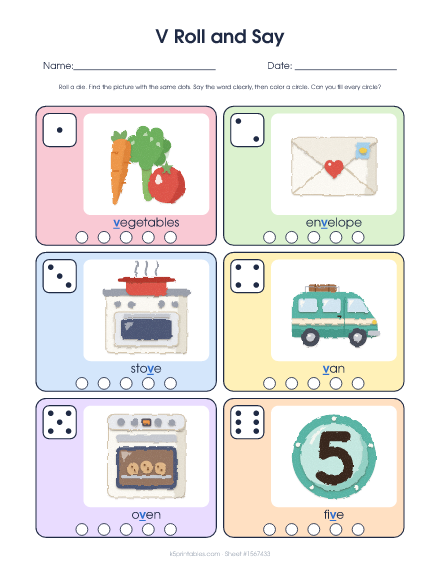
V Roll and Say
Six V pictures, one for each side of a die, with circles to color each time you say the word. Fewer has 3 circles each and More adds a second round of 6 pictures.
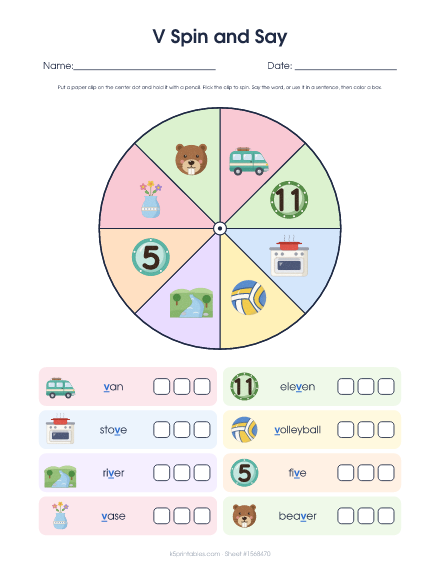
V Spin and Say
A paper clip spinner with V pictures and a box row for each word. Fewer, Standard or More give 6, 8 or 10 pictures.
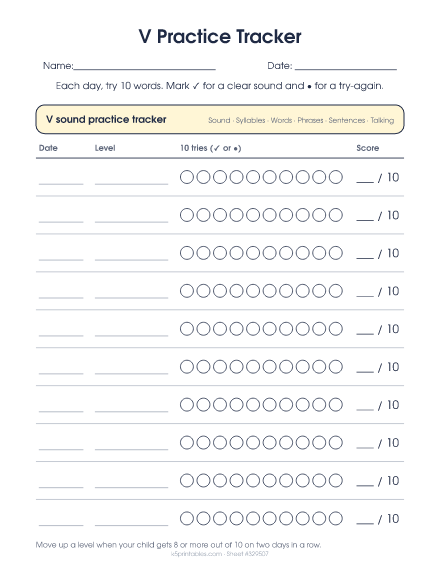
V Practice Tracker
A ten-day chart to track correct tries out of 10 at each level.
Print the whole packet
One copy of every sheet above, in order. Tap + for more copies (up to 10).
For the parent or teacher
What it is
Articulation means making speech sounds clearly. To make the v sound, the top teeth rest on the bottom lip, with the voice turned on. Most children say it by about age 5 to 6. A child who is still working on it often says b for v (ban for van), or f for v. This set walks through the steps speech therapists use: the sound by itself, then syllables, words, phrases, sentences and finally everyday talking. Common Core doesn't cover speech sounds, so these sheets have no Common Core code.
What comes next
Practice the next sound, or use the mixed sound sheets to review several sounds at once.
How to teach it
- Start with a long fffff, then turn on the voice in the middle: fffvvvv. The lip should tickle.
- Practice a little every day. Five to ten minutes of focused tries beats one long session.
- Climb the ladder. Sound, syllables, words, phrases, sentences, then talking. Move up when your child gets about 8 out of 10 right.
- Pick one word position to start, usually the beginning of words, then add middle and end.
- V at the end of words (five, glove) is often the hardest. Stretch it: fivvvve.
Common mistakes
- Moving up too fast. If the sound slips in sentences, go back to phrases for a few days.
- Correcting every word in everyday talk. Save corrections for practice time and keep conversation fun.
- Saying the sound right alone but not in words. That's normal. Syllables are the bridge.
- If your child is hard to understand, frustrated when talking, or not improving, ask your pediatrician or a speech-language pathologist for an evaluation.