Fact families and missing numbers worksheets
Aligned with Common Core 1.OA.D.8
Printable worksheets on how addition and subtraction fit together: fact family houses with teen numbers, missing number problems, and true or false equations.
The worksheets
- See it all
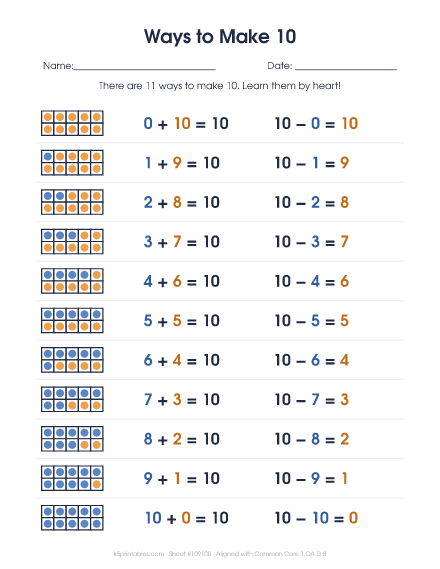
Ways to Make 10
All eleven ways to make 10, with ten frames, addition facts and subtraction facts.
- See it all
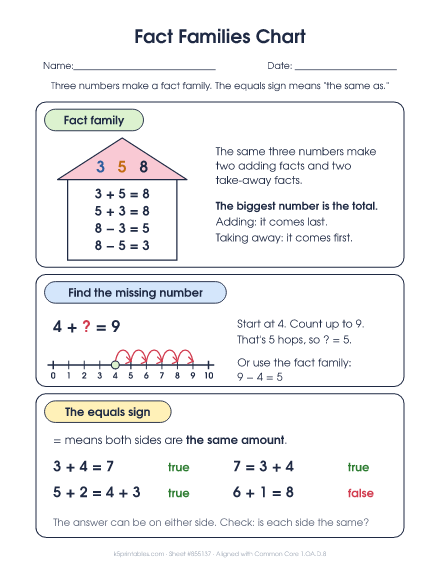
Fact Families Chart
A fact family house, how to find a missing number, and what the equals sign means, with true and false examples.
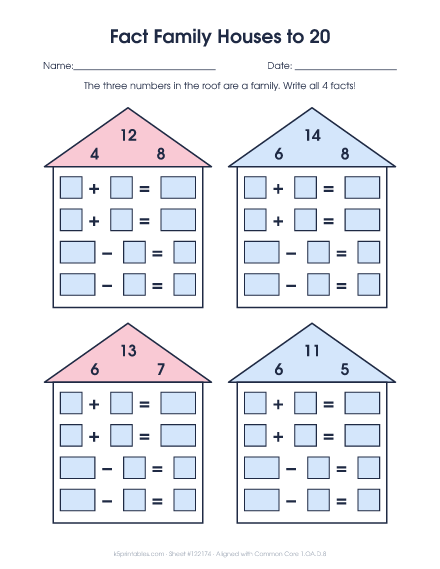
Fact Family Houses to 20
Four fact family houses with a teen number on top. Write the two addition and two subtraction facts.
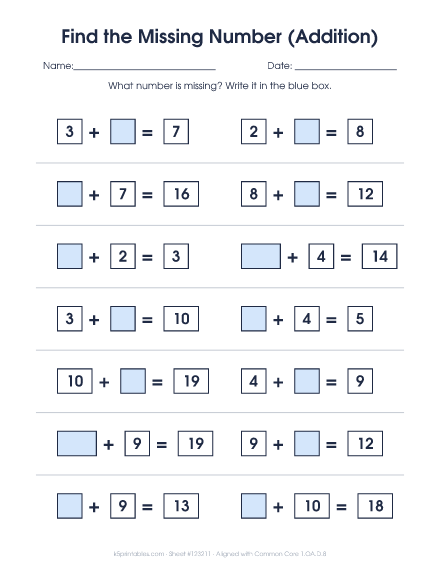
Find the Missing Number (Addition)
Fourteen addition problems with one number missing. Sometimes it's the first number, sometimes the second.
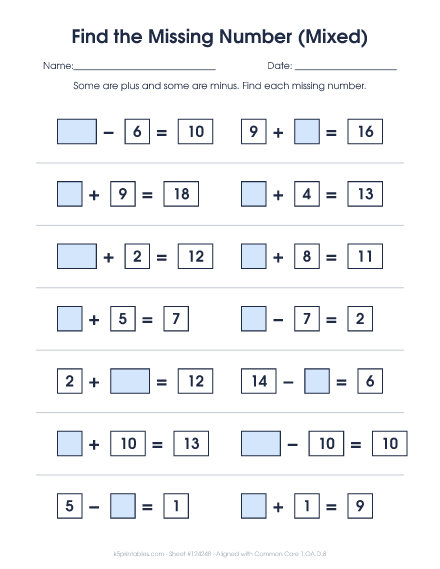
Find the Missing Number (Mixed)
Fourteen addition and subtraction problems with one number missing.
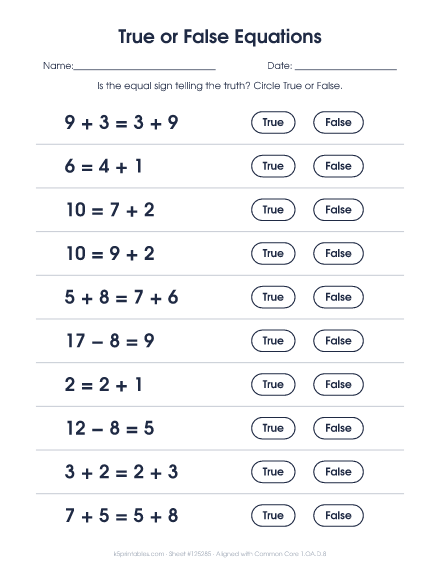
True or False Equations
Ten equations to check, including ones with the answer on the left and math on both sides. Matches 1.OA.D.7.
Print the whole packet
One copy of every sheet above, in order. Tap + for more copies (up to 10).
For the parent or teacher
What it is
A fact family is three numbers that make two addition facts and two subtraction facts, like 6, 8 and 14. Once kids see that, they can find a missing number in a problem like 6 + ? = 14 or ? - 8 = 6. They also learn what the equal sign really means. It says both sides are the same amount, not "the answer goes next".
What comes next
Word problems, where kids decide whether a story needs adding or subtracting.
How to teach it
- Use a part-part-whole picture. The whole goes on top, the two parts go underneath.
- Say the family out loud. "6 and 8 make 14. 14 take away 8 is 6."
- For a missing number, ask "Is this number a part or the whole?" If it's the whole, add. If it's a part, subtract or count up.
- Read the equal sign as "is the same as". 9 = 4 + 5 is a true sentence even though it looks backwards.
Common mistakes
- Adding every number they see, so 5 + ? = 12 gets the answer 17.
- Thinking an equation must have the answer on the right, so 9 = 4 + 5 looks "wrong".
- Putting the smaller number first in a subtraction fact.